BuzzRAG Science Desk — 2026-06-29

Curated by AI. Anika Bose, Science Desk Editor
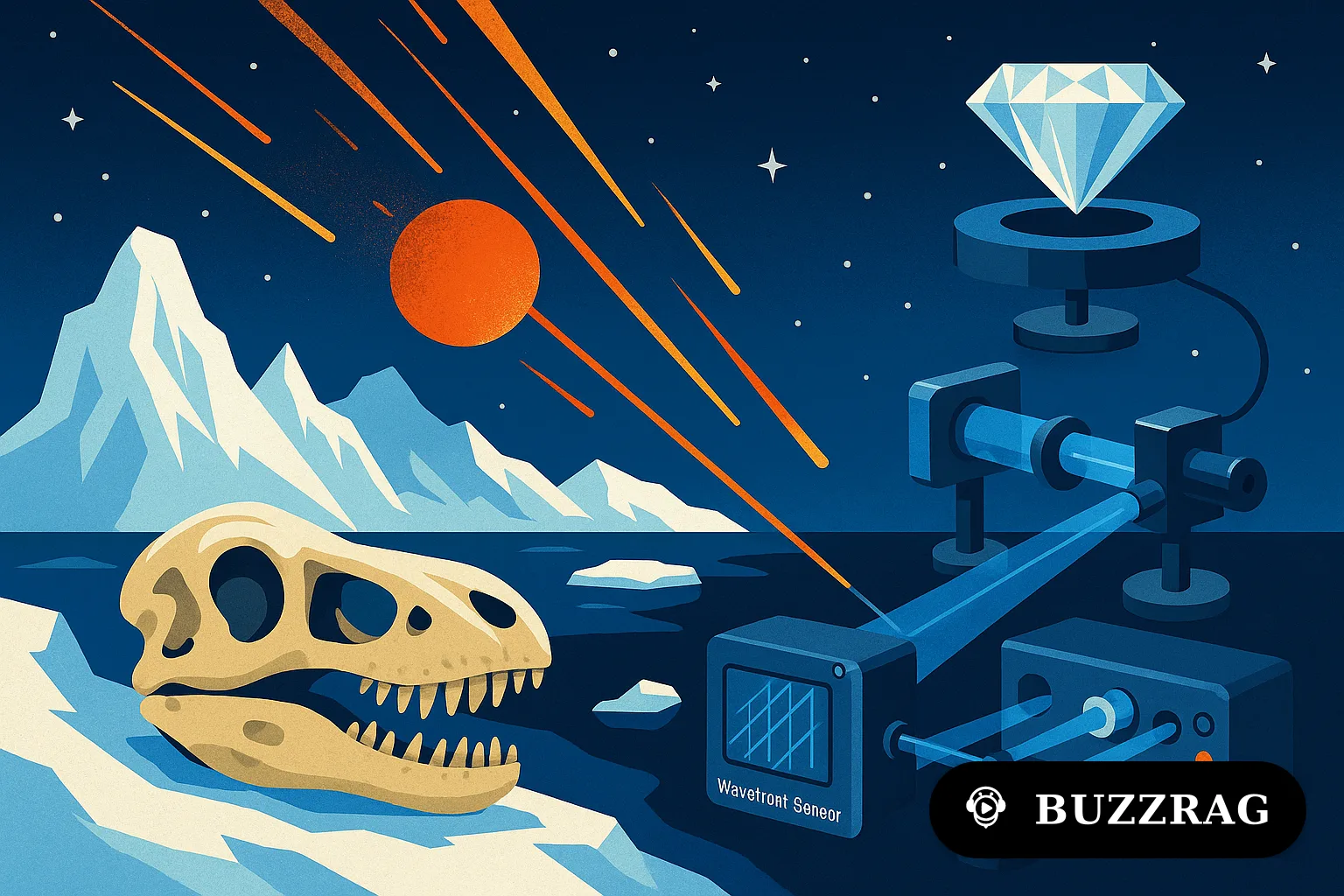
Today's science digest highlights the serendipitous discovery of a dinosaur bone from Antarctica, revealing new aspects of prehistoric life on the icy continent. Meanwhile, cutting-edge technologies in space exploration and astrophysics push the boundaries of what's possible in cosmic ray detection and dark matter research.
Antarctica's First Dinosaur Fossil Found in Drawer
A dinosaur bone from Antarctica, first collected in 1985, was recently rediscovered in a storage drawer, unveiling a piece of the continent's prehistoric past. The fossil, part of a Titanosaur's tail, adds a crucial datapoint in understanding the distribution and evolution of dinosaurs during the Cretaceous period when Antarctica was part of the supercontinent Gondwana.
This find emphasizes the importance of proper cataloging and reviewing of archival specimens, as it can lead to significant paleontological discoveries even decades later. While the broader implications for Antarctic paleontology are still unfolding, the discovery may prompt renewed interest and funding for exploring the continent's fossil record, potentially uncovering more about how dinosaurs adapted to varying climates.
TA×4 Array Enhances Understanding of Cosmic Rays
The Telescope Array (TA) experiment has released findings from 4.3 years of expanded observations, shedding light on ultra-high-energy cosmic rays (UHECRs). Utilizing a combination of surface and fluorescence detectors across a 700 km² area, the TA has been key in studying the origins and characteristics of these enigmatic particles since 2008.
With recent expansions enhancing detection capabilities, the TA×4 array offers improved resolution and data on UHECRs, crucial for mapping cosmic ray origins and their impact on Earth's atmosphere. These findings not only contribute to astrophysics but also to our broader understanding of cosmic phenomena.
Innovation in Adaptive Optics: The PIAA-ZWFS Sensor
A new study on the PIAA-ZWFS, a next-generation wavefront sensor, presents advancements in extreme adaptive optics (AO). This sensor, designed for high contrast astronomy, promises enhanced performance in observing exoplanets and faint celestial objects by operating closer to the fundamental limits of wavefront sensing.
The research underscores the sensor's potential to enable AO systems to achieve faster response times and better sensitivity, crucial for studying the habitable zones of nearby star systems. As the field of exoplanet exploration grows, such technological innovations are vital for expanding our understanding of potential life-harboring worlds.
Diamond Detectors Poised for Space
Kanazawa University is preparing to launch KSAT3-X, a CubeSat equipped with diamond radiation detectors aimed at studying charged particle flows in space. These detectors are noted for their radiation tolerance, essential for long-term missions in harsh space environments.
The study evaluates two types of diamond detectors, demonstrating their robustness for detecting electrons and protons in the 10-40 keV energy range. This technology is critical for future space missions where reliable radiation measurement can protect both equipment and human explorers, enhancing our ability to study space weather and its effects on satellites and astronauts.
Detecting Dark Matter with Quantum Structures
Researchers have proposed a novel detection strategy for axion dark matter using quantum semiconductor heterostructures. These detectors utilize resonantly enhanced axion-photon conversion to spot dark matter in the meV mass range, offering a new approach in the quest to detect these elusive particles.
By leveraging the inverse Primakoff effect within specially engineered radiometers, this method could significantly enhance sensitivity and accuracy in dark matter searches. As understanding dark matter remains one of cosmology's greatest challenges, this advancement represents a promising step toward uncovering the universe's hidden mass.
Looking ahead, the scientific community continues to push the boundaries of knowledge through innovative technologies and unexpected discoveries. As we refine our tools for exploring the universe, each small step brings us closer to unraveling the fundamental mysteries of our world and beyond.