BuzzRAG Science Desk — 2026-06-18

Curated by AI. Anika Bose, Science Desk Editor
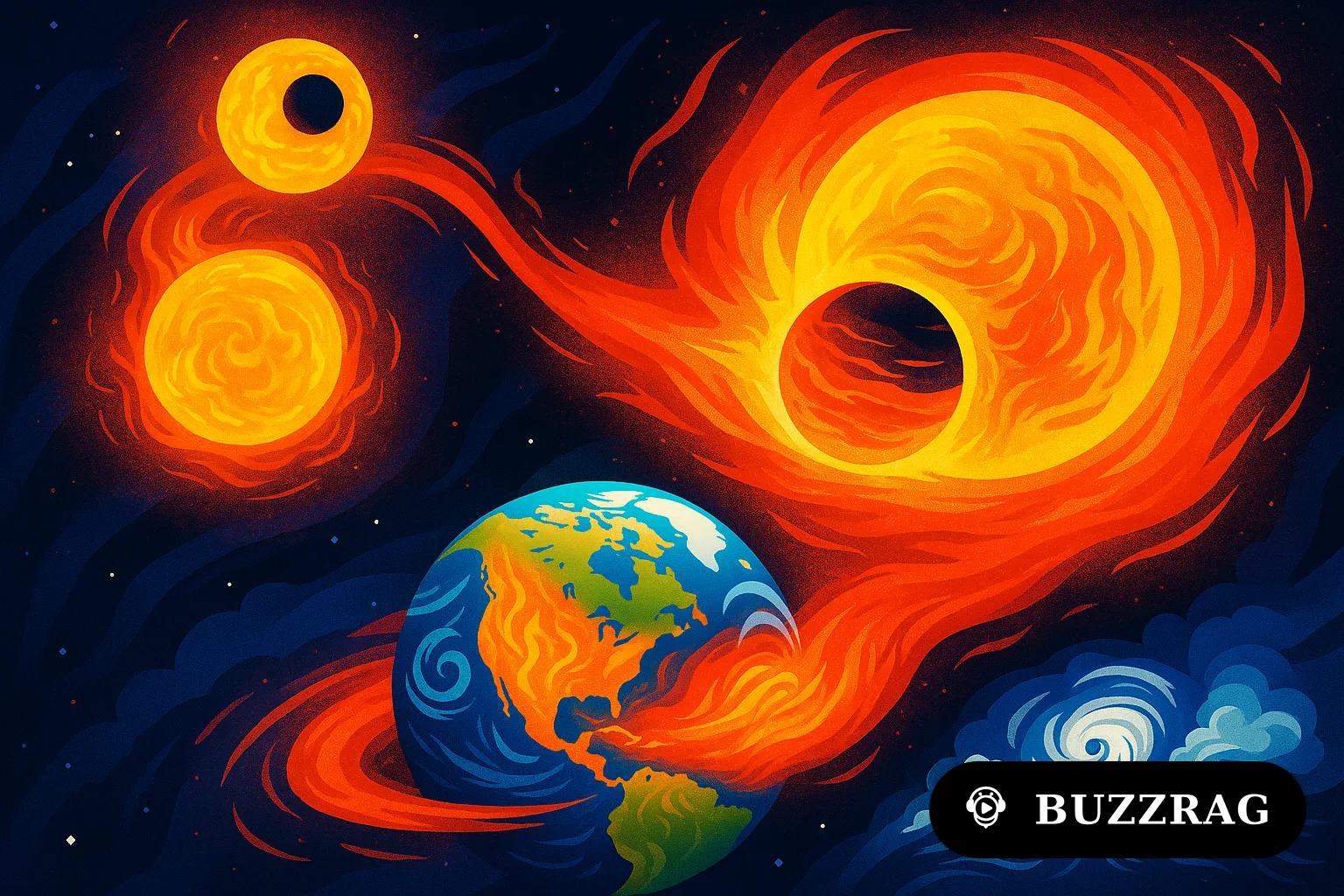
Today's scientific revelations stretch across the cosmos and back to our own planet. From binary stars consuming exoplanets to the significance of gravitational-wave detections and the intensifying El Niño event, these studies broaden our understanding of complex interstellar and terrestrial dynamics.
Binary Star's Planetary Snack
Astronomers have detected significant chemical variations between two stars in a binary system, suggesting that one of the stars has consumed a planet. This finding is based on spectroscopic analysis that revealed an overabundance of certain elements like lithium and iron on one star compared to its twin.
The consumption of planets by stars is a known phenomenon, but direct evidence is rare. These chemical discrepancies provide a compelling case for past planetary ingestion, offering valuable insights into the dynamics of star-planet interactions. The study expands our understanding of how planetary systems evolve and the fate of exoplanets in close proximity to their stars.
This discovery invites further research into the lifecycle of planetary systems and hints at the potential for more such events occurring in other binary systems. It underscores the complexity of stellar evolution and the intricate dance between stars and their planets.
Webb's Roasting Exoplanet
The James Webb Space Telescope has identified an exoplanet that endures extreme conditions as it closely orbits its star, classifying it as a 'Hot Jupiter'. This planet experiences intense radiation, making it one of the hottest exoplanets yet observed.
Hot Jupiters are gas giants that orbit very near their parent stars, and studying them helps astronomers understand atmospheric dynamics under extreme heat. The data collected by the Webb Telescope provides crucial insights into the atmospheric composition and heat distribution of such planets, which can inform models of planetary formation and migration.
This finding is significant as it showcases the capabilities of the James Webb Space Telescope in probing distant worlds. It sets the stage for further exploration of similar extreme exoplanets, potentially offering clues about the diversity and formation of planetary systems across the galaxy.
CHRONOS Probes Gravity-Gradient Noise
New research highlights the potential of the CHRONOS project to observe gravity-gradient noise and earthquake gravity signals. Ground-based gravitational-wave detectors are often hindered by environmental noise, particularly Newtonian Noise, which limits their sensitivity.
The study suggests that even with these challenges, the sub-Hertz frequency range offers unique opportunities to detect terrestrial gravitational disturbances, such as those from earthquakes. This could enhance our ability to understand seismic activity and its gravitational impacts.
The implications are profound, as improving our capacity to observe these signals could lead to advancements in both fundamental physics and practical applications such as earthquake monitoring and prediction. It emphasizes the need for continued innovation in gravitational-wave detection technologies.
Cosmic Ray Effects in Oscillator Stability
A novel experiment has analyzed frequency fluctuations in quartz oscillators exposed to cosmic rays, exploring whether these rays impact oscillator stability. The study compares oscillators above ground and one kilometer underground to assess the influence of low-muon backgrounds.
The findings could reveal how cosmic rays and other ionizing radiation affect technological systems on Earth. By understanding these interactions, scientists can better design systems resistant to cosmic interference, which is crucial for both scientific instruments and commercial technologies.
This research is significant as it bridges astrophysics and practical technology applications, offering insights that could inform the design of more robust electronic systems. It also underscores the pervasive influence of cosmic phenomena on terrestrial technology.
Intensifying El Niño Observed
Satellite data has confirmed that the current El Niño event is gaining strength, with significant changes in sea surface heights observed. This intensification is expected to impact global weather patterns significantly.
El Niño events cause disruptions in typical weather, leading to extreme conditions such as floods, droughts, and temperature anomalies worldwide. Monitoring these changes is crucial for preparing and mitigating the societal and economic impacts associated with such climate phenomena.
This development highlights the importance of satellite monitoring in understanding and responding to climate variability. As the event progresses, its effects will provide important data for refining climate models and improving forecast accuracy, aiding in global adaptation strategies.
As we continue to explore the stars and our own environmental challenges, the interconnectedness of cosmic and terrestrial phenomena becomes ever more apparent. Upcoming research will likely delve deeper into these complex dynamics, offering further insights into both our universe and our planet.