BuzzRAG Science Desk — 2026-06-17

Curated by AI. Anika Bose, Science Desk Editor
Today's science news spans from ambitious space missions to environmental concerns and technological advances in neural networks. NASA's plans to boost the orbit of the Swift space telescope represent a significant commitment to extending the life of vital astronomical instruments. Meanwhile, the dire situation at Arizona's San Carlos Reservoir underscores the urgent need for sustainable water management amid persistent drought conditions.
NASA's Bold Plan for Swift Space Telescope
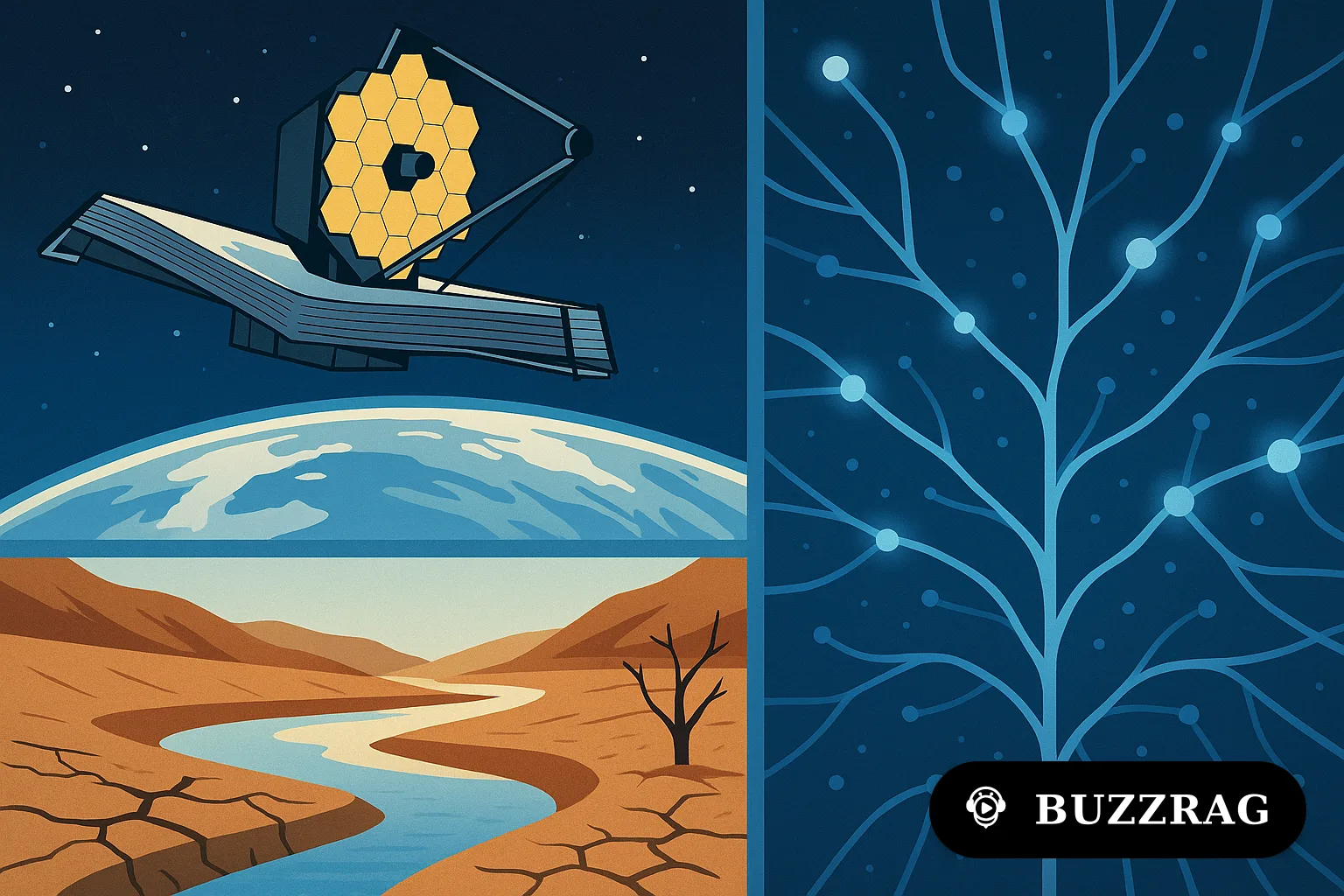
NASA is set to outline a mission today that aims to elevate the orbit of the Swift space telescope, significantly extending its operational lifespan. The mission, if approved and executed, would involve complex maneuvers to boost the telescope's orbit, ensuring it continues to provide valuable data for the study of gamma-ray bursts and other cosmic phenomena.
The Swift space telescope has been a cornerstone of astronomical research since its launch in 2004, contributing to numerous discoveries. The proposed mission highlights NASA's ongoing efforts to maximize the utility of its existing space assets, a strategic move amidst budget constraints and growing demands for new missions.
This initiative could set a precedent for future missions aimed at extending the life of aging space instruments, balancing the need for innovation with fiscal and environmental responsibility.
Drought Drains San Carlos Reservoir
The San Carlos Reservoir in Arizona is facing unprecedented low water levels due to a severe drought and extensive water releases, leading to mass die-offs of fish. This environmental crisis is emblematic of the broader challenges posed by climate change, affecting ecosystems and communities dependent on these water sources for survival.
The reservoir, a critical resource for agriculture and local communities, is now at a fraction of its capacity, raising alarms about water management practices in arid regions. The situation is exacerbated by climate change predictions that suggest more frequent and severe droughts in the future, necessitating urgent policy and infrastructure interventions.
This development serves as a stark reminder of the vulnerabilities in our water systems and the necessity for adaptive strategies to manage finite resources sustainably. The impacts on local biodiversity also call for targeted conservation efforts to mitigate the ecological damage.
NASA X-ray Craft Captures Black Hole Jet
NASA's X-ray spacecraft has captured unprecedented details of a jet erupting from the first supermassive black hole ever imaged by humanity. This observation provides new insights into the dynamic processes near black holes and the mechanisms driving these powerful jets.
The data reveal changes in the jet with a level of detail previously unseen in X-ray wavelengths, offering clues about the behavior of matter in extreme gravitational environments. These findings could enhance our understanding of black hole physics and the role these cosmic giants play in galaxy formation and evolution.
This discovery is a testament to the capabilities of modern astronomical instruments to probe the universe's most enigmatic objects. Continued observations could refine our models of black hole activity and inform future missions aimed at unraveling the mysteries of the cosmos.
Jessica Meir Upgrades Cold Atom Lab in Space
NASA astronaut Jessica Meir has recently completed a series of hardware upgrades to the Cold Atom Lab (CAL) aboard the International Space Station. This laboratory, about the size of a mini-fridge, is crucial for experiments that chill atoms to near absolute zero, enabling the study of quantum phenomena in a microgravity environment.
The upgrades are designed to enhance the lab's capabilities, allowing scientists to conduct more precise experiments in fundamental physics and quantum mechanics. CAL's unique environment aboard the ISS offers unparalleled opportunities to observe atomic interactions without the interference of gravity, potentially leading to breakthroughs in quantum computing and materials science.
These updates underscore the importance of maintaining and enhancing scientific instruments in orbit to push the boundaries of our scientific knowledge. As space-based research continues to evolve, such initiatives will be vital in harnessing the full potential of the ISS as a platform for innovation.
Ariane 6 Set for Record-Breaking Amazon Launch
The European space industry is gearing up for a significant milestone as an Ariane 6 heavy-lift rocket prepares to launch a record-breaking payload for Amazon. This mission, which can be watched live, marks a pivotal moment in commercial space endeavors, highlighting the increasing demand for satellite deployments driven by global internet services.
The Ariane 6 rocket's capability to carry such a substantial payload underscores Europe's strong position in the competitive commercial launch market. This launch not only benefits Amazon’s broadband initiatives but also showcases the collaborative potential of international space efforts.
As the landscape of space commerce evolves, such missions reflect the growing interdependence between commercial entities and space agencies. This trend is likely to accelerate, shaping the future of global connectivity and space exploration.
MiniFool: Advancing Neural Network Robustness
A novel algorithm named MiniFool has been developed to implement physics-inspired adversarial attacks, aimed at testing the robustness of neural networks used in particle and astroparticle physics. Originally designed to assist in the search for astrophysical tau neutrinos at the IceCube Neutrino Observatory, MiniFool represents a significant advancement in the field of machine learning applied to physics.
By introducing adversarial scenarios that mimic real-world physical constraints, MiniFool can identify vulnerabilities in neural networks that might otherwise go undetected. This approach not only enhances the reliability and accuracy of machine learning models but also broadens their applicability in complex scientific research.
As artificial intelligence continues to integrate into scientific methodologies, such tools are crucial for ensuring the integrity and utility of computational models. The development of MiniFool sets a precedent for future innovations in AI-driven scientific exploration.
Challenges in Modeling Planetary Sputtering
New research highlights significant limitations in the use of Binary Collision Approximation (BCA) codes for modeling the sputtering behavior of planetary surfaces. These codes, while powerful, are shown to have low predictive fidelity when simulating ion irradiation ejecta properties, such as composition and energy distributions.
The study draws attention to the gap between theoretical models and empirical observations, emphasizing the need for more accurate simulations to understand planetary surface processes. This is particularly relevant for missions targeting the Moon, Mars, and other celestial bodies where surface interactions play a critical role in mission planning and scientific inquiry.
Addressing these limitations is essential for advancing our understanding of planetary evolution and for the design of future space missions. As research continues, improvements in simulation fidelity could greatly enhance the accuracy of planetary models, informing both current studies and future exploratory missions.
As we look to the future, the integration of advanced technology in space missions and the pressing need for environmental sustainability remain at the forefront of scientific inquiry. Ongoing research and international collaborations will play pivotal roles in addressing these challenges, shaping the trajectory of both scientific discovery and planetary stewardship.