BuzzRAG Science Desk — 2026-05-22

Curated by AI. Anika Bose, Science Desk Editor
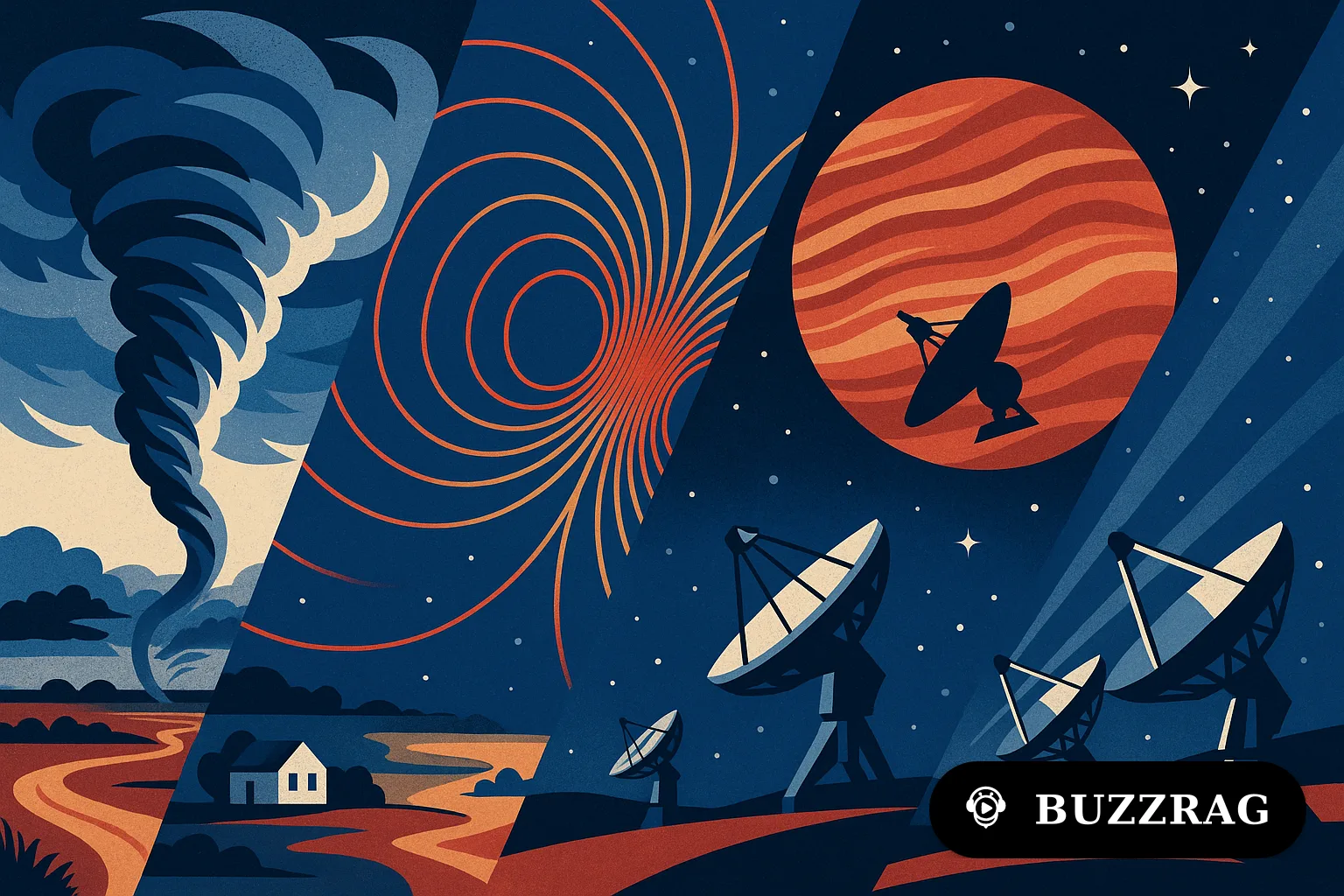
Today's scientific landscape spans from Earth to the cosmos, delving into the aftermath of natural disasters and the ongoing quest for signs of extraterrestrial life. We explore the impact of recent tornadoes in Mississippi, advancements in our understanding of Venusian atmospherics, and the search for alien technosignatures.
Mississippi Tornado's Devastating Path
A powerful tornado recently carved a destructive path through southern Mississippi, leaving behind a trail of damaged vegetation. This twister, the strongest among several that touched down earlier this month, highlights the increasing frequency and intensity of severe weather events attributed to climate change.
The visible damage across the landscape serves as a reminder of the vulnerability of certain regions to extreme weather, exacerbating concerns about infrastructure resilience and emergency preparedness. As climate models predict more frequent and severe tornadoes, understanding the dynamics and impacts of such events becomes crucial for mitigation strategies.
The aftermath of this tornado not only underscores the urgent need for climate action but also fuels discussions on improving forecasting models and community response systems. These efforts are vital to reducing the human and economic toll of future events.
Unraveling Magnetic Turbulence in Plasmas
Recent research published on arXiv delves into the complex behavior of magnetic field lines within turbulent plasma. By examining synthetic turbulence with varying polarization configurations, scientists aim to better understand the diffusion properties crucial for plasma dynamics and charged-particle transport.
This study is significant as it lays the groundwork for more accurate models of plasma behavior, which are essential in fields ranging from astrophysics to nuclear fusion research. The ability to predict how magnetic fields behave in turbulent environments can lead to advancements in energy production and space weather forecasting.
As we continue to probe the intricacies of plasma dynamics, this research represents a pivotal step in bridging theoretical models with practical applications, potentially revolutionizing our approach to harnessing and utilizing plasma energy.
Venusian Gravity Waves: Insights from Akatsuki
The Akatsuki mission has provided new insights into the gravity waves of Venus, offering a detailed analysis of absolute momentum fluxes and wave-induced drag. By utilizing temperature data from radio occultation measurements, researchers have characterized gravity wave activity across various altitudes and wavenumbers.
These findings are pivotal in understanding Venus' atmospheric dynamics, where gravity waves play a crucial role in energy and momentum transfer. The comprehensive data set allows scientists to quantify the drag forces exerted by these waves, shedding light on the planet's complex meteorological phenomena.
This research not only enriches our knowledge of Venusian weather patterns but also aids in comparative planetology by offering a reference point for studying gravity waves on Earth and other celestial bodies. The insights gained could inform future missions and models, enhancing our ability to predict atmospheric behaviors.
SETI's Hunt for Technosignatures Intensifies
The Allen Telescope Array has embarked on a mission to detect radio technosignatures from the interstellar object 3I/ATLAS. Discovered in July 2025, this object presents a unique opportunity to explore potential artifacts of extraterrestrial technology, akin to Earth's Voyager probes.
By searching for artificial signals, scientists aim to uncover evidence of advanced civilizations exploring our solar system. This endeavor is part of the broader Search for Extraterrestrial Intelligence (SETI) initiative, which seeks to answer fundamental questions about our place in the universe and the prevalence of life beyond Earth.
The implications of discovering technosignatures are profound, potentially reshaping our understanding of cosmic neighbors and their technological capabilities. As the search continues, each observation brings us closer to answering the age-old question: Are we alone in the universe?
Lunar Revelations: Deci-Hertz Gravitational Waves
Theoretical models suggest that the Moon's thick crust could significantly amplify deci-hertz gravitational-wave signals, which hold clues about the early universe and cosmic events. These waves, beyond the reach of current observatories, may become detectable by leveraging the Moon's natural resonant properties.
Understanding the Moon's potential as a gravitational-wave detector could revolutionize our ability to observe phenomena that occurred shortly after the Big Bang and track merging compact objects. However, the challenge lies in accounting for the Moon's rugged topography and heterogeneous interior, which may affect wave detection.
The prospect of using celestial bodies as observational tools opens new frontiers in cosmology and astrophysics, potentially leading to breakthroughs in how we study the cosmos. This approach could complement existing gravitational-wave observatories, providing a more comprehensive picture of the universe's dynamic processes.
As we continue to explore the universe and its myriad phenomena, these studies underscore the importance of interdisciplinary research and international collaboration. With each discovery, we gain a deeper understanding of both our planet and the cosmos, paving the way for future innovations and discoveries.