BuzzRAG Science Desk — 2026-05-21

Curated by AI. Anika Bose, Science Desk Editor
Today's science highlights span from fiery geological activity in the Bismarck Sea to cosmic insights driven by cutting-edge telescopes. Meanwhile, technological strides in detector design and theories in astrophysics remind us of the persistence in unraveling universal mysteries.
Volcanic Eruption Surges in Bismarck Sea
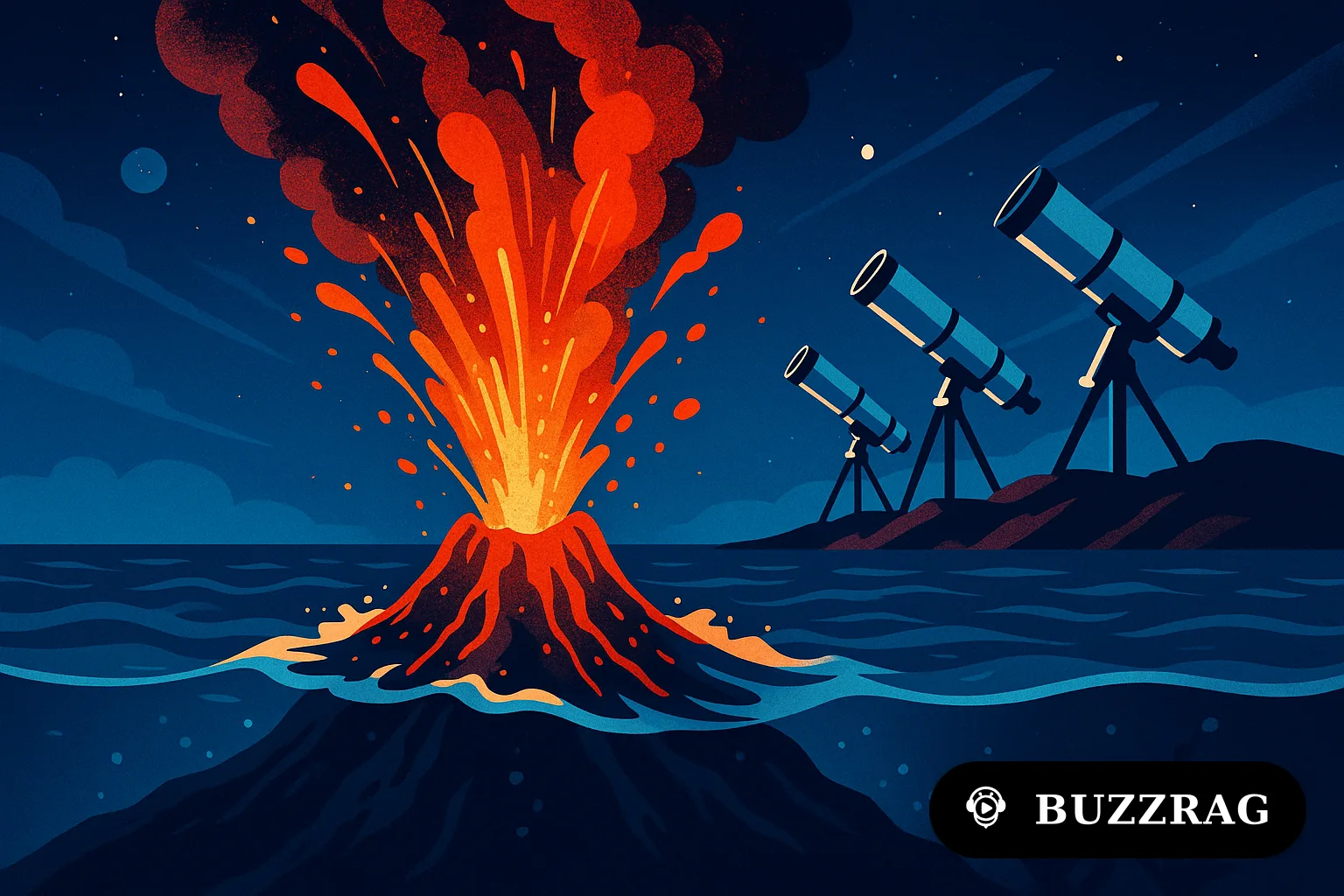
Satellite imagery has captured a sudden burst of volcanic activity in the Bismarck Sea near Papua New Guinea. This eruption, confirmed by NASA and the Earth Observatory, underscores the dynamic nature of underwater volcanism and its potential impact on regional ecosystems and atmospheric conditions.
The volcanic activity in the Bismarck Sea is significant due to its potential to alter oceanic and atmospheric dynamics. These eruptions can introduce large amounts of volcanic ash and gases into the atmosphere, impacting air quality and climate. Additionally, they can create new landforms and affect marine life, highlighting the interconnectedness of Earth's geological and ecological systems.
Monitoring such events is crucial for understanding their short and long-term implications on global climate and local biodiversity. The Bismarck Sea's activity serves as a reminder of the constant geological processes shaping our planet.
Enhanced Detector Designs for Dark Matter Searches
A new study highlights significant noise reduction in Kinetic Inductance Phonon-Mediated (KIPM) detectors using a wideband parametric amplifier. These detectors, when coupled to crystalline substrates, are poised to revolutionize rare-event searches, including the elusive dark matter detection.
The innovations in KIPM detector designs are pivotal as they offer improved sensitivity and reduced noise, essential for detecting rare astrophysical phenomena. This advancement could enhance our capacity to detect dark matter, a mysterious component of the universe that has eluded direct observation despite its significant gravitational influence.
As the pursuit of dark matter continues, these technological improvements bring us closer to unveiling one of the universe's greatest mysteries. Such developments underscore the importance of iterative design and testing in scientific instrumentation.
Unraveling Tidal Disruption Events in Black Hole Physics
Recent simulations have explored the origins of anomalous dissipation in tidal disruption events (TDEs), where stars are torn apart by supermassive black holes. The study seeks to understand the processes that lead to the formation of an accretion disk from stellar debris.
TDEs provide a unique opportunity to study the extreme environments near black holes and the physics governing them. The challenge in TDE theory has been to explain how the debris from a disrupted star transitions from chaotic orbits to a stable, accreting disk. Addressing this question enhances our understanding of accretion processes and black hole growth.
Insights from these studies contribute to broader astrophysical theories and aid in interpreting observational data from telescopes that capture these cosmic events. As simulations become more sophisticated, they offer a preview of the complex dynamics at play in the universe.
Benchmarking Blast Wave Theory with OSIRIS-REx
Researchers have applied cylindrical blast wave theory to interpret data from the OSIRIS-REx Sample Return Capsule's reentry, marking an important benchmark for weak shock theory. This study evaluates the theory's applicability in hypersonic conditions with known parameters.
The application of blast wave theory to real-world events like OSIRIS-REx's reentry offers a valuable testbed for theoretical models. Understanding blast waves is crucial not only for space missions but also for interpreting meteor infrasound and other atmospheric phenomena. By comparing theoretical predictions with actual data, scientists can refine models and improve predictive accuracy.
Such benchmarking efforts are vital for advancing aerospace engineering and atmospheric science. They provide the empirical foundation needed to validate theoretical constructs and enhance our preparedness for future missions and natural events.
The Dawn of Extremely Large Optical Telescopes
The era of Extremely Large Telescopes (ELTs) is upon us, with facilities like the Giant Magellan Telescope and the Thirty Meter Telescope promising unprecedented insights into the cosmos. These observatories, with mirrors exceeding 20 meters, represent a leap forward in observational astronomy.
ELTs will enable astronomers to observe fainter and more distant objects than ever before, providing deeper insights into the universe's formation and evolution. The technological advancements in adaptive optics and mirror design are crucial for achieving the resolution and sensitivity required for cutting-edge research.
As these telescopes become operational, they are expected to revolutionize our understanding of phenomena such as exoplanets, black holes, and dark energy. The capabilities of ELTs will challenge existing theories and inspire new lines of inquiry, marking a transformative epoch in astronomy.
As the week unfolds, watch for further developments in the aftermath of the Bismarck Sea eruption and the operational milestones of the Extremely Large Telescopes. These stories, alongside advances in detector technology, are pushing the boundaries of our understanding and capabilities.