BuzzRAG Science Desk — 2026-05-06

Curated by AI. Anika Bose, Science Desk Editor
Today's science highlights are heavily influenced by solar activity and its varied impacts, from the acceleration of space junk descent to the influence on Earth's magnetosphere. We also delve into volcanic activity in Russia and explore complex dynamics in space and fluid turbulence, where new theoretical insights are emerging.
Swarm Satellites Pinpoint Solar Storm Effects
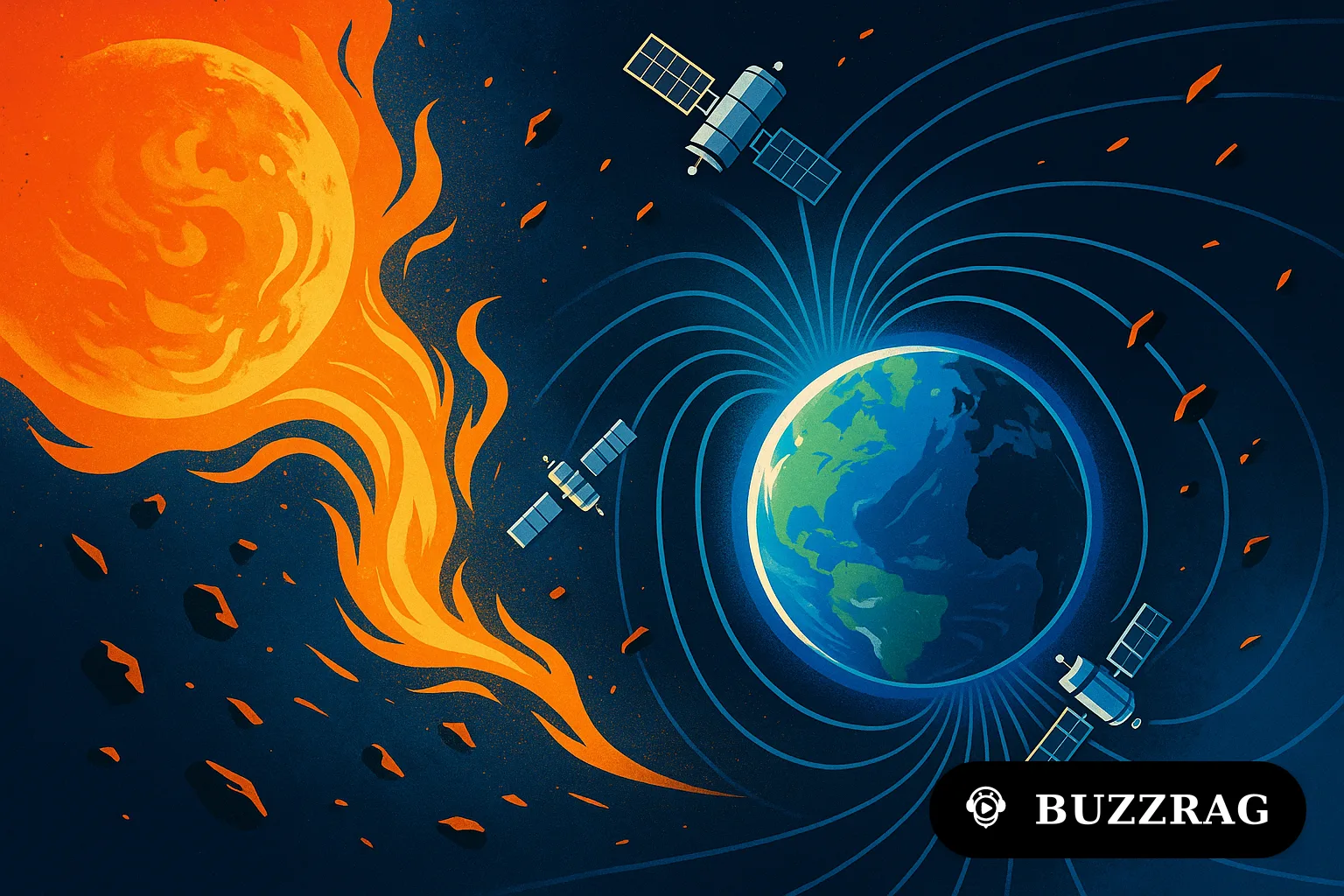
Swarm satellites are proving invaluable in identifying the precise impacts of solar storms on Earth's systems. By monitoring the magnetosphere–ionosphere system, these satellites help differentiate between solar-induced disruptions and other geophysical signals.
Sunspot Cycles Speed Up Space Junk Descent
New research finds that solar emissions during sunspot peaks increase atmospheric drag, causing space debris to fall to Earth more rapidly. This finding is based on 36 years of data, offering vital insights for satellite collision risk assessments.
Volcanic Activity at Shivelyuch Continues
The Shivelyuch volcano in Russia remains persistently active, with ongoing eruptions melting surrounding snow. This activity is closely monitored due to potential impacts on local environments and air travel.
Cyclic Dynamo Origins in Accretion Disks
A new study using weakly nonlinear theory and simulations sheds light on the cyclic behavior of magnetorotational dynamos in accretion disks. This research deciphers wave interference patterns as a key mechanism behind magnetic field reversals.
COCONUT Advances Sun-to-Earth Modeling
The COCONUT project presents a method for time-evolving magnetohydrodynamic simulations from the Sun to Earth. This approach addresses the limitations of static coronal simulations, improving predictions of solar wind impacts.
Turbulence Power Spectrum Insights
Research on the power spectrum of supersonic turbulence reveals new details about the statistical properties of compressible flows. The study provides a framework for estimating the Mach number in these turbulent environments.
Strouhal Number in Supernova-Driven Turbulence
A recent study investigates the Strouhal number in turbulence driven by supernovae, providing new data on the temporal coherence of these cosmic events. This research challenges assumptions commonly used in turbulence modeling.
As we look to the future, anticipate further advancements in space weather prediction and debris management, critical for our increasingly space-dependent world. Additionally, expect continued exploration into the dynamics of cosmic phenomena, which could reshape our understanding of the universe. Stay tuned for more groundbreaking discoveries and their implications in the weeks ahead.