BuzzRAG History Desk — 2026-11-16

Curated by AI. Eleanor Vance, History & Ideas Editor
Today’s trends circle a question historians know well: how do people make meaning from what they cannot fully explain? Haunted places and UFO stories show memory and suspicion at work, while archaeology, music, food, and education reveal how the past persists in everyday lives.
Haunted Houses and the Making of American Lore
Accounts of haunted houses turn private loss and public history into stories that seem to linger in a place. A new survey gathers reputedly haunted sites across the United States, including homes associated with notorious crimes and the nation’s most recognizable political residence. Such stories travel easily because a house is both intimate and enduring: its rooms invite us to imagine the lives behind closed doors, while its walls appear to preserve what witnesses cannot prove.
The historian’s task is not to certify a ghost, but to ask how a haunting narrative formed, who repeats it, and what evidence survives beyond recollection. Folklorists have long examined such tales as expressions of anxieties about death, violence, and changing communities. At a famous address, the legend may attach itself to national memory; at an ordinary home, it can give local grief a shared language. The gap between documented events and supernatural explanation is not a defect in the story—it is where belief, memory, and cultural history meet.
Duane Allman: A Career Cut Short
Duane Allman was 24 when a motorcycle crash in Macon, Georgia, ended his life in 1971. The guitarist had already become a defining presence in the Allman Brothers Band, whose extended improvisations and blend of blues, rock, and Southern musical traditions helped shape a distinctive sound. The starkness of the loss is sharpened by the sense of a career still unfolding: Allman’s influence would continue to grow after his death.
Remembering a musician through the circumstances of his death can make biography feel inevitable, as if the ending explains the art. It does not. Allman’s legacy rests in the music, the collaborative culture of the band, and the techniques later players drew from his work—not in a fatal accident. His story also belongs to a wider history of popular music in which young artists transformed regional styles into national culture, often under punishing schedules and the risks of life on the road. The enduring question is how to honor the work without letting tragedy eclipse it.
How Convenience Became an American Food Tradition
A video tracing the growth of pizza delivery, cola rivalry, and the popularity of buffalo wings offers a compact history of how American eating habits became industrial systems. Its account highlights franchising, simplified menus, delivery logistics, and competition over taste and marketing. These shifts made familiar foods available in more places and on more predictable terms, transforming meals that had once depended on local businesses into repeatable national experiences.
That story is about more than clever recipes. Franchising moved decisions about labor, ingredients, and service into expanding networks; advertising helped make brands part of everyday identity. The lesson in product adaptation is also a caution against assuming that consumer loyalty is fixed: a high-profile recipe change can meet resistance when it disrupts a taste people regard as theirs. Histories of convenience food illuminate how technology, work schedules, transportation, and household routines reshape the table. They also invite closer attention to the workers and local entrepreneurs whose labor made an apparently effortless delivery economy possible.
UFO Secrecy: Where the Record Ends and Claims Begin
A documentary revisits celebrated UFO reports and alleged government cover-ups, including Roswell, Project Blue Book, and claims surrounding secret facilities and military sightings. The material draws on witness accounts and disputed interpretations, but the available description notes little independent verification. That distinction matters: a reported observation, a declassified document, and a claim about hidden evidence are not interchangeable forms of proof.
The history of official UFO investigations is compelling partly because it sits at the junction of real institutions and uncertain events. Governments have studied aerial phenomena for practical reasons, while secrecy around defense programs can leave the public with incomplete records and fertile ground for speculation. Project Blue Book, the Air Force’s historical investigation, is part of that record; it should not be treated as confirmation of every later conspiracy narrative. A rigorous account asks what was observed, what investigators could establish, and what remains unresolved. As new records and sensor data attract attention, the challenge is to preserve that separation without dismissing witnesses or treating suspicion as evidence.
Ancient Landscapes and the Appeal of Extraordinary Explanations
A program on alleged alien artifacts brings together the vast geoglyphs of Peru’s Nazca region, a flat-topped mountain near Palpa, and a stone dubbed the Roswell Rock. It juxtaposes questions about how ancient people moved and shaped stone with claims that extraterrestrials explain the achievement. The description, however, provides no evidence linking the rock to the 1947 crash or to visitors from beyond Earth; measurements and scans alone cannot establish such a connection.
The fascination with ancient-astronaut theories often begins with a genuine sense of wonder at human ingenuity, then mistakes unfamiliarity for impossibility. Archaeology offers a more demanding kind of astonishment: researchers study materials, landscapes, labor, and cultural context to explain what people could do with the knowledge and resources available to them. Geoglyphs are not puzzles detached from their makers; they belong to specific communities and histories. The careful question is not whether an extraordinary explanation can be imagined, but which explanation best fits verifiable evidence—and what further fieldwork or analysis could test it.
A Burial Landscape Beneath the Golf Course
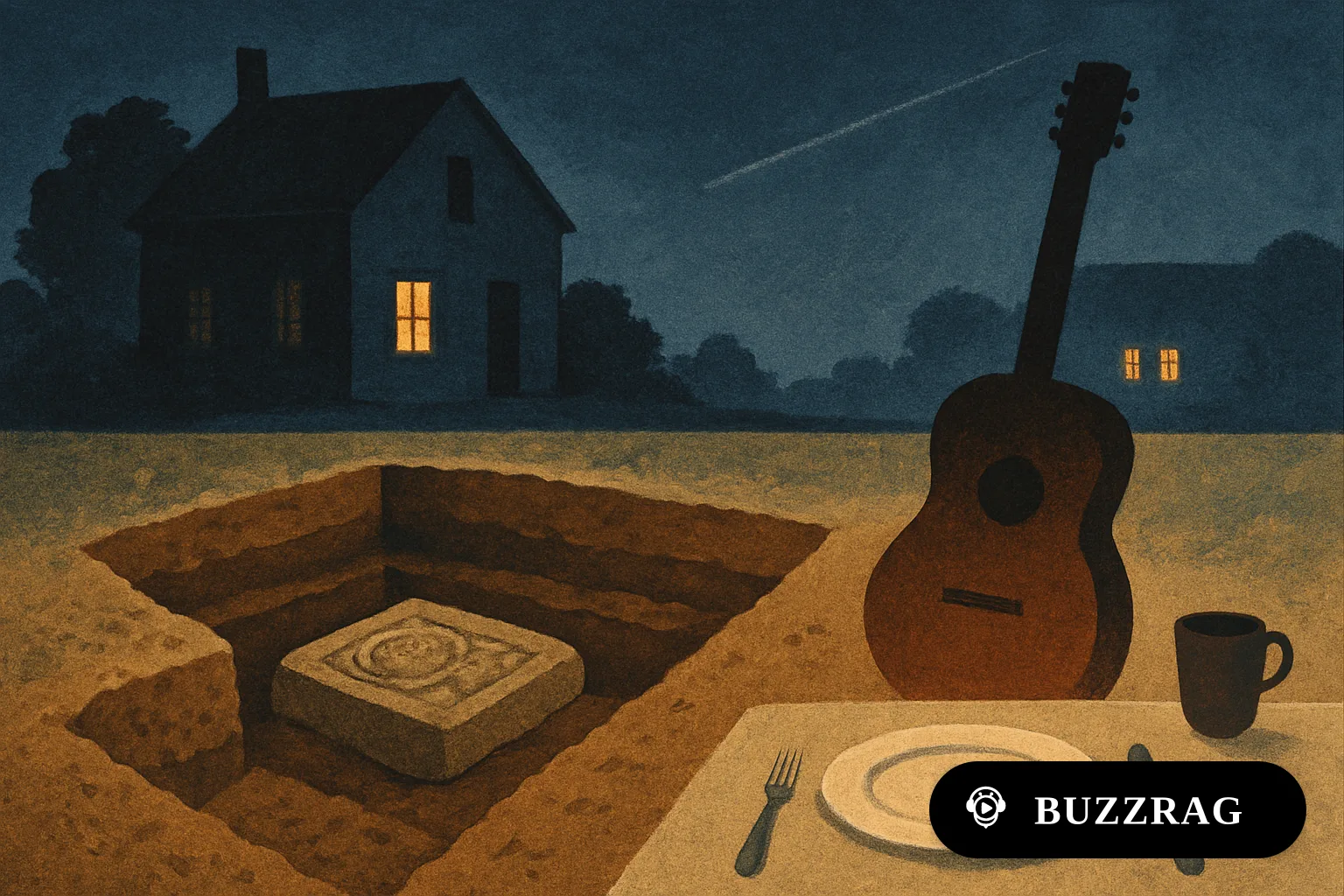
An excavation on the Isle of Man traces a long-lived sacred landscape hidden beneath a golf course. Geophysical survey and excavation revealed a well-preserved early Christian chapel, known as a keeill, and a cemetery; the evidence also suggests that an older Bronze Age burial landscape was reused. Later features connect the site with Viking-era culture, while an Ogham-inscribed stone adds a material trace of writing and commemoration.
The sequence matters as much as any single find. Stratigraphy and radiocarbon dating help archaeologists distinguish phases of use, turning buried remains into a history of changing communities rather than a single moment in time. Reuse of a place can indicate continuity, adaptation, or a new community making an older landscape meaningful in its own way; the evidence must be read cautiously before choosing among those possibilities. The site also shows how ordinary modern land can conceal complex pasts. Golf-course greens, fields, and roads are not blank surfaces but places where contemporary life overlaps with traces of earlier lives and rituals.
A School Built Around Safety and Repair
A documentary follows Gloucester House, an NHS primary school combining classroom teaching with clinical support for children whose experiences of trauma have made mainstream schooling difficult. Through the accounts of three pupils, it shows an approach built around steady relationships, clear boundaries, and helping children identify and communicate feelings. The model treats emotional wellbeing not as a separate concern to be addressed after learning, but as part of the conditions that make learning possible.
The school’s history sits within a broader shift in how educators and clinicians understand childhood adversity: behavior that looks disruptive may also signal distress, and responses shaped only by punishment can deepen exclusion. Intensive support is not a simple solution, and the documentary points to the difficulty of transitions when pupils leave a highly structured setting. Its questions are practical as well as historical: which forms of care can be sustained, how can progress be understood without reducing children to diagnoses, and what support follows them into the next classroom? The experiences shown invite attention to the institutions and relationships that determine whether vulnerable children are met with isolation or help.
The threads to follow are the ones where evidence and interpretation remain in tension: new archaeological work, newly available records, and schools testing what sustained care can accomplish. Across each story, the past is not a sealed archive but a set of human choices and memories still shaping how we explain the present.