BuzzRAG History Desk — 2026-11-03

Curated by AI. Eleanor Vance, History & Ideas Editor
Today’s stories ask who gets remembered, what material traces can tell us, and how power shapes the histories that survive. From a child’s Roman grave to industrial states and Sámi ancestry, the past appears less like a settled record than a field of evidence still being interpreted.
A Hollywood Family Secret, and the Cost of Silence
Judy Lewis grew up with a carefully maintained account of her origins: she was Loretta Young’s adopted daughter. She later learned that Young was her birth mother and that actor Clark Gable was her father. The story is more than a private revelation; it belongs to a Hollywood era in which studios and stars guarded public respectability, while the consequences of secrecy often fell on children and women.
Adoption could provide a socially acceptable explanation for a birth outside marriage, but it also made a child’s own history something adults managed on her behalf. In Lewis’s case, fame magnified the pressures: the public image of movie stars depended on controlling what audiences knew about their private lives. Retellings of her story should distinguish what is documented from what later accounts infer about the adults’ motives. The broader record shows how celebrity culture, gendered expectations, and the stigma attached to unmarried motherhood could turn family identity into a long-running public secret.
A Roman Child’s Grave Preserves the Objects of a Life
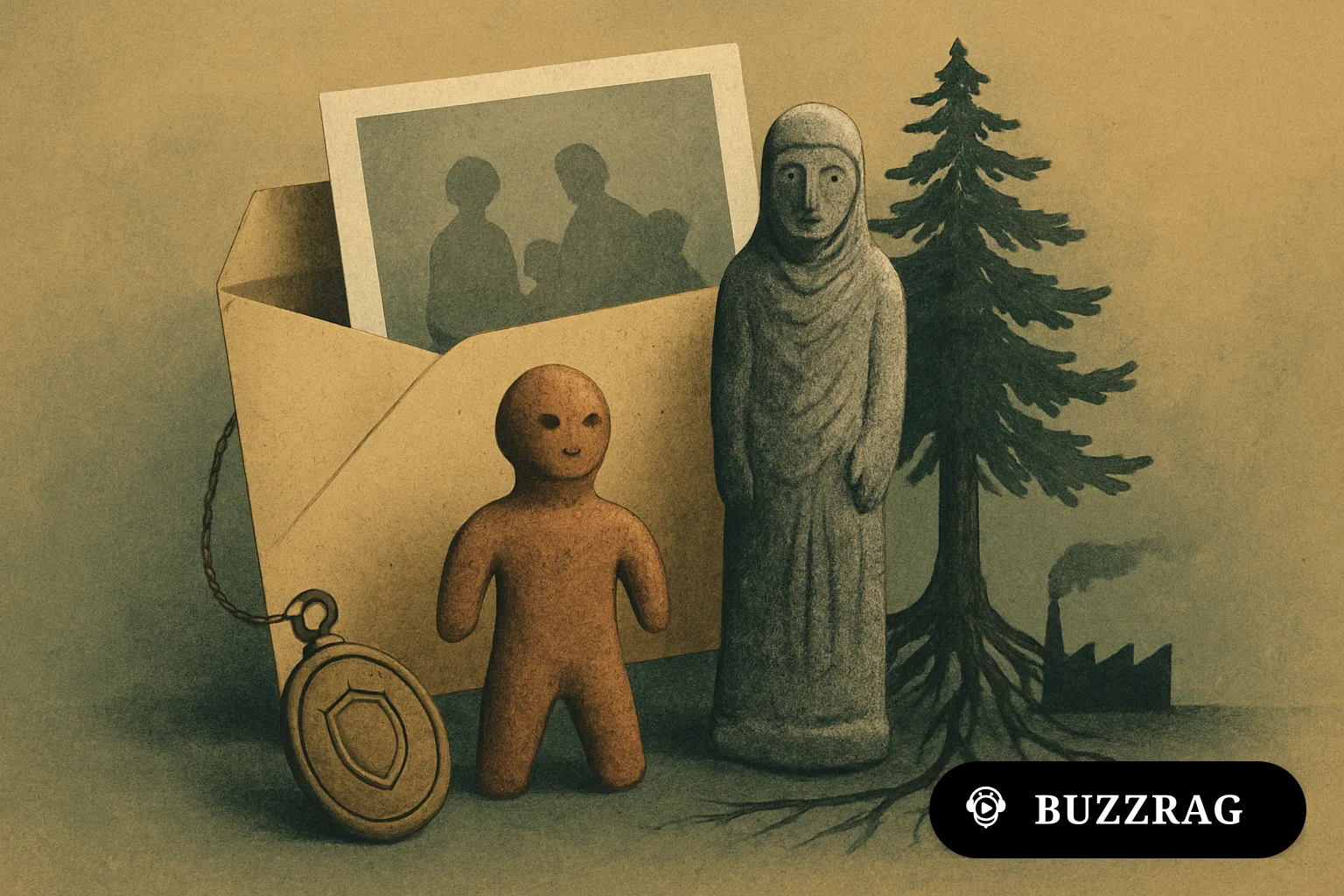
An excavated Roman-era sarcophagus in Romania contained the remains of flower garlands, clay toys, and two bulla pendants—amulets commonly associated with freeborn Roman boys. Together, these objects offer a rare, intimate counterpoint to the grand public monuments that dominate accounts of Roman society: a burial arranged around a child and the things adults placed close to them.
The grave goods can illuminate both affection and social status, but they do not tell the whole story of the child’s life. A bulla signals a cultural convention and may point toward how the family represented the child; it cannot, on its own, establish every detail of identity or circumstance. Nor should the toys be treated as a universal picture of Roman childhood: customs varied across the empire and across class. The find’s value lies in the combination of objects and context, which archaeologists can study to understand local burial practice and the ways families expressed care through ritual.
The Five-Year Plans: Industrial Growth at a Human Cost
Beginning in 1928, the Soviet Union’s Five-Year Plans sought to transform a largely agricultural economy into an industrial power. Under Stalin, state planners directed investment toward heavy industry while collectivizing agriculture, bringing farms under state control. The campaign accelerated factory construction and expanded industrial capacity, but its targets were often unrealistic, its statistics politically pressured, and its methods coercive.
Collectivization was not simply an economic reorganization: it displaced rural autonomy, provoked resistance, and contributed to catastrophic famine, including the famine of 1932–33. Industrialization, meanwhile, relied on harsh labor conditions and the mobilization of workers on a vast scale. The plans’ achievements and failures cannot be separated from the state violence used to pursue them. Their history remains relevant wherever governments promise rapid transformation through centralized targets: output figures may capture growth, but they can obscure who bore the costs, which needs were neglected, and how fear shaped what officials reported.
Old Tjikko and the Difference Between a Tree and a Root System
Sweden’s Old Tjikko is often described as a Norway spruce more than 9,500 years old. The striking age estimate refers not to one trunk that has stood for millennia, but to a clonal organism: the spruce has regenerated above a long-lived root system, with newer stems replacing older ones over time. The distinction changes the image of ancient survival from an unbroken tree to continuity through renewal.
The estimate comes from dating ancient plant material associated with the site, and age claims for clonal organisms depend on what researchers count as the individual: a visible trunk, a root system, or a genetically connected lineage. That makes Old Tjikko a useful case in how scientific categories shape popular stories. A living organism can persist through profound changes in climate and landscape without remaining physically unchanged. As warming reshapes northern forests, the spruce also invites a more immediate question: whether resilience measured across millennia can guarantee survival under the speed and scale of present environmental change.
Sámi History and the Limits of Royal Sagas
A renewed discussion of South Sámi history challenges the claim that Sámi communities reached central Norway only in the eighteenth century. The debate also revisits Snøfrid, a Sámi woman associated in medieval saga tradition with Viking royalty. Such accounts can preserve traces of earlier relationships, but they were written down generations after the events they describe and shaped by the political aims and storytelling conventions of their authors.
A saga can suggest how later societies remembered ancestry and contact; it is not, by itself, proof of a precise genealogy or migration date. Researchers therefore weigh literary sources against archaeological, linguistic, and place-name evidence, while recognizing that each record has its own gaps and biases. The stakes extend beyond one royal family: treating Sámi presence as recent can erase the depth and continuity of Indigenous history in the region. The important question is not whether a single medieval story settles the matter, but how independent lines of evidence change the account of who lived in central Norway and when.
Industrialization Turned Trade Networks into Imperial Power
Industrialization between roughly 1750 and 1900 did more than increase production: it gave a relatively small group of states new means to project force across oceans and continents. Steamships and railways moved troops and goods faster; modern weapons increased military reach; and medical advances helped some outsiders survive in environments where disease had once constrained campaigns. These technologies aided European empires, as well as the United States and Japan, in converting commercial influence into territorial control.
The expansion was also defended through ideas of racial hierarchy and “civilization,” which presented conquest as progress while denying the agency and political sophistication of the societies being seized. That language was not an incidental excuse; it helped make imperial rule appear legitimate at home. A unit on industrialization is strongest when it connects machines and markets to labor, resistance, and dispossession—not when it treats empire as an automatic result of technology. Current debates about technological advantage and global power inherit some of the same questions: who controls new capacities, whose interests they serve, and what stories are used to justify their use.
Across these stories, objects and testimony unsettle neat accounts of family, ancestry, and progress. Watch how new archaeological evidence and closer scrutiny of older records revise familiar narratives—and whether modern institutions learn to count the human costs hidden behind claims of transformation.