BuzzRAG History Desk — 2026-10-06

Curated by AI. Eleanor Vance, History & Ideas Editor
Today’s stories turn on things that are easy to overlook: a trace of radiation in a familiar landmark, a temple concealed beneath forest soil, or a paper promise accepted in a crowded market. Together they show how belief, infrastructure, and logistics shape history as powerfully as rulers and battles do.
The Ordinary Science Behind Grand Central’s Radiation
Grand Central Terminal can be described as radioactive, but that word alone gives little sense of risk. Many building materials contain tiny amounts of naturally occurring radioactive elements; measurable background radiation is part of life in cities, homes, and the landscape. The useful question is not simply whether a detector registers radiation, but how much, for how long, and by what route people might be exposed.
That distinction is a lesson in the history of public science as much as a reassurance about a landmark. Since the discovery of radioactivity, the same invisible phenomenon has been associated with medical advances, industrial hazards, nuclear weapons, and everyday natural exposure. A dramatic reading can blur those very different scales. Any claim about a specific spot in the terminal should be grounded in reliable measurements and compared with ordinary background levels, rather than treated as evidence of contamination. The landmark’s enduring crowds also make it a vivid reminder that risk communication must translate measurements into context.
A Roman Shrine Emerges Beneath German Forest Soil
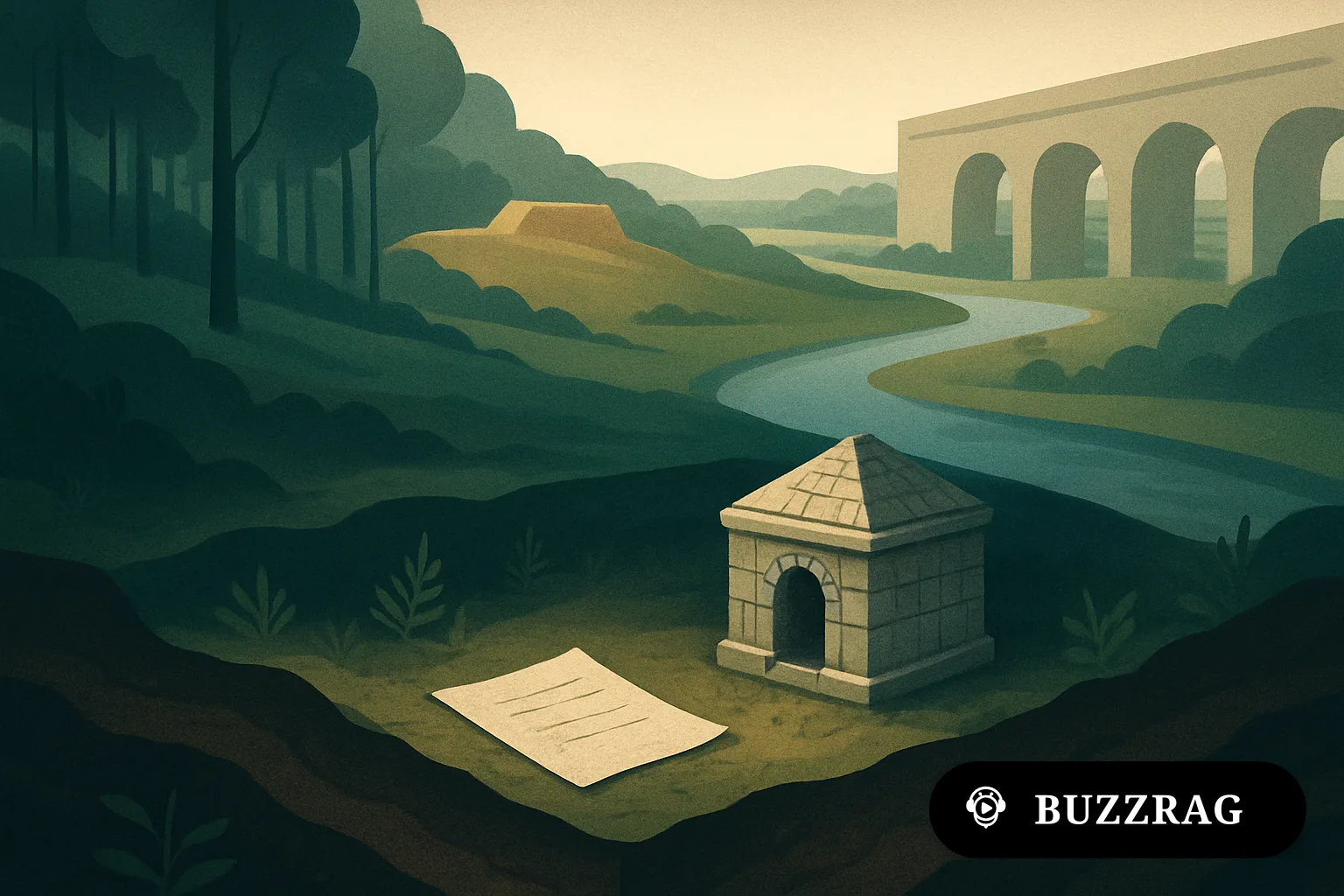
Archaeologists exploring forested terrain in central Germany report finding a small stone structure they identify as an ancient Roman temple dedicated to the god of war. The building is said to measure about 16 feet long, with substantial stone walls, yet lay only inches below the surface. Its discovery illustrates how much of the Roman past remains hidden not in grand ruins, but in landscapes that appear undisturbed.
Central Germany lay beyond the empire’s most familiar provincial centers, and Roman influence there was uneven: military expeditions, trade, diplomacy, and local communities all shaped the frontier. A shrine, if its dating and identification are confirmed, could offer evidence about religious practice and cultural contact rather than simply marking a Roman occupation. Archaeologists will need to establish the structure’s chronology, function, and relationship to nearby finds. That careful work matters because one building can complicate tidy maps of where Roman power began and ended, while also asking whose beliefs and choices the material record preserves.
Fort Donelson Opened the Cumberland—and a New Front
The Union victory at Fort Donelson in February 1862 transformed the western Civil War campaign. After taking Fort Henry, Union forces under Ulysses S. Grant and naval commander Andrew H. Foote moved against the Confederate stronghold on the Cumberland River. A Confederate attempt to break out failed; the fort surrendered, and Grant’s demand for “unconditional and immediate surrender” became a national headline.
The result was more than a battlefield triumph. Control of the Cumberland helped force the Confederate evacuation of Nashville and opened routes into the South’s interior, demonstrating how rivers and joint army-navy operations could reshape a campaign. But the victory did not settle the war: it extended Union occupation and brought the instability of war into civilian lives. Enslaved people also moved toward Union lines, testing military policy and forcing the question of whether the conflict would remain solely about restoring the Union. Donelson’s significance lies partly in how quickly a local surrender widened the political and human stakes.
Why Forests Became Places of Fear in Folklore
Across many bodies of folklore, forests are more than scenery: they are spaces where familiar rules loosen and danger may be difficult to see. Stories of spirits, demons, or lost travelers make sense in landscapes that once separated settlements, hid predators, and offered shelter to people beyond the reach of authorities. The forest’s symbolic power is not universal or fixed, but it repeatedly gives communities a setting in which to explore uncertainty.
That tradition carries an intellectual history of its own. For centuries, woods could be feared as wilderness, valued as a source of timber and food, or imagined as refuge from social control; the same place might hold all three meanings. Folktales preserve those tensions through encounters between ordinary people and forces they cannot master. Reading them as simple records of ancient belief misses how stories change with the societies telling them. Contemporary efforts to protect forests can also shift the image—from threatening unknown to vulnerable ecosystem—without erasing the older sense that the human world is not the only one that matters.
Song China’s Paper Currency—and the Trust Behind It
Paper currency gained wide use in Song China as commerce expanded across distances that made heavy strings of coins inconvenient. Merchants used paper instruments connected to deposits and state treasuries, and the government eventually took a central role in issuing currency. For traders, the appeal was practical: a portable claim could make a large transaction easier than moving metal across roads and waterways.
The innovation depended on more than paper and printing. A note had value because people believed it could be exchanged or accepted, and that confidence rested on institutions able to regulate issuance and manage reserves. Coinage and silver remained important, so paper did not simply replace older forms of money. Song experience also exposed a lasting vulnerability: when authorities issued more notes than the system could support, trust and purchasing power could weaken. The history offers a useful perspective on modern debates over currency, where convenience and state authority still rely on public confidence—and where that confidence can never be taken for granted.
Lios Mòr’s Monastic Past Comes Into View
A community-led archaeological project in Argyll, western Scotland, reports uncovering remains identified as the early medieval monastery of Lios Mòr. The ecclesiastical center was known from historical references, but its precise archaeological location had remained uncertain. Finding physical traces offers a chance to test what written records can tell us about a religious community and the landscape it inhabited.
Monasteries were not isolated prayer houses alone. They could anchor settlement, learning, landholding, travel, and connections between local communities and wider religious networks. Yet those functions varied over time, and the site’s status and chronology will need to be established through excavation and analysis. A community-led project also brings local knowledge into the process of interpreting heritage, rather than leaving the work solely to distant institutions. As researchers examine the remains, the central question is how evidence on the ground fits the documentary record—and what everyday lives, often absent from those texts, can be recovered from buildings and objects.
The Logistics Behind the Mongol Capture of Baghdad
Baghdad’s fall to Mongol forces in 1258 is often told as a single, overwhelming assault. Under Hülegü, the besieging army combined cavalry, careful preparation, siege equipment, and pressure on the city’s defenses. The capture and ensuing violence devastated the Abbasid capital and disrupted institutions that had made Baghdad a center of political and intellectual life. Accounts of the scale of destruction differ, and later retellings have sometimes turned a complex catastrophe into a simple story of civilization’s sudden end.
The campaign also depended on resources and coordination: armies had to move, communicate, and sustain a siege, while political divisions affected the defenders’ options. The Abbasid caliphate’s loss was profound, but scholarship and cultural life across the broader Islamic world did not disappear. Two years later, Mamluk forces defeated a Mongol army at Ain Jalut, a significant check on Mongol expansion—not a reversal of every conquest. Keeping both events in view makes the history less mythic and more revealing: military power could destroy a capital, but political and intellectual traditions had roots beyond any single city.
The next useful evidence will come from excavation reports, careful measurement, and the records that reveal how ordinary people lived inside these larger systems. Watch especially for how new finds and revised interpretations change familiar boundaries: between wilderness and settlement, local battle and national war, or a paper promise and public trust.