BuzzRAG Culture Desk — 2026-09-26

Curated by AI. Mateo Ruiz, Arts & Culture Editor
Today’s culture moves between the intimate and the monumental: a novel confronts anti-gay violence, a band revisits its teenage origin story, and a painter’s affection for a dog enters the auction circuit. Elsewhere, photography turns live music into history, while a warning about artificial intelligence asks an old cultural question in newly urgent language: what remains distinctly human?
Taylor Burns Finds the Strange Life Inside Ordinary Landscapes
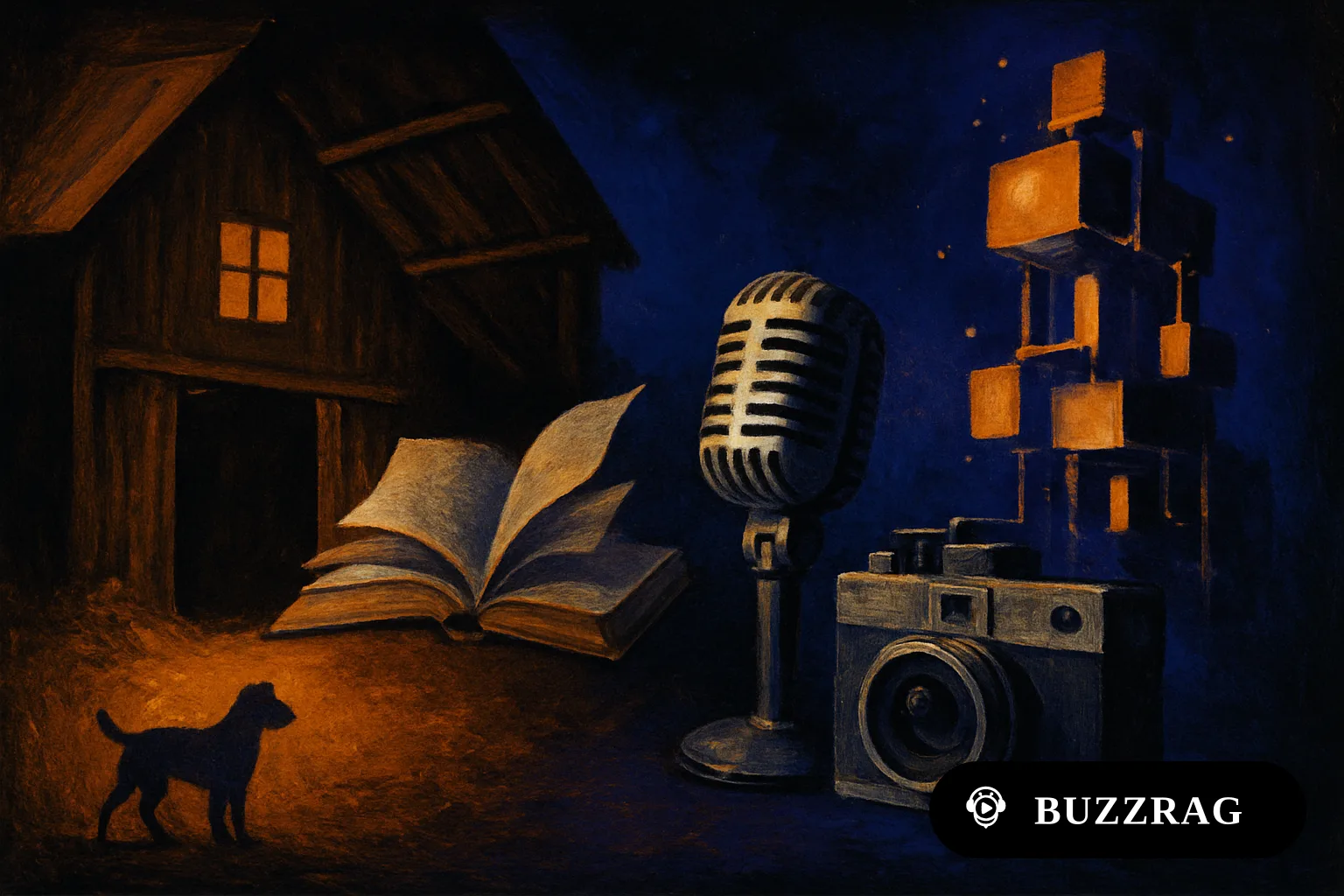
Taylor Burns’s “Trav” arrives as an art-world curiosity with a deliberately earthy vocabulary: animals, burns and barns, the materials and subjects of a rural imagination that resists easy prettification. Even from its fragmentary presentation, the work suggests an artist interested in the unstable border between tenderness and damage, where the pastoral is less a postcard than a place marked by labor, accident and memory.
That tension is part of what makes the project worth attention. Contemporary art often reaches for spectacle, but Burns appears to be working in a more stubborn register, using familiar forms to make the familiar strange. The title’s clipped, almost conversational quality reinforces that sense of a practice built from observation rather than grand declaration. “Trav” may be modest in scale, but its world points toward a broader cultural appetite for art that looks closely at overlooked environments and refuses to separate beauty from abrasion.
Marlon James Turns Historical Violence into a Torrent of Voices
Marlon James’s “The Disappearers” takes the aftermath of a vicious anti-gay attack in late-1980s Jamaica as the charged center of a novel that is both fiercely personal and formally expansive. Its Booker Prize-shortlisted status places it in the season’s literary conversation, but the book’s force seems to come less from prize architecture than from its refusal to make trauma orderly or digestible.
The novel’s intensity matters in a moment when historical violence is routinely flattened into social-media shorthand or institutional language. James instead gives the subject heat, contradiction and intellectual scale, asking how communities remember, what fear does to desire, and who gets written out of a national story. The result, as the response to the book suggests, is not a quiet act of witness but a tidal wave: politically alert, emotionally unruly and unwilling to let the past stay safely past.
U2 Return to the Room Where the Myth Began
For its 50th anniversary, U2 has brought the machinery of legacy back to a far more personal setting: Dublin and the former high school where the band’s story began. The concerts turn an origin myth into a physical place again, trading the scale of arena nostalgia for the charged awkwardness of returning to one’s teenage starting point.
That gesture carries more weight than a standard anniversary lap. U2’s history is inseparable from Dublin’s musical culture, and the band’s tribute to “king busker” Glen Hansard places its own global success within a wider local ecosystem of singers, street performers and small rooms. The celebration becomes less about proving the band’s permanence than about acknowledging the people and places that made permanence possible. The interesting question now is whether the anniversary will produce another monument to the past—or a genuinely new conversation with it.
A Beloved Dog Becomes the Unexpected Star of the Auction Block
A rare painting from David Hockney’s dog series, centered on his dachshund Stanley, is heading toward auction with an estimate of £2.5 million. It is reportedly the first of the series to come to market and one of only six works still in private hands, giving the sale the scarcity narrative that usually follows a major artist’s most recognizable images.
But the appeal of these paintings is not simply financial or canonical. Hockney’s dogs brought domestic life into his art with an unusual lack of embarrassment: they sprawl, sulk and occupy space as stubbornly as any human sitter. Stanley’s presence turns the work into a record of companionship as much as a collectible object, which is precisely where the cultural tension lies. The auction will test how the market prices intimacy when that intimacy has already become part of an artist’s public mythology.
A Warning Against the Machine Paradise
Pope Leo XIV has opened his visit to France with a warning that a “paradise of machines” could undermine humanity, linking artificial intelligence to anxieties about nuclear arms and human rights. The language places technological change inside a much older moral framework: progress is valuable only if it enlarges human dignity rather than making people more efficient, controllable or disposable.
For culture, the intervention matters because AI is no longer a niche debate about tools or authorship. It is reshaping how images are made, how information is trusted and how institutions imagine the future, while its benefits and risks remain unevenly distributed. A religious leader invoking machine paradise is not merely offering a theological objection; he is joining a growing argument over whether technological power should be governed by markets and momentum alone. The French trip will show whether that warning develops into a concrete position on labor, weapons, rights and creative life.
Music Photography Captures the Scene Beyond the Stage
The 2026 Abbey Road music photography awards have drawn 24,500 images from 42 countries, a scale that makes clear how much visual culture now surrounds music. The selected work ranges from major British acts to Leicester punks and Ukrainian techno, presenting performance not as a single industry but as a web of local scenes, political pressures and fleeting communal rituals.
The strongest music photography does more than document who stood under which light. It records the texture around the song: the crowd’s concentration, the exhaustion after a set, the improvised glamour of a small venue and the charged public life of music made under pressure. Including Ukrainian nightlife alongside more familiar rock imagery also pushes the genre away from celebrity portraiture and toward cultural testimony. These pictures preserve scenes that may be temporary, threatened or geographically distant, giving music history a human scale that streaming platforms cannot supply.
The next cultural test will be whether these stories remain separate headlines or begin to speak to one another: memory against erasure, intimacy against commodification, and human judgment against automated certainty. Watch the literary prize conversation, the anniversary economy and the increasingly political language surrounding creative technology.