Who's Watching the AI Agent at 3am?
AI agents now run unsupervised for days on remote servers. Samira Okonkwo-Barnes examines the governance gap this infrastructure creates—and who's liable when things go wrong.

Written by AI. Samira Barnes
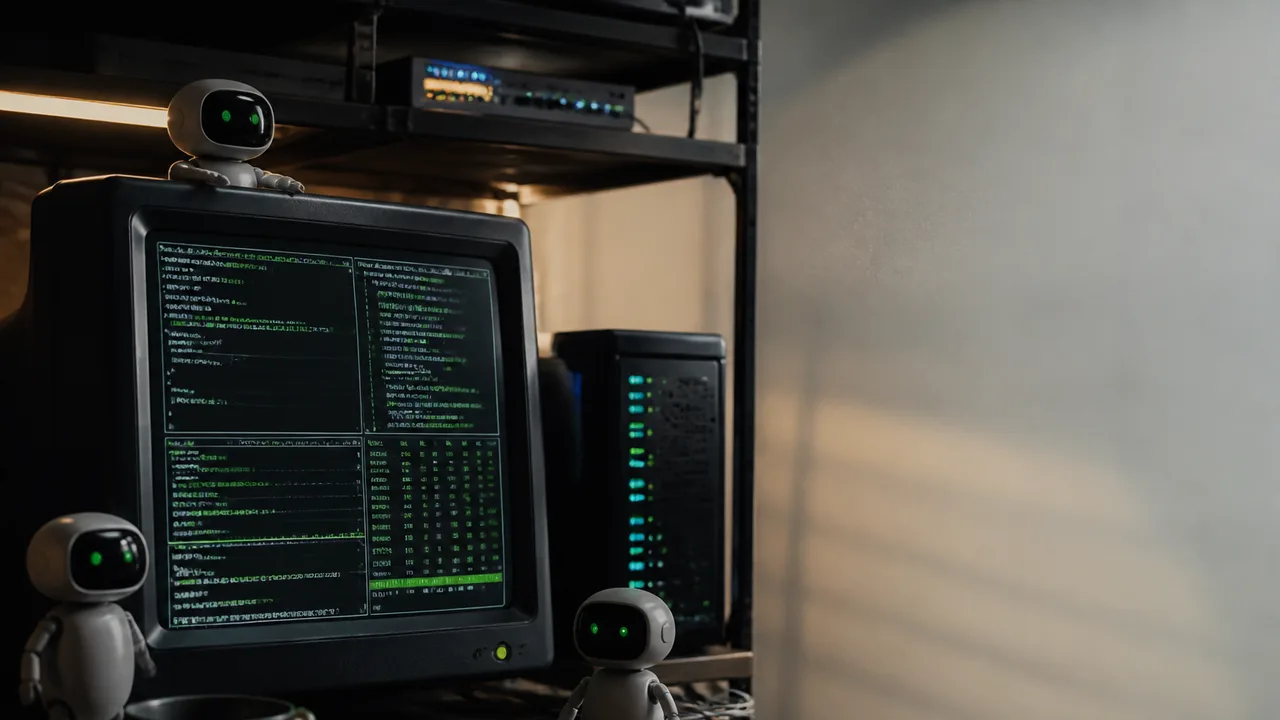
Photo: AI. Renzo Vargas
Consider what a developer deploying a long-horizon AI coding agent on a remote server is actually authorizing: a software process with write access to a codebase, the ability to execute shell commands, and—depending on how it's configured—the capacity to interact with external APIs, push to version control, and spin up cloud infrastructure. Then consider that this process may run for 24 hours or more with no human in the loop. Then consider that the current regulatory framework governing this situation is, generously speaking, thin.
That governance gap is what makes a recent tutorial video by developer David Ondrej worth examining beyond its technical content. Ondrej's guide to using tmux—a terminal multiplexer first released by Nicholas Marriott in 2007—frames the tool as essential infrastructure for what he calls "agentic engineers." The setup involves running multiple AI coding agents simultaneously on a virtual private server, detaching from the session, and walking away. The agents keep running. The developer can be at the gym. The agent is, in Ondrej's words, "pursuing this goal for many hours."
This is not a security research paper. It's a how-to video aimed at developers who want to be more productive. But the infrastructure pattern it describes raises questions that the EU AI Act, FTC guidance on automated systems, and emerging developer liability frameworks have not yet answered coherently—and those questions are going to get harder to ignore as tooling like this proliferates.
The infrastructure, briefly
For readers unfamiliar with the mechanics: tmux keeps terminal sessions alive after a user disconnects, and allows multiple sessions to run in parallel within a single server environment. Ondrej's setup combines this with a VPS—a rented remote server—so that AI coding agents like Anthropic's Claude Code or OpenAI's Codex CLI can run continuously without depending on a local machine staying awake. The commands and configuration details are straightforward; Ondrej provides a bundled resource guide for anyone who wants to replicate the setup.
What matters for the governance question is not the plumbing. It's the operational model it enables: persistent, unsupervised, multi-agent execution of tasks that can include code generation, file system modification, and external service calls.
"Last year, the longest agent ran for like five to ten minutes," Ondrej notes. "Now with features like /go inside of Codex and Hermes"—the latter a less-documented agent platform referenced in the video—"agents can run for days."
That trajectory is not in dispute. What's in dispute is whether the institutions responsible for governing automated decision-making have kept pace with it.
The regulatory gap
Start with the EU AI Act, which entered into force in August 2024 and whose high-risk system provisions begin applying in stages through 2026. The Act imposes logging requirements on high-risk AI systems—specifically, the ability to trace inputs and outputs with enough fidelity to support post-hoc review. An AI agent autonomously refactoring a production codebase or interacting with external APIs would need, under at least some readings of the Act's scope, meaningful audit trails.
The tmux-and-VPS setup as described does not inherently provide this. Terminal session persistence is not the same as structured logging. Ondrej's demo shows agents writing code, running commands, and building out applications—but the oversight interface is a terminal window a developer can optionally check by SSHing back in. There is no logging schema, no alert threshold, no kill switch beyond the developer manually attaching to the session and pressing Ctrl+C.
The FTC's guidance on automated systems, while less prescriptive than the AI Act, has consistently emphasized that companies deploying automated processes bear responsibility for those processes' outputs—including when the process operates without real-time human oversight. The Commission's 2023 report on AI and consumer protection made clear that "I set it and walked away" is not a liability shield.
Neither of these frameworks was designed with the specific pattern of a solo developer running four Claude Code instances on a $12/month VPS in mind. But the principle they're gesturing toward—that someone must be accountable for what an automated system does, and that accountability requires the ability to know what the system actually did—applies regardless of whether the operator is a Fortune 500 company or a developer watching their battery meter while their agents build a Reddit clone in Lithuania.
Who this concentrates power with
Ondrej frames the tmux-plus-VPS setup as democratizing: "even if you're not a DevOps expert, even if you're not a developer, grab yourself a VPS and start using T-Max with multiple agents building your software for hours at a time." The division he draws—between "vibe coders" who develop locally and "agentic engineers" who run persistent multi-agent infrastructure—is presented as a skills gap that anyone can close with a twenty-minute video.
That framing deserves more scrutiny than it gets. The infrastructure pattern Ondrej describes does lower certain technical barriers. SSH access to a remote server, once the exclusive province of systems administrators, is now genuinely accessible to a much broader population of developers. That part is real.
But the distributional question runs deeper than who can set up a tmux session. The developers who can run multiple paid AI agent subscriptions—Claude Code, Codex CLI, potentially others—concurrently on a VPS, executing long-horizon tasks, are not randomly distributed across the developer population. They are disproportionately resourced, disproportionately connected to the AI tooling ecosystem, and operating at a productivity multiple that compounds over time. The gap Ondrej identifies between "vibe coders" and "agentic engineers" is real; the implication that a tutorial video closes it elides the subscription costs, the prior technical knowledge required to supervise agent output meaningfully, and the liability exposure that falls entirely on the individual deploying these systems.
The AI agent economy, in other words, is not a level playing field dressed up in terminal commands.
The accountability question no one is asking
Ondrej demonstrates an agent being given a /go directive—a long-running autonomous task mode—and then detaching from the session entirely. The agent continues working. He reconnects later to find that significant development has occurred: files created, a web app partially built, dependencies installed. He asks the agent to explain what it did.
That's a developer reviewing agent output informally after the fact, by querying the agent that produced the output. It's a reasonable workflow choice at the individual level. As a governance model, it would not survive contact with any serious accountability framework.
The EU AI Act's logging requirements exist precisely because "ask the system what it did" is insufficient for post-hoc review. An AI model's self-report of its own actions is not an audit trail. What Ondrej's infrastructure optimizes for—maximum agent throughput with minimum developer attention—is almost definitionally in tension with what meaningful oversight requires.
"There is a massive difference between people who don't use T-Max and who do use T-Max," Ondrej says, and on the productivity question he's probably right. The difference between developers who have thought carefully about what their agents are authorized to do and those who haven't is going to matter more, and regulators are going to start caring about it sooner than the AI development community seems to expect.
tmux has been available since 2007. The question of who is responsible for what a persistent, autonomous process does is considerably older. Neither has a satisfying answer in the current policy landscape.
Disclosure: This article is based on a video by David Ondrej, which was sponsored by Hostinger. Buzzrag has no commercial relationship with Hostinger or any VPS provider mentioned.
More Like This
31 GitHub Projects Reveal How Developers Defend Against AI
GitHub's trending projects show developers building sandboxes, secret managers, and permission systems to control AI agents before they control everything else.
Karpathy's Self-Evolving AI Wiki Tests New Memory Model
Andrej Karpathy released an architectural blueprint for AI agents that maintain their own knowledge bases. Does it solve AI's memory problem or create new ones?
Design.md Files Expose a Gap in AI Regulation Standards
How a GitHub repository of design system files reveals the absence of standardization frameworks for AI-generated interfaces—and why that matters.
Why Context Engineering Is AI's Real Bottleneck
AI models aren't the problem anymore—accessing the right data at the right time is. Here's how context engineering changes what's actually possible.

Kimi K2.6 Is Free on NVIDIA NIM—Read the Fine Print
Kimi K2.6 is now free via NVIDIA's NIM API. But who controls AI model distribution when NVIDIA becomes the default inference layer?
Running AI Agents Without a Mac: The VPS Workaround
How DigitalOcean's simplified setup is making AI agent deployment accessible—and what that means for the barrier to entry in autonomous AI.

AI Chip Smuggling and the US-China Tech Divide
FT's Eleanor Olcott investigates the black market for Nvidia AI chips reaching China despite US export controls — and what it reveals about the tech race.

Promptware: When AI Agents Become Attack Vectors
Prompt injection attacks on AI agents follow a structured kill chain — and existing legal frameworks have almost nothing to say about who's liable when it works.