Where Starbucks Really Makes Its Money
A breakdown of Starbucks unit economics: ingredient costs, real estate, labor, the app's prepaid float, and the licensing business behind the green apron.

Written by AI. Jin Seo
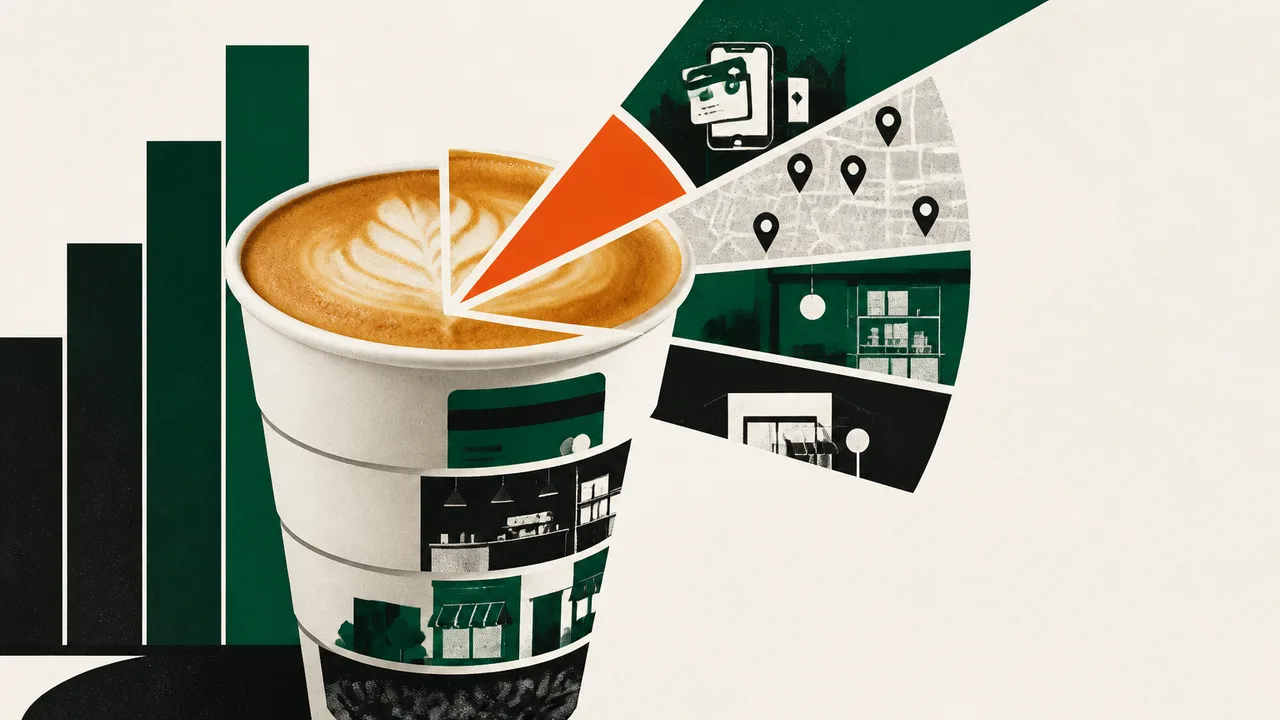
Photo: AI. Ondine Ferretti
The ingredients in a $6 Starbucks latte likely cost only a fraction of what the customer pays. Depending on the drink, milk, espresso, syrup, and packaging may amount to somewhere around 50 cents to a dollar. That means most of the price has very little to do with what is actually in the cup. The more interesting question is what the rest of that $6 is really paying for.
Starbucks is not simply marking up coffee beans and hot water. It is funding an enormous retail network, labor force, global supply chain, digital ordering system, loyalty platform, licensing operation, and some of the most strategically valuable storefronts in the restaurant business. The latte is the product. The machine surrounding it is where the economics get interesting.
The Cost Stack Behind the Cup
The apparent markup on a latte starts shrinking quickly once the full cost structure is considered.
Ingredients may represent a relatively small share of the selling price, but labor, rent, equipment, packaging, utilities, marketing, technology, logistics, and corporate overhead absorb much of what remains. Starbucks does not disclose the economics of an individual latte, so any precise per-cup breakdown is necessarily an estimate rather than an official company figure.
Two costs matter more than many customers probably realize.
The first is milk. Starbucks sells enormous quantities of milk-based beverages, which means dairy and alternative milks can matter as much as, and sometimes more than, the coffee itself. Dairy, oat milk, almond milk, coconut milk, and other alternatives expose the company to multiple ingredient markets at once.
The second is the physical store. A Starbucks location carries substantial fixed costs whether 50 customers walk through the door in an hour or 10 do. Rent still gets paid. Employees still need to be scheduled. Equipment still has to run.
That makes throughput critical. The morning rush, drive-thru lane, and mobile pickup counter are not just conveniences. They determine how many transactions Starbucks can push through an expensive piece of real estate during its most valuable hours.
The business is less about maximizing the profit on one drink than maximizing how many profitable transactions a store can complete.
The Bet on Beans
Coffee itself introduces another problem: volatility.
Starbucks buys green coffee from producing countries around the world, leaving the company exposed to weather, harvest conditions, geopolitical disruption, currency movements, and commodity markets. A frost in Brazil or drought in Vietnam can eventually work its way into the economics of a latte sold in New Jersey or California.
Large coffee buyers can manage some of that risk through contracts and hedging strategies, but that protection is neither permanent nor free. According to Coffee Intelligence, Starbucks has in recent periods moved away from some fixed-price coffee contracts, potentially leaving the company more exposed when raw coffee prices rise.
That makes coffee-price protection a management decision rather than a built-in shield. As the OpenStax finance reference explains, hedging can reduce commodity-price risk, but it cannot eliminate it.
Hedging trades uncertainty for predictability. That can be valuable when prices rise, but costly when a company locks in prices above the future market. For a business selling billions of drinks, even small purchasing decisions can eventually become enormous numbers.
The App Is More Than a Loyalty Program
One of Starbucks' most unusual financial advantages sits inside its app. When customers preload money onto a Starbucks Card or digital account, the company receives cash before providing the coffee.
Starbucks' 2025 10-K discusses the stored-value balances associated with the Starbucks Cards program. Accounting terminology aside, the economic advantage is straightforward: Starbucks gets access to customer cash before the customer redeems it. Some of that stored value is never redeemed at all. That unspent money, commonly called breakage, can eventually become revenue without another drink crossing the counter.
But the cash float may not even be the most valuable part of the app. Every logged-in transaction produces information. Starbucks can see what customers buy, when they visit, how frequently they return, which promotions they respond to, and which products they add to an order. That data can influence personalized offers, staffing forecasts, product testing, and inventory decisions.
Mobile ordering also changes store economics. If customers can order and pay before reaching the counter, a store can potentially process more transactions during peak periods without expanding its footprint. A cash customer is largely anonymous. A loyalty customer becomes a recurring behavioral pattern. That distinction matters because recurring behavior creates pricing power.
A customer who visits several times a week is likely to react differently to a 20-cent price increase than someone who stops in twice a year. Starbucks does not need every customer to ignore every increase. It needs enough habitual customers to keep coming back.
Two Businesses Under One Logo
Starbucks also operates under two very different store models. Some locations are company-operated. Starbucks receives the full revenue from those stores but also carries the labor, rent, operating expenses, and capital investment.
Others are licensed. Airports, supermarkets, hotels, universities, hospitals, and international partners often operate Starbucks locations under licensing agreements.
Starbucks' 2025 10-K explains the distinction between company-operated and licensed stores and describes how licensing fees and product sales contribute to the business. The licensed model sacrifices some revenue per transaction in exchange for something extremely valuable: less capital exposure.
Someone else may pay for the location, employees, and much of the operating risk while Starbucks monetizes the brand, products, and system. That structure allows Starbucks to appear in places where building and operating a traditional café might never make financial sense.
A similar model extends into supermarkets and convenience stores, where packaged coffee and ready-to-drink beverages allow Starbucks to earn money without operating a café at all. The brand travels much farther than the real estate footprint.
The Real Business Is Volume
The clearest way to understand Starbucks is not as a company earning an extraordinary margin on one latte. It is a company extracting modest economics across an extraordinary number of transactions. A few dollars of gross profit on one drink is unremarkable. Multiply it across thousands of locations, millions of customers, repeat loyalty purchases, mobile-order upsells, stored-value balances, packaged products, and licensing agreements, and the math changes completely.
That is why the $6 latte is somewhat misleading. The coffee is only the entry point. The customer is also paying for the store on the corner, the barista behind the counter, the supply chain moving beans around the world, the app remembering yesterday's order, the loyalty program pulling the customer back tomorrow, and the brand licensing itself into places Starbucks does not even operate.
That does not mean every popular explanation of Starbucks' economics holds up equally well. Claims that dense store placement is deliberately designed to crowd out competitors are difficult to prove without direct evidence of intent. Starbucks' labor model may offer benefits uncommon in food service, but those benefits coexist with the scheduling and cost pressures of running thousands of retail locations. And the company's approach to managing coffee prices continues to evolve rather than following one permanent hedging strategy.
Still, the larger lesson holds. The economics of a $6 latte are not really about the latte. They are about everything Starbucks has built around it.
More Like This

What Fintech Affiliate Models Could Teach iGaming
Line Peteri argues fintech's education-first affiliate model and retention focus offer a playbook iGaming has ignored for a decade. Here's what that gap actually costs.
Rockefeller's Wealth-Building Secrets Revealed
Explore how John D. Rockefeller built a $400 billion fortune through strategic discipline and overlooked industries.
How Netflix Built a Habit, Not a Streaming Service
Netflix earned $45.2B and $11B in profit in 2025, then stopped reporting subscriber counts. That's not hiding weakness. It's changing the game entirely.
America's Economic Cycles: Reinvention or Stagnation?
Examining America's economic pivots every 80-90 years and their impact.

How IKEA Built a Global Retail Empire on Inconvenience
IKEA operates fewer US stores than Ashley has in Texas alone, yet reported $5.5B in US sales for fiscal 2024. Here's the business logic behind that paradox.

Amazon's 2026 Earnings Surge: AWS Drives Record Results
Amazon crushed Q1 and Q2 2026 earnings estimates, with AWS cloud growth hitting 37% YoY. Here's what the numbers reveal—and what they obscure.
Auditing Vibe-Coded Apps Without Reading Them
A Brainqub3 video argues you can safely ship 100k-line AI-generated codebases without reading them. The framework is sound. The business model behind it is worth examining.

Taiwan Spent Billions on DRAM and Lost Every Time
Taiwan dominates logic chips but repeatedly failed in DRAM memory. Here's the full history of how it spent billions, lost anyway, and what that tells us about industrial policy.