When Robot Vacuums Become Digital Witnesses at Home
A Taiwan case shows how camera-equipped robot vacuums expose gaps in privacy, evidence law and data reliability when household recordings reach courts.

Written by AI. Marcus Chen-Ramirez
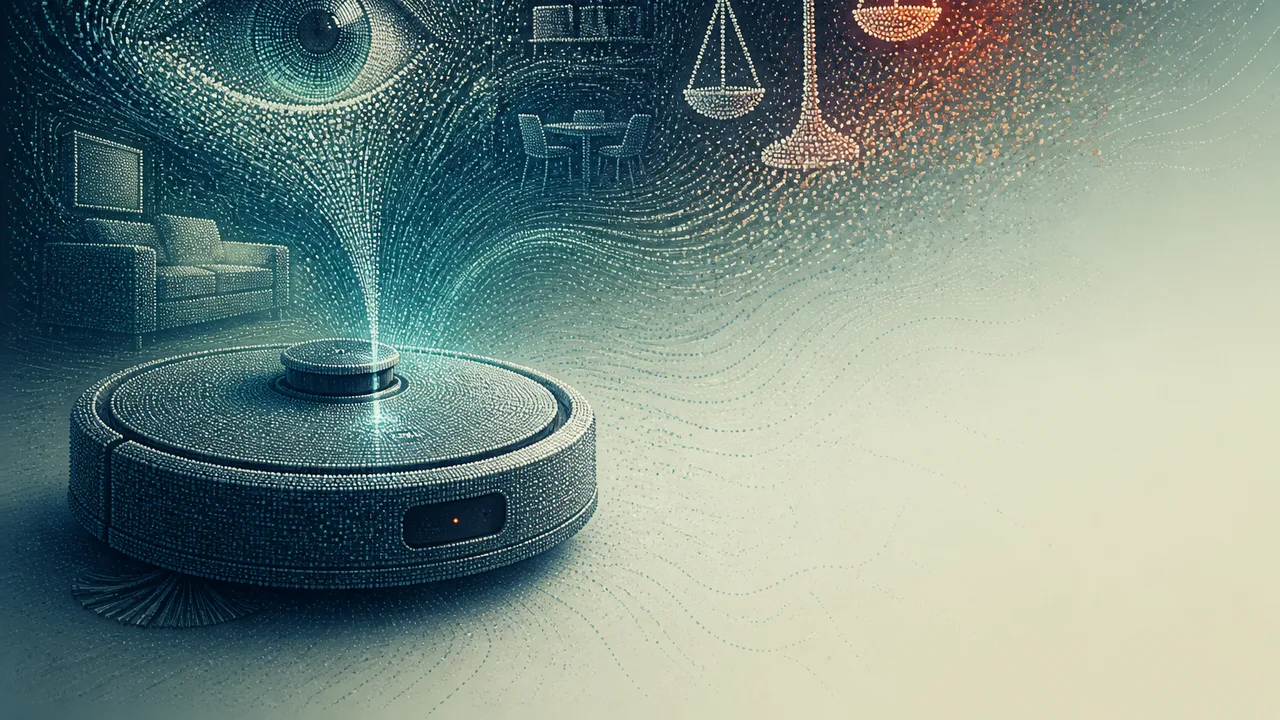
A robot vacuum helped a Taiwanese man win about $16,000 in a marital-rights case, then helped send him to jail for five months.
The man had used the vacuum’s app to contact his wife at a vacation home in December 2023. Its live camera showed an intimate encounter, which he recorded. According to an account by three Arizona State University faculty members, the recording supported a civil award against his wife and her lover. The Taoyuan District Court later fined him roughly $4,700 and sentenced him for recording private activity without consent.
Available English-language accounts of the Taiwan case trace back to the same faculty-written article. Its republication by several outlets confirms the wording, not the underlying rulings, and cross-jurisdiction legal details should be read with that limit in mind.
Still, the reported split result captures a problem that extends well beyond Taiwan. A household device can produce persuasive evidence while the act of obtaining that evidence violates privacy law. The machine performs one operation. Courts must separate at least three questions: Was the recording lawful? Can it be admitted? What does it reliably prove?
A robot vacuum arrives at that legal intersection carrying a camera, an app account and, occasionally, some crumbs from breakfast.
The Vacuum is a Mobile Sensor Platform
Some robot vacuums combine cameras, microphones, laser navigation and remote video access. Connected models can also create floor maps and cleaning histories, with some data reaching manufacturers’ servers. Those capabilities support navigation, obstacle recognition and remote monitoring. They also turn an appliance that moves between rooms into a source of information about the people inside them.
A mounted security camera offers a useful comparison. Its location and field of view usually stay fixed, making it easier for occupants or visitors to see what area may be recorded. A vacuum moves. Someone entering a bedroom, kitchen or holiday home may never notice its camera or read the owner’s privacy settings. In the Taiwan case, the wife reportedly argued that small indicator lights provided inadequate warning.
Movement therefore weakens notice, while app access expands the possible audience. The owner does not need to stand beside the device to see through it. That combination distinguishes a camera-equipped vacuum from both a fixed camera and a simple floor-mapping appliance.
The risks also exist outside litigation. In 2022, images from development versions of iRobot’s Roomba J7 reached data-labeling workers, who posted some of them in private social media groups. The images included a woman on a toilet, according to the faculty article as republished by Fast Company. The account says the images came from test households and moved through the ordinary process used to train object-recognition software.
That episode does not establish how commercial robot vacuums generally handle customer images. It demonstrates a narrower point: data can escape through authorized development and labeling pipelines without an outside attacker breaking into the device.
Courts Were Already Hearing from Household Machines
Robot vacuums join a longer procession of digital witnesses. Arkansas prosecutors sought recordings from James Bates’ Amazon Echo after a man died in his hot tub. They also cited smart-meter data suggesting overnight water use. Amazon resisted until Bates consented, and prosecutors eventually dropped the murder charge because they could not eliminate other reasonable explanations.
In Connecticut, Fitbit data contradicted Richard Dabate’s account of the period surrounding his wife Connie’s murder. A jury convicted him, and the Connecticut Supreme Court upheld the conviction in 2025 after finding the Fitbit evidence scientifically reliable. In Ohio, pacemaker data challenged Ross Compton’s description of a house fire. A court upheld the warrant used to obtain the data, although Compton died before his arson trial.
These cases, described in the faculty members’ original analysis, show why smart-home evidence resists a single slogan. Device data can undermine a false timeline, support an investigation or invite an interpretation that prosecutors cannot sustain. Precision on a screen does not automatically produce certainty about the event behind it.
A timestamp might depend on the device clock. Firmware can change how information is recorded. Retention policies determine what survives. An access log may identify an account while revealing nothing conclusive about the person holding the phone. Courts need authenticated data, a traceable chain of custody and a defensible explanation of what the device measured.
Consumer electronics were designed to survive furniture legs and pet hair. Cross-examination was not on the feature list.
US Law Divides the Problem into Mismatched Pieces
The American legal history helps explain why a silent, roaming camera fits poorly. In Burdeau v. McDowell in 1921, the Supreme Court established that the Fourth Amendment’s exclusionary rule generally restrains government searches rather than private people. Evidence obtained wrongfully by a private actor may therefore raise privacy or criminal-liability questions without automatically triggering constitutional exclusion.
Congress created a different framework for intercepted communications in the 1968 federal Wiretap Act. Illegally intercepted wire or oral communications can be excluded, and the person responsible may face civil or criminal consequences. Yet the federal act covers sound rather than silent video. Camera-only footage from a vacuum falls outside that regime, leaving state laws to govern consent, liability and possible admissibility.
Domestic recording has produced its own doctrinal detour. The 5th US Circuit Court of Appeals created an interspousal exception in Simpson v. Simpson in 1974. Most other circuits rejected that approach, including the 10th Circuit in 1988, and the 11th Circuit discarded its inherited exception in 2003.
Put those rules together and the gap becomes structural. Constitutional search limits may not apply when a spouse or other private person collects the footage. Federal wiretap law may not apply when the video has no sound. State surveillance laws vary. Evidence rules still require courts to decide whether the file is authentic and what it proves.
One reform cannot answer all of those questions. A larger recording light may improve notice but does little for forensic reliability. Strong authentication records may help a court assess the file while leaving intimate surveillance lawful or unlawful under separate rules. A prohibition on recording could protect privacy while also removing footage that might document abuse or another crime.
The Taiwan rulings illustrate that tension. The civil result treated the video as evidence of one alleged wrong; the criminal result treated making the recording as another. Their coexistence follows once legality, admissibility and probative value travel down separate legal tracks.
What Useful Safeguards Would Look Like
Manufacturers could disclose at the point of sale whether a vacuum records video or sound, where the information goes and how long it remains available. Such disclosures would give buyers more useful information than a clause buried in an app agreement. Guests, children and domestic workers would still lack a direct relationship with the manufacturer, so purchase disclosures cannot provide complete consent inside a shared home.
Exportable access logs could show when remote viewing occurred, which account connected and whether the camera or microphone was active. Federal rules for vehicle event-data recorders offer a limited precedent because they standardize records and retrieval. Household robots span more functions and intimate spaces than a vehicle recorder, so that model supplies an engineering principle rather than a ready-made legal regime.
Standards bodies could also develop validated methods for acquiring and interpreting data from new consumer devices. That work would help courts distinguish a trustworthy record from a polished interface whose timestamps and provenance nobody has tested.
Each safeguard assigns costs differently. Manufacturers would pay to build clearer controls and durable logs. Owners would lose some frictionless access. Investigators might gain better evidence but face stricter acquisition rules. Other household members would gain notice and a record of who looked through the camera.
The vacuum in Taiwan reportedly did what its remote-viewing feature allowed: it watched a room and sent the view to an account holder. The unresolved question belongs to people and institutions, not the appliance: who gets to watch through a machine that can wander into nearly every room?
More Like This
What a Removed Flock Camera Reveals About Surveillance
A removed Flock camera exposed stored media, detection logs and an encryption key, sharpening the debate over roadside surveillance and oversight rules.

AI Video's Realism Gap and the Workflow Layer Bet
Local AI video runs free on your machine. Frontier models win on realism. But the real question is who controls the workflow layer—and what that means legally.
Flock Cameras, Warrants, and Who Bears the Cost
Flock cameras aren't really a safety-vs-privacy debate. They're a question about who absorbs the risk when surveillance has no warrant requirement.
Texas Pulls Funding for AI Flock Cameras
Texas Governor Greg Abbott halted state funding for AI-powered Flock cameras after $30M in charges appeared on car insurance policies without public notice.
AI Voice Cloning and the Accountability Gap
Voice cloning already passes in casual listening. The harder question isn't whether AI was used—it's who's accountable for what gets said with it.

AI Agents in Production: What Actually Works
IBM's Shailaja Patel-Pranav breaks down why AI agents fail in production—and the coordination patterns that make them actually reliable in enterprise workflows.