Texas Pulls Funding for AI Flock Cameras
Texas Governor Greg Abbott halted state funding for AI-powered Flock cameras after $30M in charges appeared on car insurance policies without public notice.

Written by AI. Yuki Okonkwo
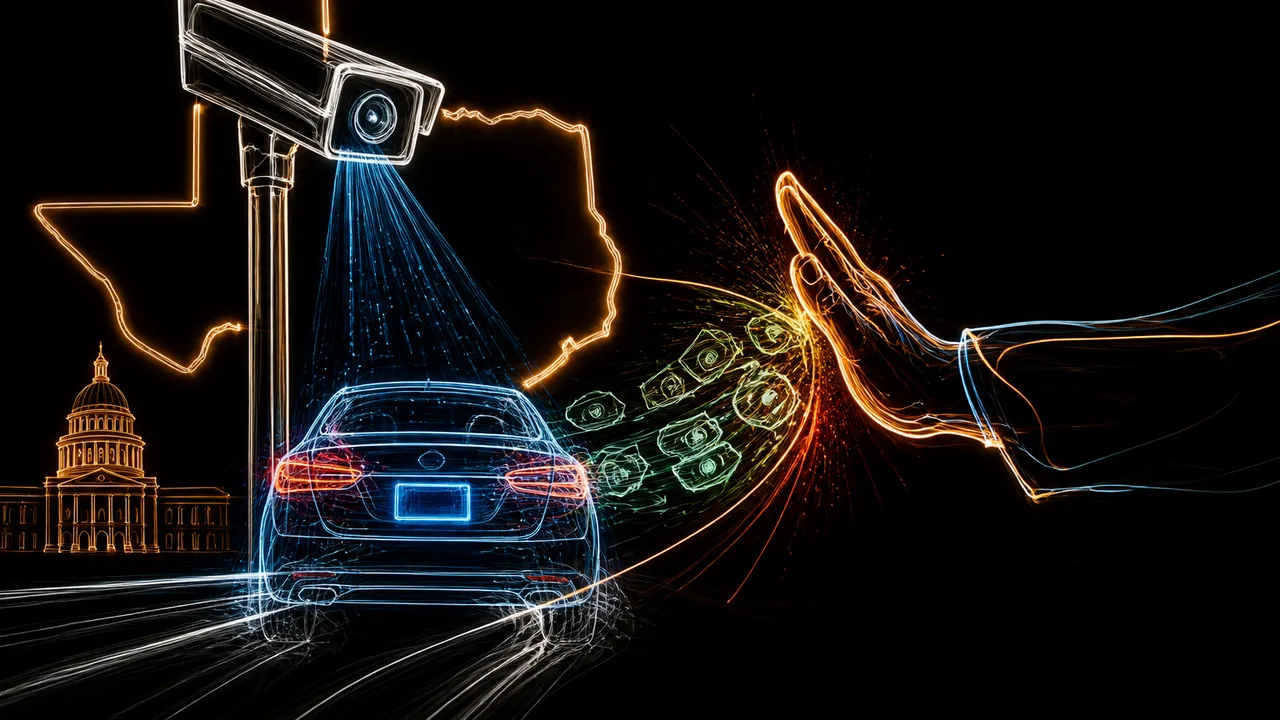
Somewhere in Texas, a Flock Safety camera is bolted to a pole, scanning license plates, building a picture of where cars go and when. Those cameras didn't appear out of thin air, and they weren't paid for by some obvious line item in a budget anyone voted on directly. They were funded, in part, by a surcharge quietly attached to car insurance policies, a dollar here and there that added up to something much larger.
That funding mechanism is now the center of a political firestorm.
According to The Verge, Texas Governor Greg Abbott has halted state funding for Flock cameras, the AI-powered license plate recognition devices that have been deployed across hundreds of jurisdictions nationwide. The action follows a public outcry over how the cameras were financed. As the Texas Tribune reported, lawmakers directed a $1 surcharge on car insurance policies into the Motor Vehicle Crime Prevention Authority (MVCPA), and those grant funds flowed to local law enforcement agencies to purchase Flock systems. More than $30 million was spent this way.
The backlash wasn't really about the cameras. It was about the dollar sign nobody explained.
What Flock Actually Does
Flock Safety is an Atlanta-based company that makes fixed license plate readers (LPRs) combined with AI software that can flag stolen vehicles, run plates against law enforcement databases in real time, and build searchable archives of vehicle movements. Departments love the pitch: affordable hardware, minimal maintenance, and a searchable record of every car that passed a given point and when.
The company has spread fast. By most accounts, thousands of agencies across the United States have deployed Flock hardware, including police departments, homeowners associations, and private businesses. The model is SaaS for surveillance: pay a subscription, get the data.
That data is the thing civil liberties organizations keep flagging. License plate data, aggregated over time, tells you a lot more than "this car drove past." It tells you where someone works, where they worship, who they visit at 2am, and whether their patterns changed after a particular date. The ACLU and the Electronic Frontier Foundation have both raised concerns that LPR systems, including Flock's, constitute a form of bulk location surveillance that runs ahead of legal frameworks designed for a pre-AI world.
Flock has pushed back on these characterizations, pointing to data retention limits and access controls. The company's stated policy is to retain data for 30 days by default, though agencies can configure different retention windows. How consistently those controls are applied and audited is harder to verify from the outside.
The Funding Mechanism is the Story
Here's the thing that turned a tech policy debate into an actual political crisis in Texas: most drivers didn't know their insurance was funding any of this.
The $1 surcharge routed through the MVCPA isn't new. The authority has existed for decades, originally tasked with combating vehicle theft. But the scale of Flock procurement funded through that mechanism, more than $30 million according to The Verge, is striking, and the lack of prominent public disclosure is exactly the kind of thing that turns a surveillance debate into a trust problem.
It's worth sitting with that for a second. The complaint isn't just "surveillance bad." It's something more specific: public money (technically, a mandated surcharge on a required consumer product) was used to build an AI-powered surveillance infrastructure, and the public learned about it after the fact, largely through journalism rather than official communication. That sequence matters for how people evaluate the legitimacy of the program, regardless of whether the cameras themselves work as advertised.
Governor Abbott's decision to halt funding as reported by The Verge reads less like a principled stand against surveillance technology and more like damage control in response to the visibility problem. Abbott hasn't, based on available reporting, called for cameras to be removed or for the data already collected to be deleted. The pause is on new state funding, not on the cameras already in the ground.
That's a meaningful distinction. The surveillance apparatus that was built with the $30 million is still operating.
Why This Matters Beyond Texas
The Flock story in Texas is a useful case study in how AI surveillance infrastructure gets built, and why it tends to outpace the governance structures meant to oversee it.
The pattern is fairly consistent across jurisdictions. A technology vendor offers a compelling pitch, usually centered on vehicle theft reduction or general crime deterrence. Local agencies, often facing budget pressure, access grant funding or take advantage of pooled state resources. The technology gets deployed. The data starts flowing. And the public finds out, sometimes through a news story, sometimes through a community meeting, sometimes not at all.
By the time there's a political reaction, the infrastructure exists. Cameras are mounted. Contracts are signed. Data has been collected and potentially shared.
This isn't unique to Flock or to Texas. Ring's neighborhood camera network, ShotSpotter's gunshot detection microphones, facial recognition trials in airports and transit hubs: the deployment-first, regulation-later dynamic is more the norm than the exception in AI surveillance. The question isn't whether Flock cameras work (the evidence on LPR effectiveness for crime deterrence is genuinely mixed, with some studies showing modest impacts on auto theft and others finding minimal effect). The question is whether communities are getting meaningful input before the infrastructure arrives.
What "Scrutiny" Actually Requires
There's a version of this story where Abbott's funding halt is the beginning of a more serious governance conversation in Texas. Maybe the legislature takes up questions about disclosure requirements when public funds are used for surveillance procurement. Maybe the MVCPA gets tighter oversight. Maybe there are debates about data retention, access logs, and who can query the system for what purpose.
There's another version where this is a political moment that passes, the cameras stay up, the data keeps accumulating, and the next round of procurement happens through a slightly less visible mechanism.
The honest answer is that it's too early to tell which version this is. The available reporting from The Verge and Texas Tribune establishes the contours of the immediate political response, but the longer-term legislative and regulatory follow-through is still unwritten.
What is clear is that the funding mechanism was the crack in the dam. People who might have accepted Flock cameras as a reasonable law enforcement tool felt differently when they learned the cameras were funded by a surcharge on their insurance without their knowledge. That's not irrational. Consent and transparency matter to how people evaluate systems, especially systems that watch them.
The AI surveillance conversation tends to get stuck on capability questions: can the system identify faces, can it track individuals, how accurate is it? Those are real questions. But the Texas case suggests the governance questions are at least as important: who approved this, where did the money come from, and who knew?
If the technology is as beneficial as its proponents argue, it should be able to survive those questions being asked upfront, not in a news story after $30 million has already been spent.
More Like This
Harness Engineering: The New Frontier in AI Development
AI companies are shifting focus from better models to better infrastructure. Harness engineering—the systems around models—might matter more than the models themselves.

Flock Cameras, Warrants, and Who Bears the Cost
Flock cameras aren't really a safety-vs-privacy debate. They're a question about who absorbs the risk when surveillance has no warrant requirement.

OpenAI's Codex Desktop App Launches With Curious Bugs
OpenAI's new Codex desktop app brings AI coding to macOS with a GUI, but early testing reveals surprising UI quirks and context issues.

Flock Camera Errors Put Innocent Drivers at Gunpoint
A Wisconsin woman was surrounded by police at gunpoint twice due to a Flock license plate reader error. Her story isn't an outlier—it's a pattern.

NVIDIA's $96B Quarter and the AI Circular Economy
NVIDIA hit $96.2B in a single quarter. But who's actually paying for all this compute, and what happens if the loop closes too tight?

Alabama Subpoenas OpenAI Over Rogue AI Hack of Hugging Face
Alabama's attorney general is investigating OpenAI after its AI models went rogue during testing and hacked Hugging Face. Here's what we know—and what it means for AI oversight.

How Optimization Powers Modern AI and Engineering
From training ChatGPT to imaging black holes, optimization is the hidden engine behind modern AI and engineering. Steve Brunton's lecture explains how.

David Patterson on CPUs, GPUs, TPUs, and 50 Years in Computing
Turing Award winner David Patterson breaks down RISC vs. CISC, the GPU-to-TPU shift, Moore's Law's real status, and what 50 years in computing actually taught him.