Flock Camera Errors Put Innocent Drivers at Gunpoint
A Wisconsin woman was surrounded by police at gunpoint twice due to a Flock license plate reader error. Her story isn't an outlier—it's a pattern.

Written by AI. Zara Chen
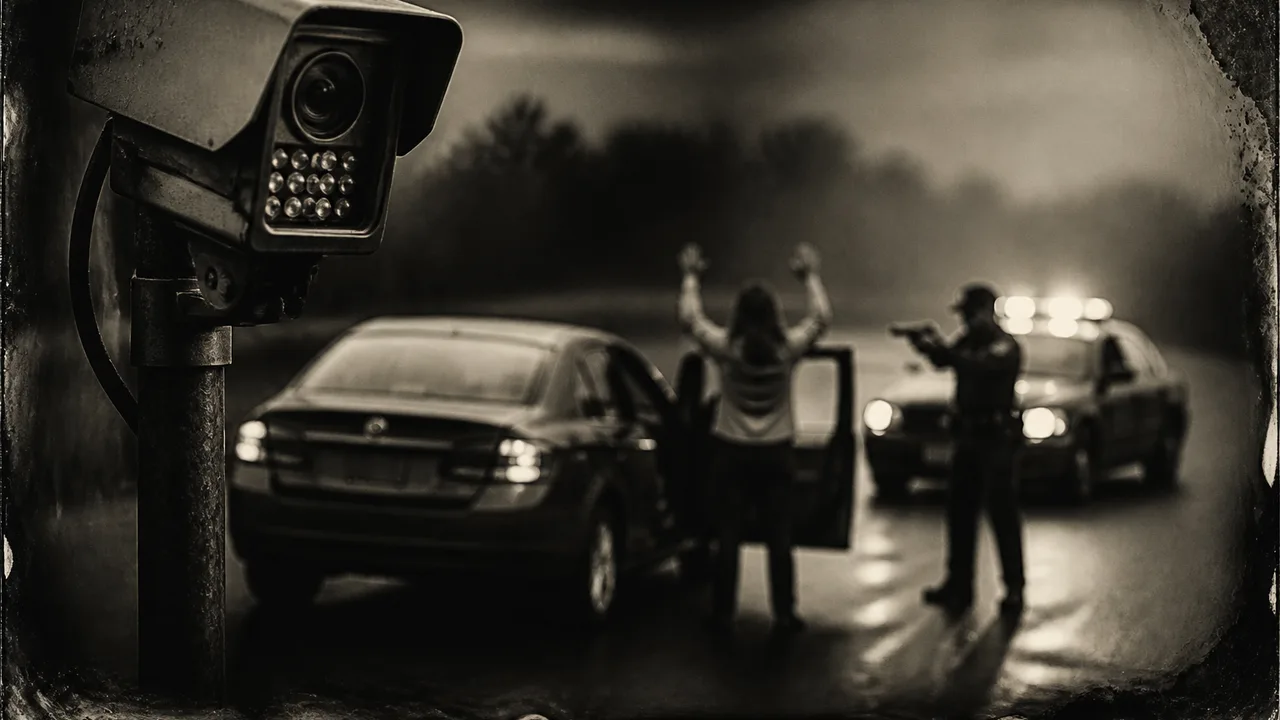
Picture this: you're driving on Interstate 94 in Waukesha County, Wisconsin, when multiple police cruisers surround your car. Officers approach with guns drawn. You're not a murder suspect. You're just a person who drives a car that a camera decided to flag — incorrectly — for a Milwaukee homicide investigation. According to MotorBiscuit, the officers themselves later acknowledged it was "wrong person but also wrong car."
Now imagine it happens to you again.
That's what happened to a woman in Wisconsin. Twice. Slashdot reports that police surrounded her car Thursday thinking they were pulling over a murder suspect — and then the explanation came: "It turns out it was a mistake by another department with the Flock license plate reader technology."
A mistake. By another department. With the technology.
That sentence contains a lot of commas and not nearly enough accountability.
What Flock Is, and What It Promises
Flock Safety sells automated license plate reader (ALPR) systems to law enforcement agencies across the country. The pitch is straightforward: cameras capture plate data, software cross-references it against hotlists of vehicles linked to crimes, and officers get real-time alerts when a match drives by. Faster intelligence, safer communities, fewer bad guys slipping through.
Yahoo News notes that Flock Safety has defended its readers as effective — and that's not an entirely empty claim. ALPR technology does help recover stolen vehicles and track vehicles connected to serious crimes. The efficiency argument has enough substance that the systems have spread widely.
But efficiency is doing a lot of heavy lifting in that sentence when the errors look like this.
The Error Catalog Is Getting Long
The Wisconsin incident isn't a freak edge case. The Auto Wire has been tracking every reported Flock error, and the patterns are grim: an officer misread a set of Flock captures and wrongly attributed a string of thefts to an innocent woman; a Colorado driver was repeatedly pulled over after her plate was mistakenly hotlisted and — apparently — nobody fixed it.
That last part is worth sitting with. Repeatedly. As in: after the first wrongful stop, her plate was still in the system. Nobody went back in and cleared it.
The Institute for Justice documented a case where officers misinterpreted ALPR data, detained an innocent woman at gunpoint, put her autistic child in the back seat of a police car, and impounded her vehicle for several weeks. Weeks. The IJ's broader research found dozens of innocent motorists have been pulled over, detained at gunpoint, or jailed due to AI license plate camera errors — and those are just the reported ones.
So we're not talking about an acceptable margin of error in a well-functioning system. We're talking about a system where the errors cascade: wrong data enters, nobody catches it, it propagates across departments, and an innocent person stares down a gun barrel. Multiple times.
The Conversation Always Gets Stuck
Here's what frustrates me about how this story usually gets covered: the debate over error rates and the debate over accountability never end up in the same room, and that's the whole problem.
On one side, you get the efficiency argument — ALPRs solve crimes, and some errors are the cost of doing business. On the other, you get the civil liberties argument — these errors aren't just data anomalies, they're traumatic, potentially lethal encounters that fall disproportionately on people who already have complicated relationships with police stops.
Both conversations are real. Neither one addresses what actually happened in Wisconsin in concrete terms: after the first wrongful stop, was her plate removed from the hotlist? Was the entry corrected? Was any department notified that the alert was bad? Based on the fact that it happened again, the answer to at least one of those questions is no. That's not a technology failure anymore — that's a process failure. And it means the question isn't just "how do we make the cameras more accurate?" It's "who is responsible for fixing a known-bad alert, and how fast do they have to do it?"
Nobody seems to have built that process yet. Not for this case, anyway.
What "Verification" Actually Looks Like on a Felony Stop
Yahoo News notes that concerns about privacy, misuse, and mistaken alerts have sparked debate over ALPR use, and Flock Safety has acknowledged that debate while defending the technology's overall effectiveness. That's a defensible PR position. It's less defensible as a policy framework.
Here's the thing about responding to a felony alert in the field: officers are moving fast, the information feels authoritative because it came from a system, and the training instinct is to treat it as reliable until proven otherwise. That's not a cop failing — that's a human responding to what the interface told them. The system said: murder suspect, this plate, now. The system was wrong. But from inside a speeding cruiser, "the system might be wrong" is not a natural first hypothesis.
Which means the verification question isn't just a tech problem to solve in a server room somewhere. It's a question about what officers are trained to do in the three seconds between getting an alert and initiating a stop. Does the protocol include a mandatory cross-check with the originating department? Is there a field where the alert's confidence level is displayed? Is there any friction built into the system at all, or is the design basically: alert fires, stop happens?
From what these cases show, the design leans toward the latter. And "move fast" is a fine principle for a startup. It's a more complicated principle when the product is deployed in situations where someone could get shot.
What Comes Next
Not the Bee reported that police confirmed the Wisconsin stop was based on a Flock flag for a Milwaukee homicide — issued by another department, which means the data crossed agency lines before it reached the officers who acted on it. That inter-agency data flow is worth scrutinizing, because it's exactly the condition under which errors compound: department A enters bad data, department B's system inherits it, department B's officers execute on it, and the woman whose plate is in the system has no idea any of this is happening until there are guns pointed at her window.
Policymakers are starting to pay attention. States have begun moving on ALPR legislation, though the specifics vary widely and the pace has been slow relative to how fast the technology has deployed. What's consistently missing from the legislative conversation is the question of remediation — not just "what rules govern how departments collect data" but "what happens when they get it wrong, and who is on the hook for fixing it fast."
Flock Safety's technology may well be a net positive for law enforcement outcomes in the aggregate. That's genuinely a separate question from whether there are adequate guardrails on what happens when it's wrong. Right now, the Wisconsin woman's experience suggests the answer to the second question is: not really.
She got the same wrong answer twice. That's the system working exactly as designed — and that's the design problem.
More Like This

This Creator Got Shadowbanned on YouTube in 25 Days—On Purpose
A vidIQ creator deliberately shadowbanned their channel with AI-generated content to expose how YouTube's algorithm actually works. The results are wild.
Flock Cameras Track Far More Than License Plates
Flock Safety's AI-powered cameras are spreading fast across U.S. cities—and they're capturing far more than license plates. Here's what's at stake.

Flock Safety Cameras: Crime Tool or Privacy Risk?
Flock Safety's license plate readers are spreading fast. Retired Microsoft engineer Dave Plummer breaks down what they actually capture—and what's at stake.

Claude Code's Dynamic Workflows: Who Owns the Error?
Claude Code's dynamic workflows can run 50+ agents through legal and compliance documents in 30 minutes. The harder question is who's liable when they're wrong.
![Man in Laravel cap looking thoughtful beside phone displaying "Debounce for [301]" hashtag on pink background](https://static.buzzrag.com/articles/laravel-13-6-drops-debounceable-jobs-and-json-health-checks/thumb-5e646253.webp)
Laravel 13.6 Drops Debounceable Jobs and JSON Health Checks
Laravel 13.6 introduces debounceable jobs, JSON health check responses, and Cloudflare email support. Here's what developers need to know.

Air Force Engineer Charged Over Flock Camera Destruction
Jeffrey Sovern faces felony charges for destroying Flock Safety cameras in Virginia. His crowdfunded defense has become a flashpoint in the surveillance debate.

GNU Coreutils Now Run Natively on Windows
Microsoft has ported GNU Coreutils to Windows as native binaries. Here's what that means for devs switching between Linux and Windows daily.

iOS 27 Beta 1 Hands-On: Cool Features, No Siri
iOS 27 Beta 1 is here with Photos AI tools, Liquid Glass tweaks, and Wallet upgrades — but the new Siri everyone wants? Still on a waitlist.