When No One Reads the Code: AI, Trust, and Accountability
Brian Casel argues developers should stop reading AI-generated code. The workflow is compelling—but what happens when it runs into regulated industries and liability?

Written by AI. Samira Barnes
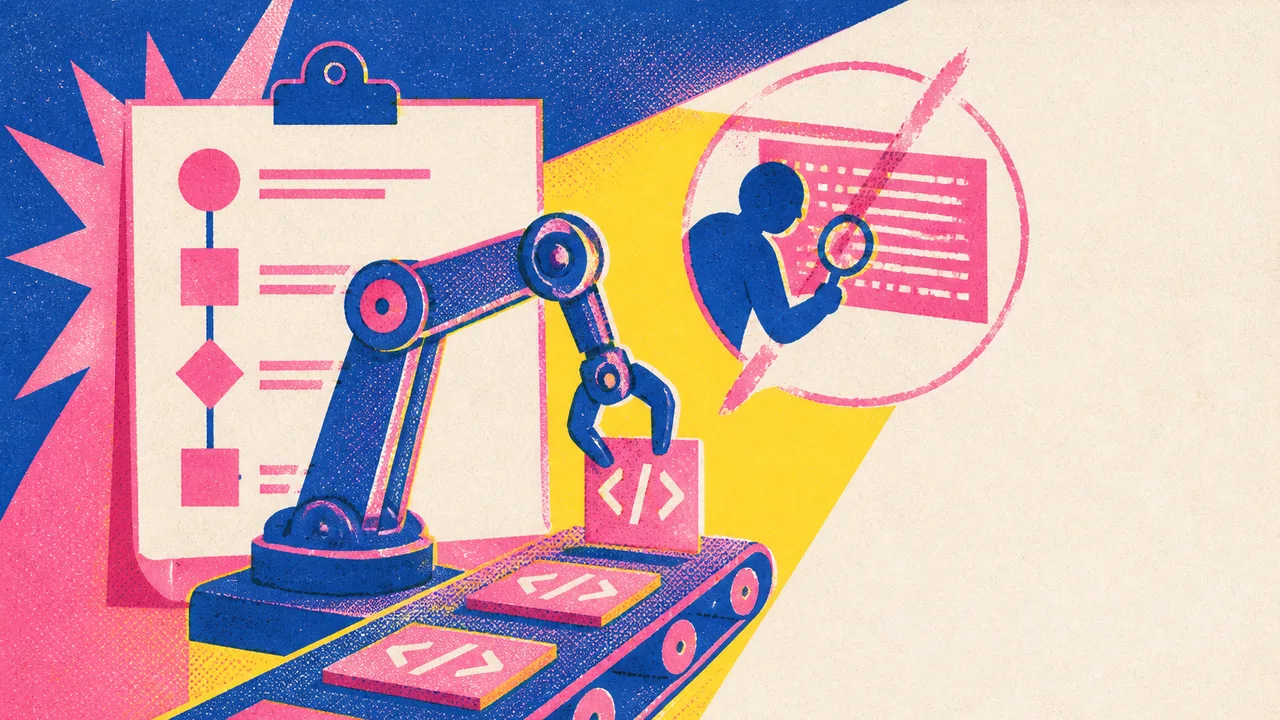
Photo: AI. Jorah Maktoum
Somewhere right now, a developer is shipping code they have not read. Not because they are negligent, but because that is increasingly the professional standard being advocated in AI-first development circles. The person who wrote the code — or rather, the model that wrote it — passed its own automated tests, took its own screenshots, verified its own outputs. The human in the loop approved the spec. They did not read the implementation.
That is the framework Brian Casel lays out in a recent video that has been circulating among builders. As a workflow optimization argument, it is coherent and, in its context, genuinely interesting. As a governance question — who is accountable when unreviewed code fails in production — it opens territory that Casel does not visit, and that the organizations adopting this approach absolutely will.
The Argument, Stated Fairly
Casel's core claim is that the code-review bottleneck in AI-assisted development is not a necessary cost. It is a symptom of applying human-supervision habits to a fundamentally different kind of collaborator. "Reviewing every line of AI-written code is micromanaging," he says in the video. The analogy he reaches for is a capable engineer being shadowed so closely they never exercise judgment. The manager pays twice: once in the engineer's salary, once in their own time, and never receives the full value of either.
His proposed alternative redistributes effort rather than eliminating it. Developers own what he calls "the what and the proof" — the product requirements document, the architectural decisions, the milestone scope, the verification loops — and delegate "the how" entirely to the coding agent. The PRD he shows in the video is genuinely detailed: data models, relationship logic, explicit scope definitions for each milestone. The AI implementation plan follows from that document; the code follows from the plan. Automated test suites must pass at 100% before any milestone is declared complete. A browser agent from Vercel's tooling then navigates the front-end, clicks through user flows, and takes screenshots that the model itself analyzes for visual compliance with the spec.
The resulting workflow does not look like vibe coding — the dismissive shorthand for prompting without structure. It looks like structured delegation, with the rigor relocated upstream and downstream rather than abandoned.
Casel is also honest about his own learning curve, which earns him some credibility. According to his own account in the video — corroborated by the public release history of the project on GitHub — he built Agent OS in 2025 around a system of "standards files" that prescribed exactly how agents should write code. By 2026, he had stopped using it in his own work. The scaffolding that earlier models needed had become counterproductive with newer frontier models; prescriptiveness, he found, degraded output quality rather than improving it. That is a meaningful data point, and not an easy one to publish when you built the tool being deprecated.
What the Framework Assumes
Here is where my policy lens diverges from the developer's workflow lens, and where I think the more consequential questions live.
Casel's framework operates cleanly in a specific context: an indie builder or small team shipping product features for their own applications, iterating quickly, and bearing direct accountability for what they ship. In that context, "I wrote a detailed spec and the automated tests passed" is a reasonable basis for trust.
The framework does not map cleanly onto regulated industries, and a significant and growing share of software development happens there. The EU AI Act, which entered its phased enforcement period in 2024 and 2025, establishes explicit human oversight requirements for high-risk AI system outputs — including, in many readings, AI-generated code used in critical infrastructure, healthcare, and financial services. Emerging US federal guidance on AI in government contracting similarly emphasizes auditability of AI-generated work products. Neither regulatory regime treats "the model tested itself" as a satisfactory substitute for human review of consequential outputs.
The question this raises is not whether Casel's workflow works for Casel. It plainly does. The question is what happens when organizations in fintech, healthcare, or government contracting read his framework — as many will — and conclude that its logic applies to their context, when it legally and operationally does not. When an AI code review process sits inside a regulated pipeline, "human judgment still can't be automated away" is not a philosophical preference; in many jurisdictions, it is a compliance requirement.
There is also a liability question that the framework quietly sidesteps. If a production failure traces back to an implementation decision made by a coding agent — a decision that no human reviewed because the PRD-to-code pipeline was trusted — who is legally responsible? The developer who wrote the spec? The organization that deployed the application? The model provider? These questions are not yet fully settled in case law or regulation, but they are being actively litigated and legislated. A developer shipping personal projects can afford a pragmatic answer. An engineering organization at a bank cannot.
The Rate-of-Change Problem
The honest admission about Agent OS deserves more scrutiny than it gets, not as a criticism of Casel personally but as a structural observation about the framework itself.
A workflow that was state-of-the-art in 2025 was obsolete by 2026, by the account of the person who built it. That is a remarkable rate of change, and for an indie builder who controls their entire stack, it is navigable. You update your approach, deprecate your tools, move on.
For an organization maintaining a codebase over a five-year horizon — the minimum planning window for most enterprise software — that rate of change is a different kind of problem entirely. The trust model that Casel describes is calibrated to current model capabilities. The METR study published in July 2025, measuring the impact of early-2025 AI tools on experienced open-source developers, found that those developers actually took 19% longer on tasks when using AI assistance — while believing they were working faster. The gap between perceived and actual productivity is its own governance problem: organizations may be making staffing and architecture decisions based on speed assumptions that do not match empirical performance.
The point is not that AI coding tools don't work. It is that AI coding agents require a calibrated institutional response, not just a personal workflow adjustment. The planning infrastructure Casel describes — layered PRDs, milestone logs, self-verification loops — is genuinely sound as far as it goes. But "as far as it goes" is doing a lot of work in that sentence.
Where the Accountability Actually Lives
The most interesting thing Casel says is not about verification loops. It is about what he believes the developer's job has become. "Engineers write zero or near zero code," he says, "and pour all of their energy into shaping, planning, designing, and building verification loops." That is a genuine shift in what software engineering looks like — and it has governance implications that extend well beyond any individual team's workflow.
If the developer's primary contribution is the spec and the verification architecture rather than the implementation, then accountability for what ships is concentrated at exactly those points. A flawed PRD becomes a production failure. A verification loop that does not catch a security vulnerability — because no human read the code that contained it — is an organizational exposure, not just a developer error. The security risks embedded in AI-generated code are real and documented; automated test suites are good at catching functional failures and considerably less reliable at catching injection vulnerabilities, authentication flaws, or subtle data handling errors that do not manifest in happy-path testing.
None of this makes Casel wrong about the direction of travel. The question of how much human review AI-generated code requires is genuinely open, and the line-by-line review model is genuinely unsustainable at scale. But "unsustainable at scale" and "replace with automated self-verification" is not the only axis available. The harder institutional question — who is accountable, to whom, and by what auditable trail — does not get answered in a video comment section. It gets answered in production, often at the worst possible moment.
That is the question organizations adopting this framework should be stress-testing before the answer is forced on them.
More Like This
AI Code Review: Faster PRs, But at What Cost?
AI code review promises faster PRs and fewer bugs. IBM's Anna Gutowska breaks down how it works—and why human judgment still can't be automated away.

9-Arm Skills: AI Agents Need Brakes, Not More Gas
A tiny GitHub repo called 9-arm-skills argues AI coding agents need behavioral constraints, not more power. The accountability implications go deeper than the code.
When Your AI Agent Fails 17% of the Time
Anthropic's workshop on agent architecture drift reveals a 17% failure rate with real regulatory implications for enterprises deploying AI in supply chains.

AI Agents Running for Hours—and Who's Accountable
Anthropic's Prabaker and Wilson reveal the engineering behind long-running AI agents—and raise accountability questions regulators haven't caught up to yet.
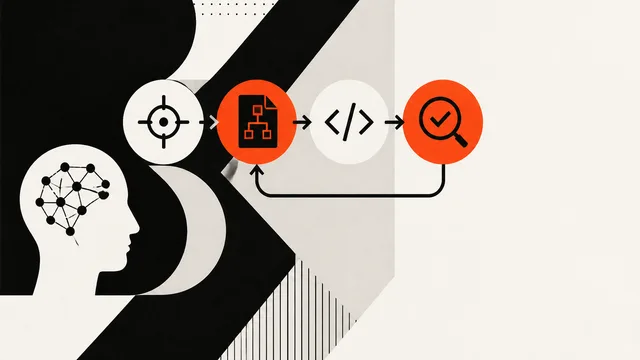
AI Coding's Babysitting Problem Has a Structured Fix
The BMAD Method's QuickDev tool folds planning, coding, and review into one loop—less hand-holding, more discipline. Here's what it actually does.

AI Knowledge Gaps Are a Governance Problem
When AI systems encode stale or incomplete institutional knowledge, who's liable? A workflow technique surfaces a regulatory blind spot nobody's addressing.

AI Voice Cloning and the Accountability Gap
Voice cloning already passes in casual listening. The harder question isn't whether AI was used—it's who's accountable for what gets said with it.

Claude Code Artifacts: What Enterprise Teams Need to Know
Claude Code's new Artifacts feature auto-publishes live web pages from coding sessions. Here's what enterprise compliance teams need to ask before deploying it.