Van Gogh’s Starry Night Gets a New July Sky Hypothesis
A new reconstruction links The Starry Night to a July 1889 sky. Star positions and lunar phase support it; disputed sightlines and a June letter complicate the date.

Written by AI. Priya Sharma
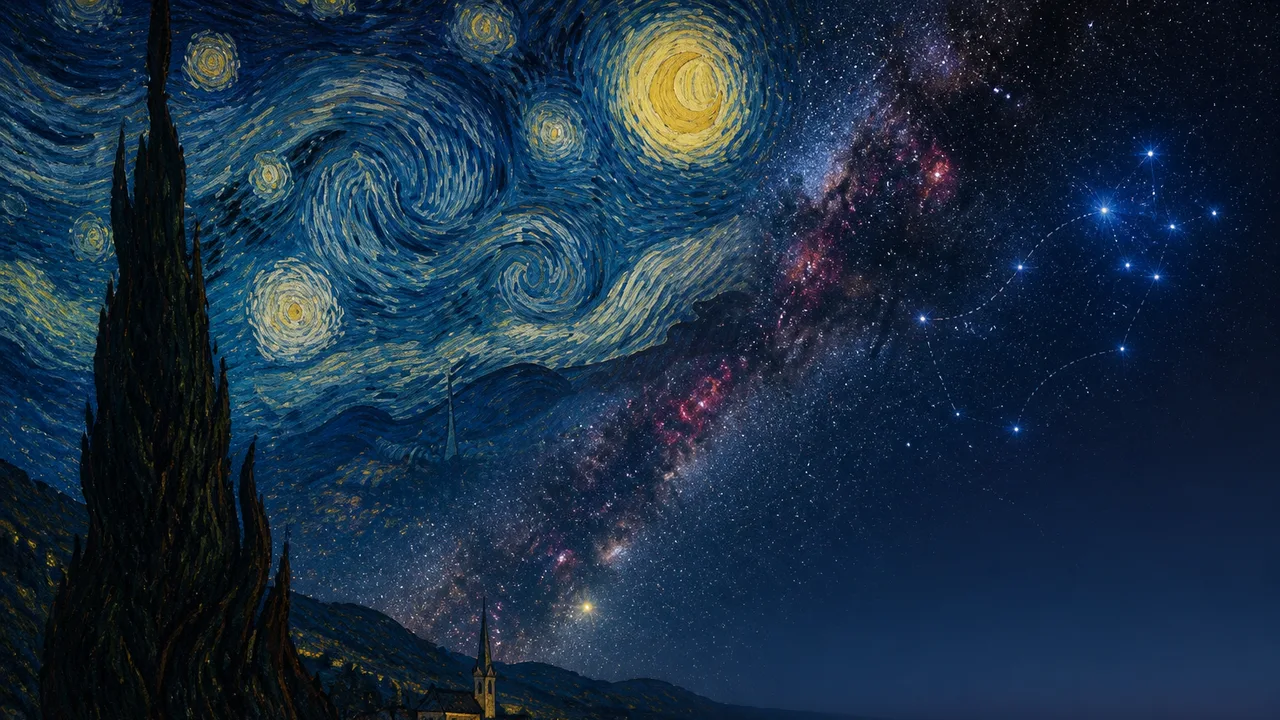
Vincent van Gogh’s The Starry Night may contain a recognizable patch of the predawn sky from July 22, 1889. In a study published October 22 in Scientific Reports, Elijah Jeong-hyun Kim and colleagues propose that five stars near the painting’s center correspond to the Hyades cluster in Taurus. Their reconstruction also places a crescent Moon and Venus near the cluster above Saint-Rémy, France.
The proposal invites a more precise question than whether van Gogh painted a real sky. A sky can supply part of an image without supplying its date of completion. Kim’s team has assembled several astronomical clues that favor a July observation, but the painting’s composition and van Gogh’s surviving correspondence leave room for a different account of when those clues reached the canvas.
How the Proposed Sky Was Reconstructed
The team began with the relative positions of five painted stars. Using a technique called Procrustes shape analysis, the researchers shifted, rotated and uniformly resized a candidate star pattern to measure how closely its points aligned with those on the canvas. The Hyades gave the strongest fit among the alternatives they tested, including Aries, an identification proposed in earlier work. The method compares arrangement rather than treating a painted star’s size or color as a faithful record of its appearance.
Five points alone make a fragile identification. Other star groups also produced close geometric matches, and the choice of which marks count as stars affects what the technique can compare. The researchers therefore asked whether the surrounding sky made sense as well. A thin crescent appears on the canvas; the Moon around mid-June, the period conventionally associated with the painting, was much fuller. Around July 22, a waning crescent, Venus and the Hyades appeared in the predawn sky near one another.
To narrow the possible view, the team made two field trips to France in 2019, photographing features van Gogh had drawn or painted. For The Starry Night, they used a viewing frame derived from an earlier drawing associated with its village landscape and compared it with computer reconstructions of the 1889 sky. On June 23 and July 22–23, the Moon and Venus could both fall inside that frame; around July 22, the Hyades also occupied its center. The researchers found a closer Hyades match in van Gogh’s later pen drawing of the painting, and the cluster’s proposed tilt agreed with their reconstructed horizon.
That combination is the case for July: star positions, lunar phase, Venus and a proposed sightline narrow the candidates more than a familiar V shape could. It is also where the assumptions accumulate. A viewing frame inferred from a drawing has to be appropriate for the painted sky, and the bright objects have to occupy the right places relative to one another, not merely fit inside the frame. If either condition fails, the five-star resemblance carries less weight.
The researchers tried the shape method on another van Gogh night scene, Starry Night over the Rhône, which depicts the Big Dipper. Its match to the known pattern was comparably strong. That gives the method a useful reference case: it can recover a recognizable group of painted stars despite artistic changes to their appearance. It does not identify the Hyades independently. The Rhône painting offers a known pattern against which to test the procedure; The Starry Night asks the procedure to help decide which pattern, if any, van Gogh represented.
Why June Remains in the Picture
The June chronology rests on more than a habit of dating the work by its season. Around June 18, 1889, van Gogh wrote to his brother Theo that he had a new study of a starry sky. Art historians have generally placed The Starry Night in mid-June on the strength of that letter. Van Gogh had entered a hospital at Saint-Rémy about a month earlier, and an ensuing period of illness during which he did not paint has also figured in arguments for an earlier completion date.
Kim’s team proposes that the June letter could refer to work already begun rather than a finished canvas. It also reexamined letters and contemporary weather records to argue that the illness may have started later than usually assumed, leaving July 22 open as an observation date. No medical notes fix its onset. A later start would remove one obstacle to the July proposal, while the letter would still place a starry-sky study in van Gogh’s hands by mid-June. He could have returned to a canvas or incorporated observations made on more than one morning.
Astronomers have encountered this problem before. Albert Boime’s 1984 reading associated the painted stars with Aries and a June sky; Charles Whitney’s 1986 analysis reached a conflicting conclusion. The newer reconstruction changes the terms of that dispute by measuring a painted pattern and testing it alongside lunar phase and a proposed field of view. It cannot turn the June letter into a record of the final brushstroke, or the July sky into one. Those are questions about the artist’s working sequence, for which astronomy supplies constraints rather than a diary.
Don Olson, an astronomer who has studied celestial details in artworks, raises two objections with direct consequences for the reconstruction. The calculated position of Venus relative to the Hyades V does not match the painting. He also argues, as he told Science News, that the narrow field needed to make the Hyades fill so much of the sky conflicts with the wider view required to include the painting’s hills and cliffs. These are challenges to the proposed geometry, rather than objections to the idea that van Gogh observed stars.
Olson further points to Aldebaran, at the lower left of the Hyades V: an observer trying to locate the cluster in the painting might expect that conspicuous star to stand out, yet other painted stars are more prominent. Artistic choices about brightness could explain such a departure, but making room for those choices also reduces the force of a literal sky match. The question then becomes how much alteration the interpretation permits while still treating position as evidence.
A July morning offers Kim’s team an unusually well-specified candidate for part of van Gogh’s sky. To make it an account of the painting’s chronology, the candidate must also survive the Venus and sightline challenges and fit the June letter. The stars can help locate a possible observation; they cannot say when van Gogh put down his brush.
More Like This
Adam Riess on the Hubble Tension and Cosmic Expansion
Nobel laureate Adam Riess explains why two precise measurements of the universe's expansion rate keep disagreeing—and what that could mean for cosmology.
How Volcanoes Work: Formation, Types, and Real Risk
From shield volcanoes to supervolcanoes, here's what geology actually tells us about how volcanoes form, erupt, and how dangerous they really are.