Using Hermes AI Agent as a Remote Lead Developer
ZazenCodes shows how to run Hermes AI agent on a VPS with Telegram and GitHub to automate coding tasks remotely—even from your phone on a subway.

Written by AI. Marcus Chen-Ramirez
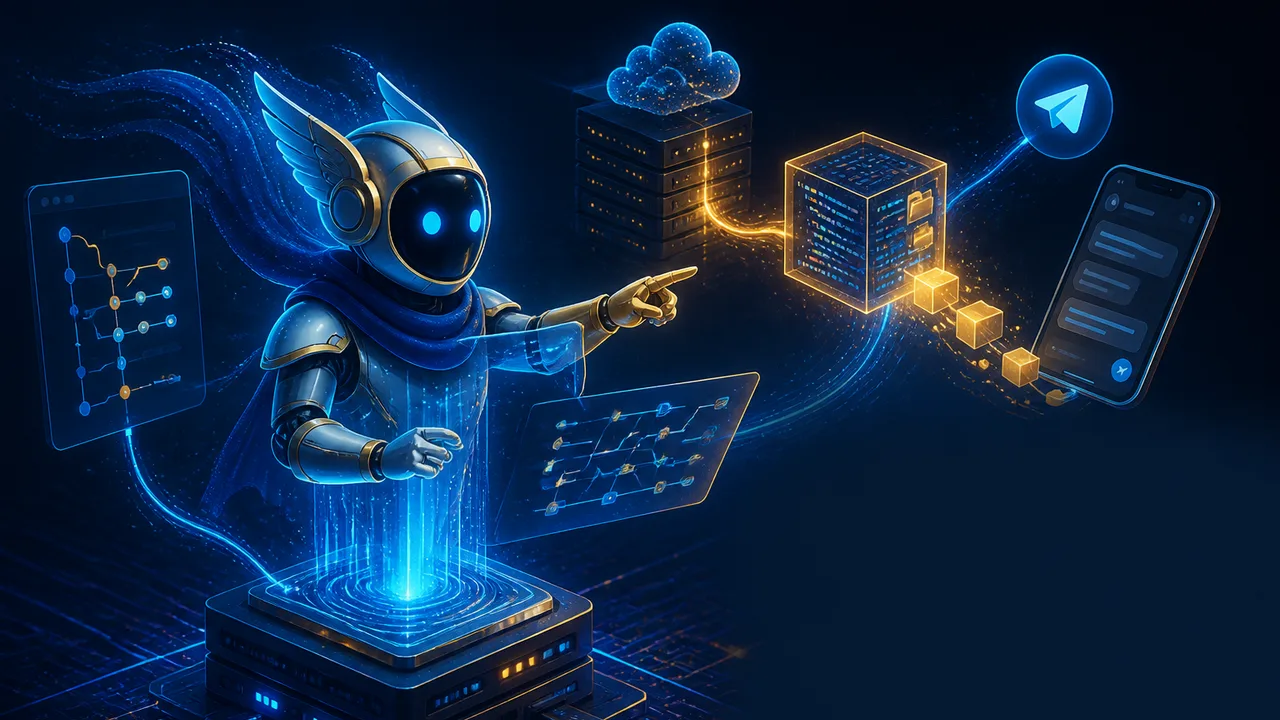
Photo: AI. Dante Nwosu
The subway commute as a coding session. That's the premise ZazenCodes is selling in a recent 25-minute walkthrough, and it's either the future of software development or a very compelling piece of content marketing—possibly both.
The video demonstrates how to set up Hermes, an AI coding agent built by Nous Research, on a virtual private server (VPS), then pipe instructions to it through Telegram from your phone. The result, if everything works as shown, is a persistent AI developer that writes, deploys, and debugs code on your behalf while you're doing something else entirely. The creator frames it simply: "This is how to actually set up Hermes as a software developer so that it can be a software developer when you don't want to code or when you can't code."
That framing deserves a moment's attention before we get into the architecture.
What's Actually Being Built Here
The tech stack ZazenCodes assembles has four moving parts: a VPS (the always-on remote machine), Docker (the container that keeps Hermes isolated and portable), Telegram (the chat interface to your phone), and GitHub Actions (the deployment pipeline that pushes code to a live site). None of these are exotic—developers have been running VPS workloads, containerizing applications, and automating deploys via GitHub Actions for years. What's different is the thing sitting at the center of all of it: an agent that can read a codebase, write features, debug itself, generate images, and push to production, all from a natural language prompt.
Hermes ships with what it calls "skills"—essentially pre-packaged capabilities that the agent can load on demand. GitHub CLI integration comes built in; a front-end design skill loaded automatically when working on a website. The agent also generates and accumulates new skills through usage, which is where the "self-improving loop" the creator mentions starts to become meaningful rather than just a marketing phrase.
The persistent memory piece matters more than it sounds. Many AI coding tools reset their context between sessions, which means they start fresh every time—slow, expensive, and frustrating when you're working on a complex project. Hermes maintains state across sessions, so it remembers where the code lives, what conventions the project follows, and what it's done before. Over time, it should get faster and more accurate on familiar codebases.
The VPS Question
Why not just run this locally? The creator addresses this directly: a local setup means the agent is offline whenever your computer is off. A VPS removes that constraint. You can fire off a Telegram message at 7am on a train, and Hermes will start working before you've reached your stop. The agent continues asynchronously. You review results when you're ready.
The practical tradeoff is cost and configuration overhead. The video uses Hostinger's one-click deploy (a sponsored integration, worth noting), which dramatically simplifies the infrastructure setup—Docker, VPS provisioning, and the Hermes container are handled through a GUI. The creator recommends starting with a 4 GB RAM tier and upgrading if parallel tasks cause slowdowns.
There's also a security consideration that the video handles more carefully than most content in this space does. ZazenCodes sets up a dedicated GitHub account for the agent with scoped repository access, rather than handing it credentials to an existing developer account. Telegram access is locked to a specific user ID. Deployment secrets stay inside GitHub Actions rather than being surfaced to Hermes directly. "It's more secure in my opinion to get GitHub to manage these sort of deployment secrets than to show those things to Hermes," the creator explains. It's the kind of operational caution that distinguishes people who've actually deployed agentic systems from those who've just demo'd them.
The Self-Debug Moment
The most instructive part of the walkthrough, arguably, isn't when everything goes smoothly—it's when it doesn't.
After setting up the Telegram integration, the bot fails silently. Messages from Telegram aren't reaching Hermes. Rather than hunting through logs manually, the creator just tells Hermes the problem: I just connected you to Telegram, but I can't see that working. Can you just make sure your Telegram connection is running properly?
Hermes loads a self-diagnostic skill, identifies what's broken, runs the necessary commands, and restores the connection. The creator's reaction is almost more telling than the demo itself: "I'm really glad I got to show you this. This is real life, right?"
It is real life. And it surfaces something genuinely interesting about the current state of AI agents—the failure modes are real, but so is the recovery. An agent with access to its own runtime environment and the right permissions can often fix itself faster than a developer can diagnose and fix it manually. That's not magic; it's just having root access and a decent model. But the experience of watching it happen is, as the creator admits, "addicting."
The Token Cost Problem
The video earns credibility by acknowledging where the experience breaks down. Hermes is verbose. You can watch it think—every tool call, every search, every command it executes is visible in the chat, which the creator loves for transparency reasons ("this is the thing that's got me addicted"). But all of that visibility comes from token usage, and tokens cost money.
The creator flags this honestly: "It seems to me like Hermes has this kind of issue of using a lot of tokens. We saw how much it was thinking in this video... I want to settle that down a little bit. I want to get Hermes doing the work that I want it to do without all of this extra stuff that's costing me so much tokens and causing me to wait a long time."
This isn't a minor footnote. Token consumption is the primary lever controlling whether agentic coding setups are economically viable at scale. A one-off demo where Hermes builds a blog section and writes a blog post is easy to absorb. A production workflow where the agent is running dozens of tasks a week, exploring codebases, debugging, and regenerating context on every session—that math gets serious quickly. The choice of underlying model matters too: the creator recommends Nous Portal or Codex over Anthropic specifically because cost scales differently.
How This Fits the Broader Picture
Hermes isn't the only player in the agentic coding space, and the video situates it carefully. The creator makes pointed comparisons to OpenClaw (likely a reference to OpenHands, formerly OpenDevin), noting that Hermes provides more visible reasoning in the chat interface while OpenClaw doesn't. "I'm not saying it's better than OpenClaw. It's just different," they say. The Nous Research lineage—built by AI researchers rather than a product-focused company—seems to give the creator confidence in its design intentionality.
What's striking about this particular implementation is how ordinary the components are. VPS, Docker, Telegram, GitHub Actions—these are boring, battle-tested technologies. The novelty is the orchestration layer in the middle that speaks English, reads code, and makes decisions. Developers have been automating deployment pipelines for a decade; this is just a pipeline that can write the code being deployed.
Whether that's a fundamental shift in how software gets built, or a very sophisticated script runner with a good conversational interface, probably depends on what you need it to do—and how much you trust the agent to do it unsupervised.
The creator's commute-coding habit is a real use case, but it also comes with a real question: when Hermes pushes something to your staging branch at 8am and you approve it from Telegram without looking closely, who's reviewing the code?
More Like This
This AI Second Brain Debugs Code While You Sleep
A developer built an autonomous AI system using Claude Code that finds bugs, analyzes churn, and ships fixes to dev—all without human intervention.
Hermes Agent Hit 100K GitHub Stars Faster Than Any Project Ever
Hermes Agent reached 100,000 GitHub stars faster than any project in history. Here's what's driving the growth—and what it means for AI agents.

Kimi K2.6 Is Free on NVIDIA NIM—Read the Fine Print
Kimi K2.6 is now free via NVIDIA's NIM API. But who controls AI model distribution when NVIDIA becomes the default inference layer?
Can Harness Engineering Fix AI Agent Chaos?
Archon promises to turn chaotic AI coding agents into deterministic systems via harness engineering. Here's what that actually means—and what it doesn't solve.

OpenAI's Codex Is Growing Up Fast—And Getting Weird
OpenAI's latest Codex updates add browser control, AI-reviewed approvals, and... animated pets? A look at where AI coding tools are actually heading.
Inside an AI Engineer's Workflow for Building MCP Servers
AI engineer Alex demonstrates his complete workflow for building and deploying MCP servers, revealing how AI tools shape—and complicate—modern development.

AI Loop Engineering: Separating Hype from Practice
Loop engineering is the latest term developers are chasing. A new video argues the fundamentals — prompt, context, harness — still matter more than the label.

Hugging Face ML Intern Automates AI Development
Hugging Face's ml-intern is an open-source agent that automates the full ML research loop. Here's what it does, what it can't, and what it signals.