TradingAgents: AI Bots Run a Simulated Hedge Fund
TradingAgents organizes LLM bots into analyst and trader roles, copying a hedge fund's org chart. Does role-play plus debate produce actual trading skill? Probably not yet.

Written by AI. Zara Chen
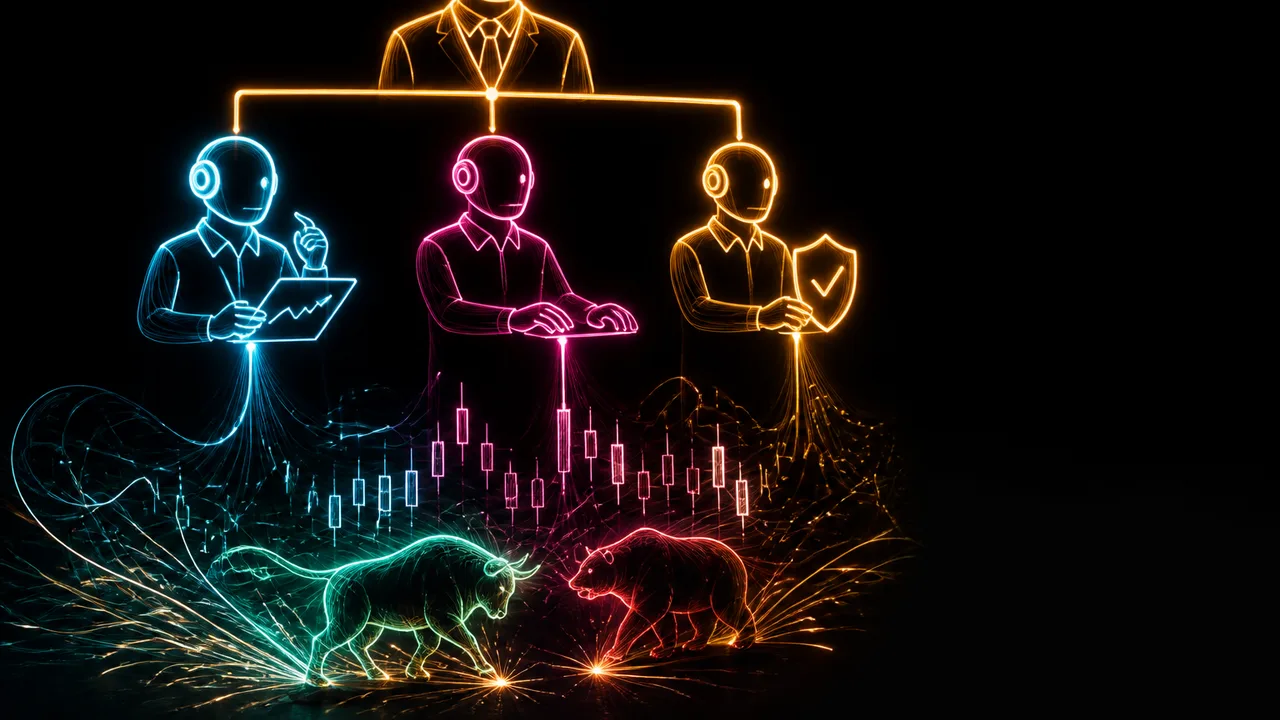
A group of researchers built a fake hedge fund out of chatbots, gave every bot a job title, and open-sourced the whole org chart. That is TradingAgents, a framework from a UCLA and MIT team that splits financial decision-making across multiple language-model agents: fundamental analysts, sentiment analysts, technical analysts, and traders with varied risk profiles. According to the project page, the design is "inspired by trading firms." The paper lives on arXiv, and writeups like Devang Vashistha's Medium walkthrough and DigitalOcean's guide have been circulating it further.
Put plainly, the premise is a group of copies of the same chatbot role-playing as a hedge fund. One acts as the analyst, another as the cautious trader, they argue the case, and a portfolio decision emerges on the other side. The real question is whether that simulated division of labor creates genuine investment skill or just more elaborate reasoning theater. So far, the answer is intriguing engineering, but still-unproven economics.
How the Machine Firm is Organized
Instead of prompting one model for a market take, TradingAgents divides the work. Per the arXiv paper, agents hold specialized roles: fundamental analysts, sentiment analysts, technical analysts, and traders with different risk appetites. The GitHub repo describes a structure meant to make debate, research, and portfolio choices more systematic, with agents arguing before a decision gets made.
The logic here comes from real firms. Human trading desks separate research from execution, and disagreement between smart people with different mandates is a feature, not a bug. The framework copies that division of labor. A bull researcher and a bear researcher hash it out; a trader agent with a risk profile weighs the debate and sizes a position. The Medium piece notes that most prior finance systems used a single model, so the multi-role design is the novelty being tested.
As an orchestration study, this is legitimately interesting. Agentic workflows, where models call tools, pass memos, and critique each other, are where a lot of applied AI is heading, and finance gives you a concrete, high-stakes workflow to structure. The architecture is the contribution. The performance claims are where I start side-eyeing.
What the Agents Are Actually Made Of
Every analyst in this firm is the same underlying model with a different system prompt. The bull researcher and the bear researcher share weights, training data, and biases. When they disagree, you cannot always tell whether that is genuine analytical friction or the same model vibrating between two learned personas.
In a human firm, diverse viewpoints come from diverse brains, different information diets, different career scars. Here, diversity is simulated, and simulated diversity can collapse. If the shared model overrates a hot sector, every agent overrates it; the bear just overrates it more politely. Multi-agent disagreement can improve coverage, per the framework's own design goals, but it can multiply errors just as easily as it surfaces them. Correlated mistakes are the classic killer in finance, and this architecture is essentially a machine for producing correlated mistakes with impeccable formatting.
The flip side, and the strongest version of the argument for this design: forcing agents through explicit debate and role constraints produces an audit trail. You can read the memos, see which considerations got weighed, and debug the pipeline in a way you cannot debug a single opaque prompt. That is a real engineering win, even if it says nothing about alpha.
The Evaluation Problem, or Why Markets Are Ruthless
Backtesting is where ambitious trading systems go to lie to themselves, and markets are uniquely cruel about it. Historical simulations can flatter any strategy through survivorship bias, look-ahead leakage, or plain overfitting. A framework that passed its backtest in December 2024, when the arXiv paper landed, has told you very little about 2026.
There is also a sneakier failure mode here: the agents write convincing reasoning. Plausible prose creates an illusion of competence. A fundamental analyst that produces three tidy paragraphs about a company's margin story looks authoritative even when the underlying forecast is a coin flip. Fluent writing is not a track record, and in markets the only grade that counts is realized, risk-adjusted return after costs.
The honest scoreboard for any trading system includes transaction costs, slippage, live risk controls, and reproducible evaluation. The brief and the sources do not include independent live results for TradingAgents, and I want to be straight about that: the record is thin. The repo is open, which means others can run the evaluation, and nobody has posted a verified multi-year live record that I can point to. Until then, treat performance claims as unproven.
Why This Matters Beyond One Repo
TradingAgents is an early, visible example of a broader migration from chatbots to agentic systems, and finance is the stress-test arena because it prices mistakes immediately. If role-based multi-agent architectures survive contact with markets, expect them everywhere. If they do not, the autopsy will be instructive for every other domain considering the same org-chart pattern.
The open-source angle matters too. A closed hedge fund pitching an "AI strategy" can cherry-pick its numbers forever. An open framework invites the community to check the backtest, poke the agents, and find the leakage. Sunlight is the one backtest cleaner that actually works.
What I'd Watch Next
Three things would move this from curiosity to evidence: a reproducible benchmark with transaction costs baked in, live paper-trading with published results, and someone showing the multi-agent setup beats a single model with the same compute. That last one is the control experiment, and it is the one I would run first.
The market does not care how stylish your agents' internal memos are. Two copies of one chatbot arguing about Tesla is a great demo; whether it is a great trader is still an open bet, and the house has not posted odds.
More Like This
This Creator Got Shadowbanned on YouTube in 25 Days—On Purpose
A vidIQ creator deliberately shadowbanned their channel with AI-generated content to expose how YouTube's algorithm actually works. The results are wild.

Space Agent Lets AI Rewrite Its Own Interface While You Watch
Agent Zero's new Space Agent runs entirely in your browser, letting the AI modify its own runtime environment and build tools on the fly. No backend required.
When AI Agents Learn to Delegate: AutoResearch Goes Multi-Agent
A developer reimagined Andrej Karpathy's AutoResearch with specialized agent roles and open-source models. Here's what happened when AI learned teamwork.

Using Claude to Review Your Trades the Right Way
A trader-built AI system uses Claude for coaching, not computation. Here's what that distinction means for active traders who want real answers.

Six Protocols That Make AI Agents Actually Work
Google's agent protocol stack—MCP, A2A, UCP, AP2, A2UI, AGUI—explained through a kitchen manager demo. What each protocol does and when to reach for it.

Starlink Satellites Are Now Scanning Earth's Atmosphere
Kyoto University researchers repurposed 1,200 Starlink satellites as an accidental atmospheric scanner. Here's what that means for science—and who controls it.

Google Now Lets You Log In With a Selfie Video
Google's new selfie video login is a convenience play with real privacy stakes. Here's what it actually does, how it works, and what you should think about before opting in.

LG Bans Smart TV Apps That Sell Your Internet Connection
LG is banning webOS apps that secretly turn your TV into a residential proxy node. Here's what that means, why it took this long, and whether it'll actually stick.