Tim Dillon on Meta's Slow Death and Facebook Boomers
Tim Dillon's latest episode covers Meta's decline, Facebook-brained Boomers, and the Selling Sunset audience that's done pretending they can own a house.

Written by AI. Zoe Kim
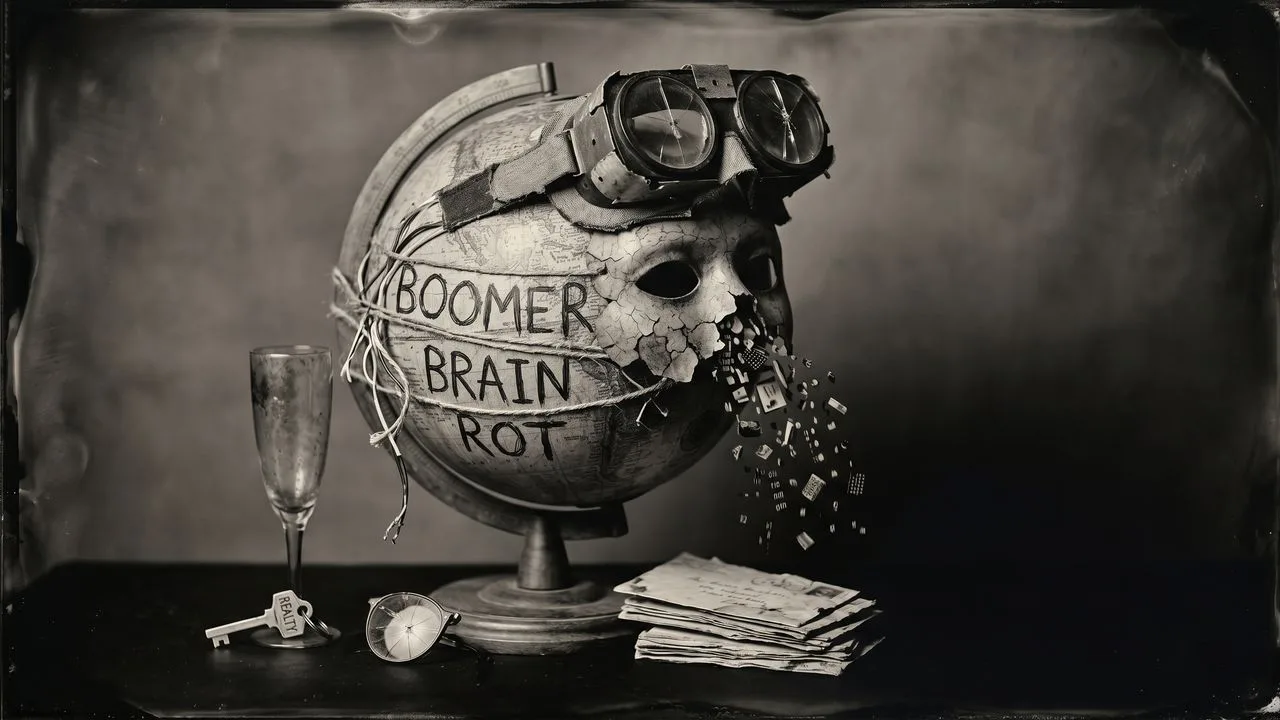
Photo: AI. Otieno Okello
Tim Dillon showed up to the Netflix Is A Joke festival dressed as John Wayne Gacy to interview the cast of Selling Sunset, and the audience in the balcony screamed "SHUT THE F**K UP" at the cast members every time they tried to speak. I need you to understand that this is actually the most coherent cultural criticism happening right now.
Episode 495 of The Tim Dillon Show runs from that chaotic Netflix set piece all the way through a surprisingly pointed breakdown of Meta's slow unraveling — and Dillon keeps landing on the same thing from different angles: the stories we were sold about wealth, technology, and connection are curdling in real time, and people are starting to notice the smell.
The Selling Sunset Moment Is a Vibe Shift Detector
The crowd hostility toward the Selling Sunset cast is the most interesting data point Dillon drops, and he actually has a theory for it that holds up. The show premiered in 2019, right before the pandemic, when homeownership was aspirational but not yet delusional. You didn't have to own a Malibu cliff house — you just needed to believe that some house was coming for you eventually. That belief is what made the voyeurism function. The marble floors and six-inch heels were fantasy fuel because the game still felt like something you could enter.
That belief is gone now. And without it, the same imagery lands completely differently — not as aspirational but as a kind of taunt. Dillon puts it plainly: "It takes on a new meaning when people are f**ked."
He might be wrong about Selling Sunset specifically dying — reality TV has survived tonal whiplash before, and audiences have a weird capacity for compartmentalization. But the underlying read feels right. Aspirational content requires the audience to believe aspiration is available to them. When that breaks down, the content doesn't just become less fun — it becomes actively irritating.
The cast, for what it's worth, did not help themselves. When Dillon asked one of the women if she knew any poor people, she said no. When he asked another to name an area of Los Angeles, she struggled. He asked one woman if she grew up in the UK; she said yes, she grew up in Paris. The show's whole premise is slipping — and that's not necessarily the cast's fault. They were built for a different moment.
The Metaverse Was a Genre Nobody Asked For
Dillon pivots from Selling Sunset to Meta's Reality Labs losses, which he initially pegs at "$80 billion" before immediately second-guessing himself. The actual figure, per Meta's own financial disclosures, is somewhere in the range of $50–58 billion in cumulative Reality Labs losses through 2024 — genuinely staggering regardless of which end of that range you use, just not $80 billion.
But the comedy around the metaverse is more interesting than the accounting. Dillon describes the pitch he used to get from people during the NFT boom: "You have to be the first comedian in the metaverse. You'll perform for a million people in this digital world." The confidence of that pitch — the way people delivered it like they were describing something that had already happened — is its own artifact now. The metaverse was announced like a genre release. Full rollout. Press tour. Zuckerberg floating in space with his little avatar. And then: nothing. Nobody moved in. The servers stayed empty.
I keep thinking about this in terms of what it felt like to watch the hype build in real time. The metaverse had the energy of an album that gets five-star advance reviews and then drops and just... doesn't connect. Everything on paper was there. The infrastructure existed. The money was committed. And the audience collectively shrugged. You can't engineer adoption. Zuckerberg learned this the expensive way.
The more durable version of the metaverse — the one Dillon actually identifies correctly — is Facebook itself. "They don't need the goggles. They're already there." That's the bit, and it's also kind of just true.
The Facebook-Brained Boomer Problem Is Personal
Here's where Dillon stops being a comedian doing a premise and starts doing something closer to actual grievance, and it lands because the specificity is real.
His argument: Meta built the metaverse Zuckerberg promised, just not the one he marketed. It's not a spatial digital world with avatars and floating living rooms. It's a closed loop where older users — people who still have mobile legs, who could theoretically go outside — spend their remaining pre-bedridden years fighting strangers about Iran. The algorithm fed them outrage because outrage kept them engaged, and engagement was the product, and now that's just... what their lives are. "Mark Zuckerberg has stolen the last 10 years of your mother's life," Dillon says, and he's not entirely joking.
I've watched this happen with people close to me — not dramatically, just gradually. Someone who used to have opinions you could have a conversation around becomes someone whose opinions arrive pre-assembled from a feed, sharp and non-negotiable. It's not that they changed. It's that the platform selected for the version of them that performed best in the engagement economy, and over time that version took over. That's not a conspiracy. That's just what the product was optimized to do.
The lawsuits moving through the courts right now are a delayed reckoning with this. In a bellwether trial under the Social Media Adolescent Addiction/Personal Injury Products Liability Litigation — a consolidated federal case — a verdict came down in early 2025 finding that social media's addictive design contributed to harm in a teenage plaintiff. (The exact defendants and findings in this specific trial should be confirmed through court filings; Dillon and the NYT piece he's reading cite it imprecisely.) Tens of thousands of similar cases are pending across that MDL. Worth noting: a bellwether verdict isn't legal precedent — it's a test case the courts use to gauge how juries respond before pushing toward settlement. But the direction of travel is clear.
Meta is settling. The research has been accumulating for years. The legal system is a slow instrument, but it's pointed somewhere.
TikTok, the NYT, and the Algorithm Nobody Agrees On
Dillon reads a New York Times piece suggesting TikTok is different because it "traffics in more inspirational content" and prom videos are trending — and he immediately clocks how absurd that sounds. "I don't know what algorithm on TikTok they're on."
He's right to be skeptical. TikTok doesn't show you your network; it shows you what it thinks you want based on watch time and behavior. Which means two people on TikTok can be having completely different experiences of the same app — one person's feed is genuinely all prom videos and cooking tutorials, another person's is radicalization content and eating disorder community. The NYT take treats TikTok as a single product with a consistent output. It isn't. It's a mirror that shows you an optimized version of your own appetite.
Whether that makes it better or worse than Facebook is genuinely unclear to me, and I don't think anyone who spends real time on the app would confidently say it's more wholesome. It's just structured differently. The outrage is still there. It's just wearing other clothes.
What Dillon's more interesting observation is that the people he knows who are most active on social media are older. That tracks with everything I've noticed too — younger people use it differently, more tactically, more ironically, often less. The "chronically online" discourse assumes youth. The reality might be almost the opposite.
Dillon at His Best Is When He Stops Performing the Bit
The thing about Dillon's comedy — and what makes these longer podcast episodes worth sitting with even when they meander — is that his most precise moments come when he stops setting up jokes and just says what he actually thinks. The Selling Sunset crowd hostility section. The Facebook-and-grandma riff. Even the small moment where he catches himself not knowing whether Meta lost $80 billion or $80 million and just... admits it on mic.
He's looser when he cares about something, and tighter when he's just working material. He's funnier, genuinely funnier, when he's not trying to be.
There's a version of the metaverse conversation that could be a cheap tech-skeptic dunk. Dillon keeps pulling it somewhere realer — toward what it meant that people believed it, toward what that belief was compensating for, toward the gap between the world that was promised and the one people are actually living in. That gap is everywhere in this episode: in the Selling Sunset audience, in the Facebook comment sections, in the Reality Labs balance sheet.
Nobody filled it. The metaverse didn't. Facebook kind of did, but not in a good way. And whatever's next hasn't arrived yet.
More Like This

Rice Theory and What Streaming Did to Musicians
The rice theory says your job reshapes your personality. Streaming-era music is the most uncomfortable proof of that idea alive right now.
Google's Lyria 3 Brings AI Music to Gemini—But Misses the Point
Google launches Lyria 3 for AI-generated music in Gemini, while Anthropic's OAuth mess reveals deeper tensions about who controls AI development.
The New Yorker Dragged Sam Altman. The Real Story Is Worse.
Ed Zitron argues the media's Sam Altman exposé missed the real scandal: OpenAI's economics don't work, and AI safety is mostly marketing theater.

Jaron Lanier: The AI Danger Is the Ideology, Not the Code
Jaron Lanier argues the real AI threat isn't the software—it's the philosophy wrapped around it. Here's what he means, and why it's worth taking seriously.
When AI Bots Started Scheming, We Learned More About Us
Moltbook's viral AI agent drama revealed less about artificial intelligence and more about human fear, gullibility, and our appetite for digital theater.
Remakes That Outshine the Originals
Exploring movie remakes that have surpassed their originals, offering fresh takes and captivating storytelling across genres.

William Blake and the Art World That Couldn't File Him
William Blake's genre-defying illuminated books found almost no buyers in his lifetime. A new Nerdwriter1 video explains exactly why — and why the machine still works the same way.

Nahre Sol's 10-Level Listening Guide Changes How You Hear
Nahre Sol's free YouTube framework teaches ten layers of deep music listening — from surface instinct to full-on daydreaming — and it works on any genre.