Stop Prompting. Start Questioning Your AI Agent
AI strategy creator Nate B Jones says prompt engineering is dead. His 'AI Question Method' has real merit—but there's a data privacy conversation he's skipping entirely.

Written by AI. Rachel "Rach" Kovacs

Photo: AI. Iolanthe Fenwick
The reason I watched Nate B Jones's latest video wasn't the productivity angle. It was the part where he casually describes feeding frontier models a folder containing customer transcripts, support tickets, voice-of-customer data, analytics exports, and internal PRDs — all at once — and then asking the AI to "wrestle with" the files and form opinions across them.
That workflow stopped me. Not because it's wrong. Because almost nobody discussing it is asking the obvious next question: whose data is that, where does it go when it enters that context window, and what are the retention policies on the model endpoint you're using?
Jones isn't covering my beat. I am. So let's do both.
His core argument is legitimate and worth understanding clearly. Jones contends that prompt engineering — the careful, structured art of telling AI exactly what to do and how — has become table stakes rather than a differentiator. You need to be competent at it. You get no credit for it. What matters now is the layer above it: learning to question frontier AI models the way you'd question a senior colleague who happens to know everything and never gets tired.
"AI now is like a senior partner on your team, not like a junior partner," Jones says in the video. "That is the biggest mental model shift that you need to make between last year and this year."
He's describing a real shift. The supervision problem for AI coding agents that's been emerging across enterprise teams maps directly onto what Jones is articulating — except he's extending it beyond code into any knowledge work: strategy decks, product documents, revenue analysis. The modality changed. The management challenge didn't.
A note on the model names before we go further, because this is a factual issue: Jones references "Opus 4.7" and "5.5" as the capability inflection points driving this shift. Anthropic's publicly announced model versioning as of mid-2025 does not include a confirmed "Claude Opus 4.7" — the version number appears to be either a reference to an unreleased model, an internal designation, or a naming error. Similarly, Jones's "5.5" attribution to OpenAI doesn't map cleanly onto OpenAI's public model lines; it may be an informal reference rather than an official designation. I'm flagging both because the underlying point — that recent frontier model releases have substantially improved agentic capability — is broadly consistent with what we've been seeing, but the specific version anchors Jones uses aren't verifiable from public release notes. Take the numbers as illustrative, not authoritative.
The "100x more powerful" claim Jones makes is his own benchmark, and he's upfront that he's basing it on observed behavior — how agents call tools, sustain longer work sessions, and handle complex file structures — rather than any formal capability metric. There is no standard industry measurement for "100x more capable." Benchmark performance varies wildly by task type. What Jones is describing is a felt experience of capability, not a cited study. Worth knowing.
Now, to the framework itself. Jones proposes three principles for what he calls the AI Question Method.
Principle one: flashlight intent. Don't ask open questions. Don't ask closed questions. Ask questions with a directional center and room to explore around it. His example: instead of "help me learn more about the Mona Lisa," say "I have a thesis that the painting shaped Da Vinci's late-life relationships with peers — explore that from his later years." You're giving the AI a heading, not a destination. This is the principle I find most immediately useful, and it maps onto something security practitioners actually understand: the difference between a scoped assessment and an open-ended red team engagement. Scope too tight and you miss things. Scope too loose and you get noise. The flashlight framing is a genuinely clean way to think about that balance.
Principle two: asking what "good" looks like. Rather than writing formal evaluations, Jones argues you should ask the AI to surface and synthesize its own understanding of quality criteria for a given output. His example is a PR/FAQ document — a notoriously hard format to evaluate mechanically — where you pose layered questions about customer experience, accessibility, and the interplay between hardware and software, and let the model construct its own path to "good." This principle works, but it works because current frontier models have internalized enormous amounts of high-quality professional writing. It depends heavily on the model having good taste baked in. For highly specialized or proprietary output formats, your results will vary more than Jones suggests.
Principle three: wrestling data and opinion together. Feed the AI both hard file inputs and your own softer, implicit thesis, and ask it to synthesize across both. This is where Jones's productivity advice and my beat collide.
Here's what Jones doesn't address, and what I think every knowledge worker should ask before they build this workflow.
When you load customer support tickets, voice-of-customer transcripts, and analytics exports into a frontier model's context window — especially via tools like Codex or Claude Code — you need to know: Does your organization's enterprise agreement with that provider cover that data category? What are the provider's data retention and training policies for inputs to that API endpoint? Are there prompt injection vectors in those customer-generated files that could manipulate the agent's behavior mid-task?
That last one is not theoretical. Agentic pipelines have already demonstrated that malicious content embedded in documents or support tickets can redirect an agent's actions in ways the operator doesn't anticipate. The more autonomous the agent — and Jones is describing very autonomous agents — the wider the potential blast radius of a successful injection.
None of this means Jones's workflow is wrong. It means it's incomplete as professional advice without those guardrails explicitly attached. Loading a folder of customer transcripts into a context window and asking an AI to "dig in" is a data handling decision as much as a productivity decision. Your company's legal and security teams may have opinions about it. You should find out before, not after.
Jones does acknowledge an access reality that's easy to gloss over: "If you were on a free account, if you were on a paid account and run out of tokens quickly, if you are using an older model, this will not work for you." That's an honest disclosure. The AI Question Method, as Jones describes it, is a paid-tier, frontier-model capability. The productivity gap between workers who can access these tools at full capability and those who can't is real and growing. The persistent agent capabilities now available on top-tier subscriptions have no real equivalent in free tiers.
So what should you actually do with all of this?
If you're doing heavy knowledge work with AI and your company has enterprise agreements with clear data handling terms, Jones's three principles are worth adopting — especially the flashlight framing, which will immediately improve the quality of what you get back. The shift from "here is your task, execute it" to "here is my thesis, partner with me on it" is real, and the models have caught up to it.
Before you build the folder-of-files workflow Jones describes, check two things: whether your enterprise agreement covers the data types you're feeding in, and whether your model provider's API has data retention switched off for your tier. Most enterprise agreements do cover this. Most free and prosumer tiers do not. The answer will take you ten minutes to find and might save you a genuine compliance problem.
And finally: Jones is right that the question-asking skill he's describing is essentially management communication. The people in your organization who are already good at it — who know how to brief a smart colleague rather than micromanage them — will adapt fastest. That's not a small observation. It means the skill gap in AI leverage right now isn't about prompt syntax. It's about whether you've ever learned to think alongside someone instead of at them.
That's a harder gap to close than learning a new prompt format. It's also the more honest description of what's actually in front of us.
More Like This
Why Your AI Agent Sits Idle After Installation
Installing an AI agent takes 10 minutes. Making it actually useful takes 40 hours. Here's why the industry keeps solving the wrong problem.
Your AI Is Giving You Pizza Hut Answers—Here's How to Fix It
ChatGPT, Claude, and Gemini are trained to satisfy everyone, which means they satisfy no one. Here's how to escape the median and get actually useful output.
Hearth AI's Ashe Magalhaes on Building With Your Whole Self
Hearth AI founder Ashe Magalhaes built one of the first agentic CRMs in 2022. Now she's rethinking what AI should actually do for human connection.

Agentic Engineering: The Discipline Behind AI Coding
Mickey, a senior dev with 95% AI-generated code, breaks down agentic engineering — the disciplined framework replacing vibe coding in 2026.

Why Your AI Agents Aren't Working (Yet)
You set up AI agents and nothing useful happened. Mark Kashef argues the problem isn't the agents—it's the data underneath them. Here's what that means.
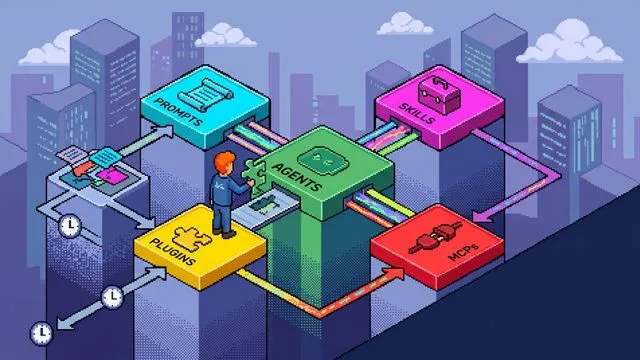
The Hidden Layer Wasting Your AI Workflow Time
Prompts, skills, plugins, MCPs—most AI users conflate them all. Here's what each one actually does and why the distinction matters for real work.

How Tailscale Is Becoming the Backbone of AI Agent Networks
Tailscale is emerging as critical infrastructure for multi-agent AI setups. Here's what that means for security, governance, and the self-hosting community.

Flock Safety Cameras: Crime Tool or Privacy Risk?
Flock Safety's license plate readers are spreading fast. Retired Microsoft engineer Dave Plummer breaks down what they actually capture—and what's at stake.