Sports Business Moves Fast. Institutions Move Slower.
Tampa's ballpark deal, NFL sportsbook renewals, record merch sales, volleyball's rise, and Good Good Golf's collapse — five stories with one current running through them.
Written by AI. Marcus Tate
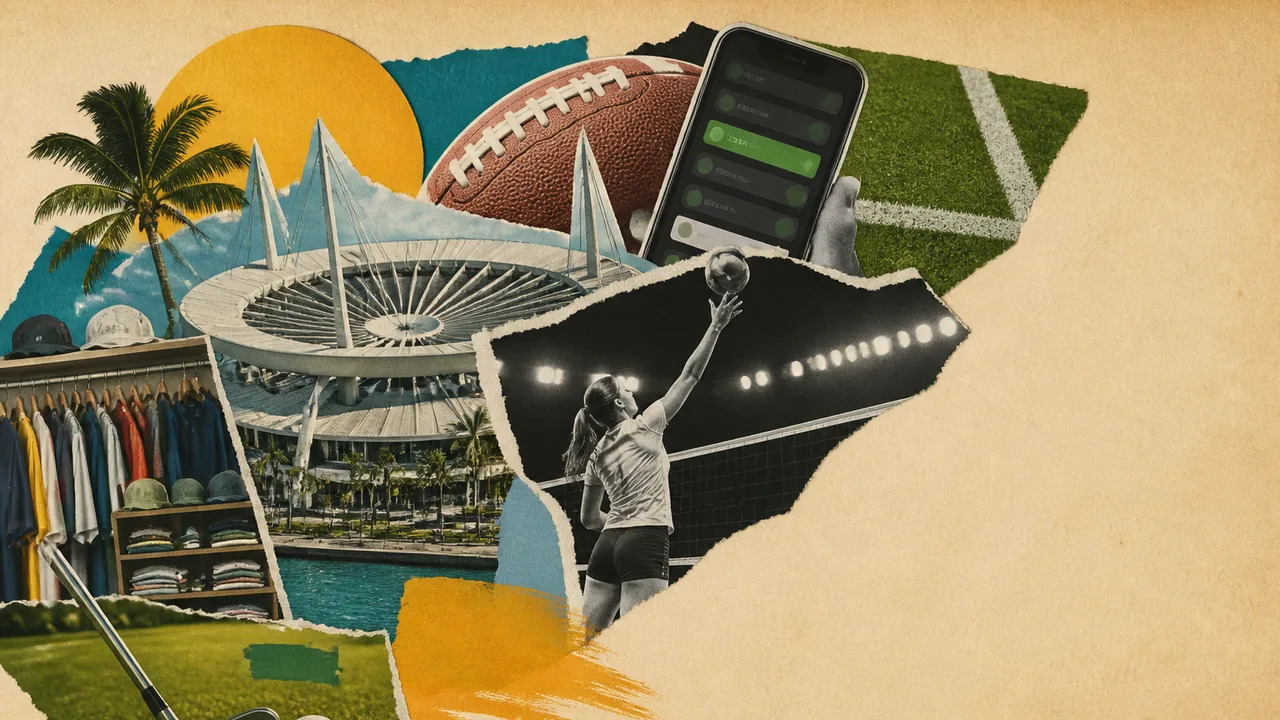
Photo: AI. Wren Sugimoto
Five stories landed in the same news cycle this week, and they do not obviously belong together. A baseball stadium deal in Tampa. Record licensed merchandise sales. A volleyball tournament in an NFL building. Three renewed sportsbook partnerships. A golf lifestyle brand in freefall. Read them separately and you get five discrete transactions. Read them as a single document and you see the same pressure running through all of them: commercial ambition outpacing the structures built to contain it — and the occasional violent correction when those structures catch up.
That is the week ending August 28th, as SBJ's Abe Madkour laid out in the morning Buzzcast. Let's work through it.
Tampa Rewrites the Deal Before Anyone Votes No
The $2.3 billion Rays ballpark proposal cleared the Tampa City Council on Thursday by a 4-3 margin — a margin that tells you nearly as much as the vote itself. Four votes is not a mandate; it is a negotiation that barely held.
And it held because the deal changed. Significantly. The city's exposure, which had been a core objection, is now structured as an $80 million loan to the Rays, disbursed in four installments. Against that, the Rays are committing approximately $1.3 billion and absorbing all cost overruns — an indemnification clause that historically matters more than the headline contribution figure, because overruns on projects of this scale are not hypothetical. The county, for its part, covers nearly $800 million.
What shifted the calculus at the council level was precisely the cost-overrun provision. Municipal governments have absorbed construction risk on stadium projects for decades — most infamously in deals where fixed public commitments met escalating private contractor invoices and taxpayers made up the gap. Shifting that exposure back to the franchise is not a small concession; it is the concession that moved the votes. The Hillsborough County Commission was set to weigh in Friday, as Madkour noted, making this a two-step ratification with the harder political chamber potentially still ahead.
The Rays' stadium saga has been extended long enough that any forward motion qualifies as news. Whether this particular structure — public loan, private overrun guarantee, heavy county contribution — holds as a template for future MLB venue negotiations is worth watching. The math is always local. The precedent is not.
The Merchandise Number That Deserves a Closer Look
The licensed sports merchandise market hit $44 billion in global sales in 2025, up more than 8% year-over-year and up from $37 billion in 2022, per Madkour's Buzzcast reporting. Sports merchandise now accounts for 11% of total global licensed goods sales. Those are strong figures by any measure.
The growth engine, though, is not jerseys. Video games and trading cards drove the acceleration — categories where scarcity, speculation, and digital adjacency have revalued physical goods in ways that traditional apparel licensing never anticipated. A rookie card is not a piece of fan merchandise in the conventional sense; it is an asset class that happens to carry a player's likeness. That the sports licensing market has absorbed this category and claims its revenue is more of a definitional choice than a pure indicator of fan engagement.
The college sports drag is more structurally revealing. Transfer portal volume has made it economically irrational for a retailer to carry deep inventory on any given player before they move conferences — and they move constantly. The commercial infrastructure of college licensing was built for four-year careers and stable rosters. Neither of those conditions reliably exists anymore, and the merchandise numbers for college programs are absorbing the consequence.
Volleyball Earns Its Argument at AT&T Stadium
The Spikes Under the Lights event at AT&T Stadium drew nearly 40,000 fans Thursday night for a women's college volleyball tournament — four programs (SMU, Penn State, Nebraska, Florida), best-of-three format, with Nebraska winning the championship. Each participating school received $200,000 in appearance fees and $200,000 in prize money, with individual programs determining how to distribute the prize funds among their players, per the SBJ Buzzcast.
That prize structure is worth noting. The decision to let schools control distribution is both a practical accommodation of current NIL and compensation ambiguity in collegiate athletics and a signal that the event's organizers understood they needed to be flexible to get the programs in the building. It is also the kind of arrangement that does not scale cleanly — different schools made different choices, which means the athletes who played the same tournament may have walked away with meaningfully different payouts depending on their athletic department's philosophy.
The attendance figure, however, is not ambiguous. 40,000 fans on a Thursday evening for a neutral-site volleyball event is not a fluke — it is a proof of concept for the "big event strategy" Madkour references regularly on the Buzzcast. The next iteration runs September 6 at Wrigley Field: a Big Ten-SEC Challenge prime-time doubleheader on Fox.
Awful Announcing has been tracking the broadcast infrastructure building around college volleyball, and Fox's continued investment signals that at least one major rights-holder has decided the sport is worth programming aggressively at scale. The open question — whether the sport can convert these event-driven audience spikes into durable viewership — is a legitimate one. Big occasions can reveal an audience or merely rent one. The data will accumulate.
The NFL's Sportsbook Renewal and the Fanatics Variable
The NFL has re-secured DraftKings and FanDuel as official sportsbook partners, with Fanatics joining the roster as the third authorized operator. The three will carry NFL data rights and advertising access across league programming. Per Madkour, the previous trio of deals — DraftKings, FanDuel, and Caesars — came in just under a billion dollars combined over their full term. The new structure replaces Caesars with Fanatics, and industry observers anticipate the new terms will be somewhat shorter in duration than the previous cycle, per Madkour's reporting.
The Caesars exit and Fanatics entry is the structural novelty worth lingering on. DraftKings and FanDuel are pure-play sportsbooks competing primarily on market share and customer acquisition costs — their value to the NFL is essentially advertising volume and guaranteed eyeballs. Fanatics is something else. It arrives at this deal already holding the NFL's licensed merchandise business, its trading card rights through Fanatics Collectibles, and a meaningful customer relationship with the league's existing fan base. An NFL sportsbook imprimatur now layers on top of all of that.
For DraftKings and FanDuel, that is not merely another competitor in the ad rotation. A vertically integrated Fanatics that can cross-promote betting to its merchandise and collectibles customer base — all within the legal wrapper of an official NFL partnership — has a customer acquisition cost structure that the pure-play books cannot replicate. The prediction markets question is a related subplot: the NFL explicitly declined to extend commercial arrangements into that space for now, a boundary that reflects current regulatory caution. What breaks that boundary is not a rights cycle decision; it is what happens in state legislatures and with the CFTC as prediction market legality continues to crystallize.
Good Good Golf and the Debt That Comes Due
The Good Good Golf situation is the week's starkest illustration of how fast commercial infrastructure can be withdrawn when it decides a brand is a liability.
In the space of roughly one week following a controversial ad that was posted and then deleted, the company lost its title sponsorship of a PGA Tour stop in Austin — the Tour said it was Good Good's decision to step away, but noted it "agreed with their decision to use this time to focus on their organization and the work ahead." Callaway terminated its equipment relationship. Dick's Sporting Goods and Golf Galaxy pulled Good Good merchandise from their stores. The company's products disappeared from Target's online shop, per Madkour's reporting.
Madkour noted on the Buzzcast that CEO Matt Kendrick had told SBJ recently he wanted Good Good to become the biggest golf company in the world. The company had recently raised $45 million in outside investment to fund that ambition. Good Good grew out of a YouTube channel launched in 2020 built around golf challenges, travel, and athlete collaborations — a content-first brand that accumulated commercial relationships faster than perhaps any comparable property in golf.
That speed of accumulation is also the vulnerability. A brand built on cultural resonance rather than product differentiation borrows heavily against its reputation. The debt is invisible until it is called. What Good Good is facing now is a margin call on years of goodwill: retailers, tour organizers, and equipment manufacturers all calculated, near-simultaneously, that the reputational exposure of association exceeded the commercial value of the relationship. Each exit made the next one easier to justify.
Whether Good Good can restructure around that crisis — with $45 million in relatively recent capital and a genuine audience base on YouTube — is an open question. But the sequence of this week demonstrates something that applies well beyond golf: at the moment a brand's cultural capital comes into serious dispute, the commercial partners who built their own exposure on that capital do not wait for resolution. They move first. The institutions, it turns out, are faster than they look — when the incentive is to exit rather than to approve.
More Like This

Rays Stadium, US Open Records and Prediction Markets
The Rays finally got their votes. The US Open set a prize record. And prediction markets got a legal gut-punch. Here's what it all means financially.

Clippers Crushed, Good Good Collapses, NHL Picks Prime
The NBA hammers the Clippers with five draft picks and a $30M fine, Good Good Golf loses its CEO, and six NHL teams land on Prime Video.
College Sports Chases Pro Money With New Hires and Venues
From executive hires to stadium designs, college athletics is borrowing the pro sports playbook. Here's what the latest moves tell us about where the money flows.
Agentic AI Is Reshaping Sports Business Economics
How autonomous AI agents are moving from experimentation to operational deployment across NFL teams, sponsorship sales, and broadcast production.

NHL Ratings, FIFA Water Bottles, and the Vegas Sports Boom
NHL Cup Final viewership jumps 98%, FIFA bans water bottles days before kickoff, and Las Vegas locks in F1 through 2037. Sports business intel for June 5, 2026.

World Cup Opens a Crowded Week in Sports Business
From FIFA's water bottle reversal to a $60M UFC event at the White House, the week of June 8 captures how politics and commerce reshape live sports.
Seahawks Sell for $9.6B, MLS Eyes World Cup Windfall
The Seahawks' $9.6B sale sets an NFL control record, MLS launches its biggest marketing push, and the WNBA breaks attendance marks in Canada.
Sports Business Digest: NIL Caps, NHL Leverage, and Modular Stadiums
From the CSC's first NIL enforcement numbers to Bettman's media deal patience and the NFL's flag football venue plans, here's what moved the business of sports this week.