South Korea's 2027 AI Budget Tests Its Sovereign Ambition
South Korea proposes 21.3 trillion won for AI in 2027. Its sovereign model ambition hinges on spending choices, computing access and measurable public results.

Written by AI. Marcus Chen-Ramirez

South Korea wants to put 21.3 trillion won, about $15.8 billion, toward AI in its proposed 2027 budget. That is a large public commitment to a technology often discussed as though its future will be decided entirely by a handful of companies. Seoul has attached an especially demanding ambition to the money: a sovereign AI model capable of competing at the top of the field.
The government is targeting what it calls the "world's highest performance" sovereign AI model. The proposal does not yet specify how much of the AI allocation would pay for model training, computing infrastructure, data, talent or deployment, so the headline figure cannot tell us what the model will cost or how well it will perform. For now, the budget is a statement of priorities with a proposed price tag.
It also belongs to a much larger fiscal story. South Korea's proposed overall budget is roughly $530 billion, with the AI chip boom part of the economic backdrop. On the approximate dollar figures, the AI allocation amounts to about 3% of that total. A country whose technology industry helps supply the AI boom is preparing to spend public money on becoming a more capable user and developer of AI itself. Supplying a crucial part of the machinery and controlling the systems built with it are different positions in the value chain.
What Sovereignty Would Buy
A sovereign model sounds like a product: train a system, give it a national label, put it to work. In practice, sovereignty is a set of decisions about control. Who can determine how a model handles Korean-language tasks? Who decides which data it trains on, where it runs and how it can be updated? If a public agency relies on the system, who can inspect its failures or move it to another provider?
Those questions have different answers depending on the architecture. A locally developed model running on infrastructure the government or domestic companies can govern would give Seoul one degree of control. A model developed locally but dependent on scarce computing capacity or externally controlled services would give it another. Neither arrangement guarantees good answers for users. Both could still improve the country's ability to set procurement terms and choose how the technology is deployed.
The strongest case for public spending starts there. If schools, hospitals and government offices eventually use AI for routine work, they will need systems that handle Korean language and local administrative contexts reliably. Public investment could support evaluation and infrastructure that no single customer has much incentive to fund. Domestic businesses might also benefit from access to tools they can adapt without depending entirely on a foreign provider's pricing, policies or release schedule.
That case does not require every government task to run on the largest model in the world. A smaller system that works well on a defined set of Korean-language forms might deliver more public value than a general-purpose model that wins an international benchmark and struggles with the form on a clerk's desk. Seoul's performance target raises a fair question for budget planners: performance on whose tasks?
The Expensive Parts Behind the Model
A model budget has several clocks running at once. Training needs concentrated access to capable chips and engineers. Deploying a model needs reliable computing capacity every day it is used. Evaluating it takes people who can design tests, examine mistakes and check whether updates fix one problem while creating another. Each activity can absorb money; only some produce a model that can be demonstrated onstage.
Hardware access presents a particular complication for any national AI strategy. South Korea's role in the chip industry gives it industrial expertise, but a sovereign model still needs the right computing systems, software and operational capacity. Chip production and model training draw on overlapping industries, not an identical supply chain. A government can fund a training run more readily than it can guarantee every component and specialist will be available when needed.
Data poses a different problem. More Korean-language text could improve a system's usefulness, yet the quality, relevance and permissions attached to that material matter. Government records may contain sensitive information; licensed commercial material comes with conditions; public text may poorly represent the situations a model will meet in a welfare office or a small business. A data strategy has to decide who may contribute material, who may benefit from the finished model and who handles complaints when the system gets something wrong.
Talent spending can be less photogenic than a new computing facility and just as consequential. Training and maintaining a model require researchers, software engineers, security staff and subject specialists. A public program could concentrate those people around a single flagship project, or build skills across universities, agencies and companies. The first route offers a clearer national showcase. The second could leave more organizations able to adapt as the technology changes.
Who Gets to Use the Investment?
Public money can change a market's shape. If most of the allocation flows to a small group of contractors, those firms could gain computing access, data relationships and government customers that rivals cannot easily match. Concentration might be a practical response to the cost of large-scale AI development. It could also make later procurement less competitive if agencies have few viable alternatives.
Another approach would treat public funding as a way to widen access. Shared computing resources, published evaluation methods and procurement rules that let agencies switch suppliers could give smaller firms and researchers room to participate. Each choice involves trade-offs: open access can complicate security and oversight, while tightly controlled access can limit the number of people testing a system for weaknesses. The label "sovereign" does not settle who inside the country holds the reins.
Citizens have a stake beyond industrial policy. An AI system used to summarize documents or assist staff can save time; an incorrect summary can also travel through an office with the apparent authority of software purchased by the state. Before deployment becomes a measure of success, agencies need a way to identify errors, assign responsibility and let people challenge consequential outcomes. Those requirements apply whether the model is built at home or bought abroad.
A Target that Can Be Measured
A world-class ambition can attract engineers and justify sustained investment. It can also encourage a narrow contest over benchmark rankings. A useful set of milestones would test several claims separately: whether the system performs well in Korean, whether it works on public-service tasks, what it costs to operate and whether users can identify and correct failures. A model that improves on one measure might regress on another.
Budget allocations will show which version of sovereignty Seoul intends to pursue. Computing capacity would indicate a commitment to building and running systems. Funding for data governance and independent testing would indicate attention to how those systems behave. Procurement terms would reveal whether public investment creates options for agencies or locks them into a new domestic dependency.
South Korea has put 21.3 trillion won beside an ambitious AI goal. The next consequential number may be smaller: how much of that sum makes a model useful and accountable after the training run ends.
More Like This
AI's Inference Crisis: Why Sora Died Burning $15M Daily
OpenAI killed Sora after six months. The reason reveals AI's shift from training races to inference economics—and what breaks next.

UK AI Biosecurity Lab Faces a Test Beyond Its Funding
The UK's £100m AI Biosecurity Lab will use company model credits to pursue biological threats and treatments. Its governance and measures of success remain open.
AI Dominates Davos: US-China Race and Future Impacts
Davos 2026 focuses on AI, highlighting the US-China race, economic implications, and societal impacts of AI advancements.

Who Gets the Good AI Model? Access Is the New Battleground
Anthropic's fake-account allegations, secret model downgrades, and what quietly routing users to worse AI means for people who actually pay for it.
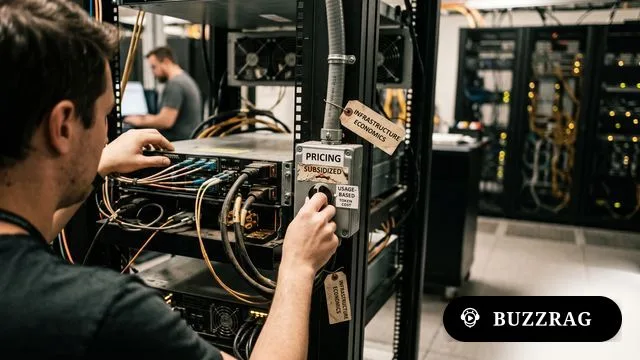
AI's Subsidy Era Is Ending—And the Real Business Begins
Token scarcity is forcing AI companies to abandon flat pricing. What happens when the era of experimentation meets the reality of infrastructure economics?

Cloudflare's KiteSurf Browser Is Built for AI, Not You
Cloudflare built KiteSurf, an AI-agent browser in Rust that uses 7x less memory than Chromium. Here's what it reveals about infrastructure's quiet transformation.

How to Structure Content So AI Search Cites Your Brand
Brian Dean's four-part framework for getting cited by ChatGPT, Gemini, and Claude—without chasing tactics that expire in three weeks.

Joint Scaling Laws for Pre-training and RL Explained
A new paper uses chess to map how pre-training compute shapes RL gains—and finds RL amplifies what models already know rather than creating new skills.