Royal Caribbean’s Sandals Deal Extends Its Reach Ashore
Royal Caribbean’s $3 billion Sandals stake pushes the cruise group into resorts. Here’s what changes for guests and what remains uncertain after the deal.

Written by AI. Tomas Reyes-Kim
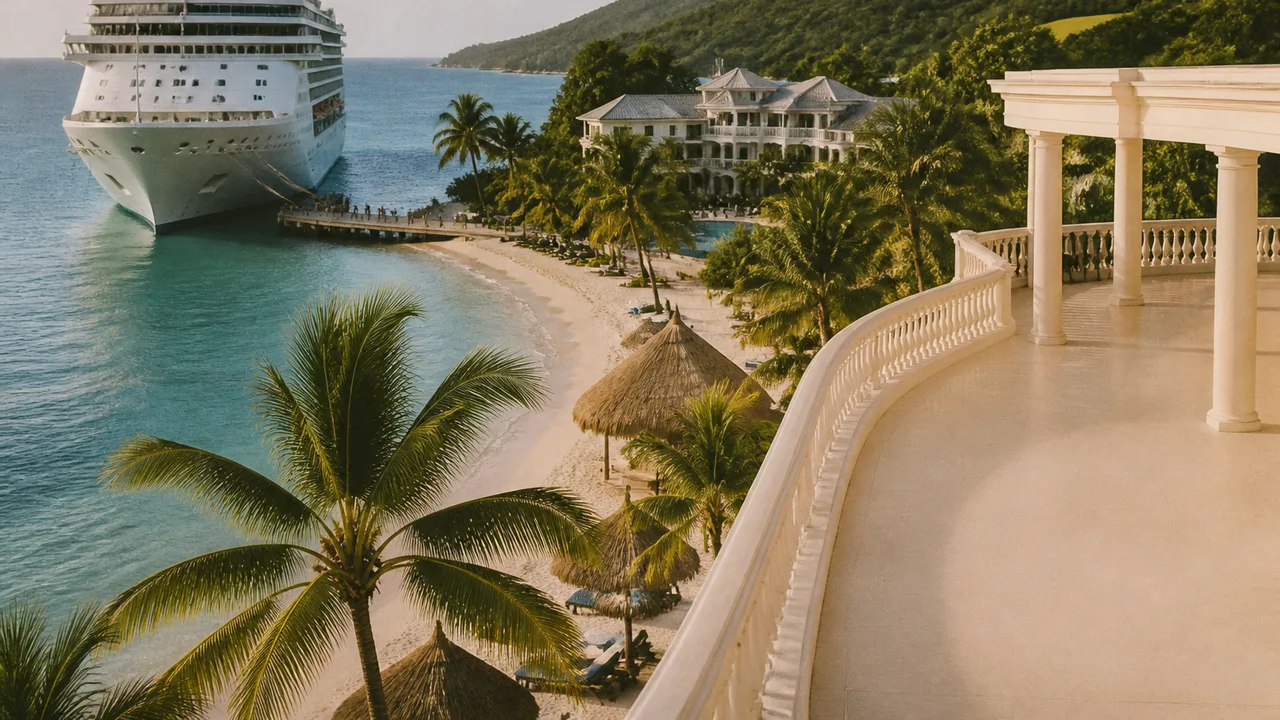
Royal Caribbean Group agreed to spend $3 billion for half of Sandals Resorts International, giving a cruise company a large new claim on the Caribbean vacation dollar before anyone even orders the welcome cocktail.
The companies announced the 50% investment on September 23 and described it as a joint venture. The announced terms value Sandals at about $6 billion, put the price at approximately 10 times forward EBITDA and include committed debt financing from Morgan Stanley. The transaction is expected to close in early 2027.
That is the corporate version. For travelers, the short version is simpler: Royal Caribbean has agreed to buy access to an established all-inclusive resort business, while the Stewart family keeps the other half. Existing Sandals and Beaches reservations, operations and loyalty programs are supposed to continue. A combined cruise-and-resort product remains an idea under exploration, rather than something you can book today.
So please do not build a 2027 honeymoon spreadsheet around imaginary reciprocal points. Spreadsheets deserve evidence too.
Royal Caribbean Wants More of the Trip
Royal Caribbean already operates private destinations for cruise passengers and has been expanding its land offerings. Sandals brings a different product: overnight resorts where guests may remain for days, buy an entire stay through one operator and never board a ship.
That makes the deal a logical extension of Royal Caribbean’s stated ambition to compete across vacations, rather than only cruises. CNBC’s report on the negotiations said Sandals and its Beaches brand have more than a dozen Caribbean properties. The later announcement-derived account put the combined portfolio at 20 properties across Jamaica, The Bahamas, Saint Lucia, Grenada, Barbados, Antigua, Curaçao, and Saint Vincent and the Grenadines.
Those counts likely use different definitions, with one referring to Sandals or a narrower operating set and the other combining Sandals and Beaches. The available accounts do not reconcile them, so “more than a dozen” is safer than pretending the resort inventory performed mitosis overnight.
Skift’s early analysis called prime Caribbean beachfront the main prize and described the investment as a faster path into land-based revenue. That interpretation fits the disclosed structure: Royal Caribbean is paying for half of an operating company with established brands, properties and customers instead of assembling a comparable resort network one parcel at a time. Skift also identified Sandals as privately held, making the Stewart family’s retained stake central to how the business may run.
The stronger strategic reading, then, is broader than “cruise plus hotel.” Royal Caribbean can potentially sell more nights around a sailing, market resorts to existing cruise customers and keep a larger share of vacation spending inside affiliated businesses. Sandals gains capital and access to Royal Caribbean’s distribution. Those possibilities follow from the companies’ footprints and stated plans to explore cross-distribution and joint marketing. No disclosed evidence yet shows how packages will be priced, whether they will beat booking separately or whether loyalty benefits will cross over.
Cheap bundles are possible. So are very photogenic bundles with the financial temperament of an airport sandwich.
Two Caribbean Histories Meet in the Middle
Sandals began in 1981 under Gordon “Butch” Stewart and is now led by his son Adam Stewart. Its adults-only Sandals resorts and family-oriented Beaches properties built a recognizable all-inclusive network across multiple Caribbean islands. The family has agreed to share ownership, rather than sell the whole company and disappear behind a tasteful hedge.
Royal Caribbean arrived from the water. Its private-destination strategy already extends the cruise product ashore, giving the company more control over what passengers do during a port day. The Sandals investment pushes that progression into overnight accommodation and independent resort stays.
The history helps explain why a 50-50 venture could appeal to both parties. Royal Caribbean gets an immediate position in all-inclusive resorts without creating a hotel brand from zero. The Stewart family receives $3 billion for half the company while retaining a large economic interest and, depending on the joint-venture agreement, potentially substantial influence.
Equal ownership also creates an obvious governance question. Neither side automatically has majority control. Decisions about expansion, brand standards, capital spending or a future sale may require negotiated consent. The public deal description does not provide voting rules, deadlock procedures or exit rights, so the ownership split cannot tell us who wins an argument in the boardroom. It only tells us an argument may need two signatures.
The Useful Comparison is Royal Caribbean’s Own Land Play
Private cruise destinations and all-inclusive resorts share an economic goal: capture spending that might otherwise flow to unrelated hotels, tour operators, restaurants or attractions. Both can also make the customer journey easier by putting transport, accommodation and activities into one sales funnel.
The products diverge after that. A private destination primarily serves passengers arriving on scheduled ships. Sandals and Beaches sell multiday stays to guests who may have no interest in cruising. Resorts carry accommodation operations, longer guest relationships and a different booking rhythm. Royal Caribbean is entering an adjacent business, rather than cloning its port-day model on a larger beach towel.
That limit is useful for evaluating the deal. Cross-selling could work well among customers already comfortable with packaged Caribbean vacations. It may work less well when the audiences separate, such as resort guests who dislike ships or cruisers choosing Royal Caribbean partly because one floating hotel already feels like enough hotel.
The 10-times-forward-EBITDA figure offers another clue, with caveats. EBITDA is a company-supplied measure of earnings before interest, taxes, depreciation and amortization, and “forward” means it relies on expected performance. It can help compare a purchase price with anticipated operating earnings, but it does not reveal the assumptions behind those expectations or the future costs of renovating and expanding resorts. Without Sandals’ underlying financial statements and the transaction documents, calling the price cheap or expensive would be cosplay with a calculator.
Investors Supplied the First Skeptical Review
Royal Caribbean shares fell roughly 6% when news of the negotiations emerged, CNBC reported. The stock was already down about 25% over the preceding year after the company trimmed revenue-growth forecasts amid softer demand for European sailings.
A one-day share move cannot diagnose a $3 billion transaction. Investors may have disliked the price, the debt financing, diversification outside cruising or some combination of market factors. Still, the decline shows that the growth story did not receive instant applause from everyone holding the stock.
The case for the investment is straightforward. Royal Caribbean obtains a foothold in an established all-inclusive company, gains additional Caribbean distribution and may create longer itineraries spanning ship and resort. The skeptical case is equally concrete: $3 billion is a large commitment, Morgan Stanley financing adds debt exposure, and a 50-50 structure can complicate decisions. Softer demand in one cruise region also does not prove that resorts will offset it.
What Travelers Should Do Now
Anyone with an existing Sandals or Beaches reservation should treat the announcement as an ownership event, not an itinerary change. The companies say current operations, bookings and loyalty programs will continue. Travelers should keep using the terms attached to their actual reservation instead of assuming Royal Caribbean benefits have appeared by corporate osmosis.
Future packages deserve ordinary comparison shopping. Check the combined price against separately booked cruise, flight, transfer and resort components. Compare cancellation rules, travel-insurance coverage and what “all-inclusive” covers in each half of the trip. A single checkout screen can reduce hassle without reducing cost.
The largest unanswered questions sit beyond booking mechanics. The available announcements do not detail workforce effects, planned development, local procurement, tax arrangements or how expansion would affect communities on the eight island destinations named in the coverage. A bigger integrated seller may bring investment and customers; it may also gain more leverage over where visitor spending lands. The deal terms currently support the first half of that sentence more clearly than the second.
Royal Caribbean has agreed to pay $3 billion for half of Sandals. Whether travelers get a cheaper, smoother Caribbean trip, or simply a longer path through one corporate checkout, will depend on products and prices that have yet to exist.