Qwen3.8-Flash-Next Puts 180B Parameters on Laptop Hardware
Qwen3.8-Flash-Next uses a 51B engram lookup table in system RAM to run 180B parameters on modest hardware. Here's what the architecture actually means.

Written by AI. Yuki Okonkwo

Photo: AI. Dexter Bloomfield
Kai had a spreadsheet. Quantization levels, VRAM requirements, context lengths: one glance, instant verdict on whether a model would fit. "I was proud of that system," he says in his deep-dive video, "right up until a friend nodded politely at it in the way people do when they are about to tell you something uncomfortable." On August 26th, Alibaba's Qwen team shipped Qwen3.8-Flash-Next, and the spreadsheet didn't survive.
The question the spreadsheet answered was: how many gigabytes of VRAM does this model need? Qwen3.8-Flash-Next makes that question structurally incomplete.
What the model actually is
Surface stats first. Qwen3.8-Flash-Next is a 125B-parameter mixture of experts (MoE), meaning only a slice of that fires per token: 6B active parameters during inference. That part is established territory; MoE models have been around long enough to feel routine. But bolted alongside the MoE core sits a 51B-parameter engram embedding table and a 4B-parameter multi-token prediction head for speculative decoding. Total on disk: roughly 180B parameters.
The config file describing the model's own architecture labels it Qwen4-XP. Not Qwen3, not Qwen3.5. Qwen 4 experimental. As Kai puts it, "this is a dress rehearsal where they are testing the ideas they intend to ship in Qwen 4 in public right now." MarkTechPost's coverage confirms the framing: this model is explicitly previewing the Qwen4 architecture.
The engram table, explained without the jargon spiral
An engram is a short token sequence, two or three tokens in a row. When the model is generating text and has just produced a few tokens, it has a concrete fingerprint of recent context. Feed that fingerprint into the engram table as a key, get back a row of numbers. No matrix multiplication. No attention computation. Just a lookup, like a dictionary.
One developer who got this running reports roughly 16 rows fetched per token from a tensor 320 million rows deep and 160 numbers wide, with a deterministic hash. The memory traffic clocks at around 100 to 200 kilobytes per decoded token, compared to megabytes for an expert block that then has to sit on the GPU and run compute.
The fetch address is decided before the data arrives. The tokens that index the table are tokens you already produced. So the prefetch can start while the GPU is computing the current token. Memory access hides behind computation. You don't wait; you overlap.
Kai credits the underlying idea to a DeepSeek paper on conditional memory (which he cites in his video description as "Conditional Memory via Scalable Lookup"), quoting their framing directly: "because retrieval indices are deterministic, the memory tables can be offloaded to CPU RAM with negligible latency." Nobody made memory faster. They built a parameter type that doesn't need fast memory.
Is it elegant or is it a hack? Honestly, both, and the both is the interesting part. A phrase book stapled to a neural network sounds almost embarrassing as a research contribution until you realize DeepSeek apparently derived a scaling law for how to split a parameter budget between neural computation and static memory. The insight isn't "lookup tables are clever." It's that slow memory can be a first-class architectural choice instead of a failure mode. The phrase book earns its tier.
Three other changes, all pointing toward smaller KV caches
The engram table absorbs most of the attention, but Qwen3.8-Flash-Next ships three other architectural changes that all push toward the same outcome: reducing how much context the model has to keep in hot memory at once.
Three out of every four attention layers use Gated DeltaNet, which compresses history into a fixed-size state rather than an ever-growing KV cache. One in four uses Qwen Sparse Attention, described in Alibaba's own words as "a compressed lightweight indexer selecting important context at microbatch granularity." Nvidia published prefill and decode speedups for that attention variant on their own hardware with Alibaba's benchmark, and Kai flags the obvious caveat: "it is Nvidia's blog, Nvidia's hardware, and Alibaba's benchmark. So it is a really promising number which certainly looks good on paper but it is not a guarantee."
The residual stream widens into four gated branches. The popular online gloss is that one branch becomes a long-range express lane, but Kai went looking for where Qwen actually says that and came up empty. The official readme describes cross-layer information flow and training stability, which is more conservative. I'd take the conservative version.
The model trained with Muon instead of AdamW. Alibaba claims a meaningful training cost reduction versus Qwen3.7+, but the specific figure cited in the video transcript is an unresolved placeholder, so I'm not printing a number I can't verify. Take the training efficiency claim as a directional signal from the team's own scoreboard, not a settled benchmark.
What the hardware receipts actually show
Kai hunted for real-world measurements and found more than he expected. A DGX Spark (128GB unified memory) running the full 180B model at Q4 quantization over a 262K context hits around 22 tokens per second on decode, 405 on prefill at 16K. Two config flags: pin the embedding table to CPU, memory-map it. Steady state around 95GB used with 26GB of page cache. KV cache runs about 24 bytes per token, so 4 million tokens of context costs roughly 6GB.
That's a $3,000+ machine most people aren't buying. Here's the number for people with actual laptops:
A laptop RTX 3060 with 12GB of VRAM and 48GB of DDR4 runs Qwen3.8-Flash-Next at a 256K context window using only 11.66GB of VRAM, decoding at 10 tokens per second. A 256K context window. On a laptop GPU that costs around $300 secondhand. Six months ago that would have read like a spec sheet typo. The engram table lives in system RAM; the GPU handles the actual math. The GPU never sees the phrase book, so the phrase book's 51 billion parameters cost the GPU zero.
Unsloth has a 1-bit dynamic build that claims 75GB of RAM and no GPU at all, which should not be possible to type about a 180B-parameter model.
For comparison, benchmarking the same quantized table in two locations shows 142.6 tokens per second with the table in RAM against 77.5 tokens per second reading the identical table from NVMe. RAM to NVMe is a cliff, not a step. The design works on the assumption that you have RAM, not just disk.
What you actually need, and what's still broken
The number that determines whether this runs on your machine is your free host RAM, not your VRAM. In BF-16, the engram table wants about 95GB. Quantized to int4, that drops to 32GB. NVFP4 brings it to 28.8GB at around a 5% throughput cost, with one developer's measurement showing no measurable accuracy loss (one developer, one repo, treat it accordingly).
If you have 24GB of VRAM and 96GB of DDR5, you can run it. If you're under 64GB of RAM total, this model is not for you right now, and nothing about the smaller VRAM footprint changes that.
The software situation is early. llama.cpp support lives in a pull request (PR #27742) not yet merged to mainline. A second concurrent inference request crashes the current fork. Quantized KV and the MTP head don't work yet. The MLX path needs a PR that hasn't hit a tagged release. Kai's video was six days after release. This is what six days old looks like.
Two things to watch: PR #27742 landing in mainline llama.cpp, and MLX's external table storage reaching a tagged release. Until then, running this means tracking a fork.
The actual question this model is asking
Kai closes with something that stuck with me: "Qwen didn't end the VRAM bottleneck because 2300 GB is not the end of anything. But what it did end is the assumption that all of a model belongs behind fast memory."
The old framing was: model parameters live in VRAM, and if they don't fit, you make them fit or you pick a smaller model. Qwen3.8-Flash-Next, and the DeepSeek conditional memory research underneath it, introduce a different question: which parameters actually need fast memory? For the engram table, the answer turned out to be zero.
That's the number worth putting in the spreadsheet.
More Like This
TurboQuant Makes 16GB Macs Actually Useful for AI
New compression tech lets budget Macs run large language models that previously required 128GB. Here's what actually changed and what it means for you.

Anthropic's Model Hardware Standard Explained
Anthropic's Model Hardware Standard lets AI agents run real lab experiments. Here's what the pilots showed, what failed, and what's still unknown.

PrismML's Bonsai 27B Brings Qwen to Consumer Hardware
PrismML's Bonsai 27B runs Qwen 3.6 27B on 10GB of RAM using ternary compression. Here's what the benchmarks show—and what they don't.
Decoding MoE: Token Routing with a Twist
Explore how Mixture of Experts models use token routing to optimize AI model efficiency and performance.

Five AI Terms That Actually Change How You Use It
Tokens, context windows, temperature, hallucinations, RAG—Kai's video breaks down the five AI concepts that separate fluent users from confident nodders.

GLM 5.3 Flash vs GLM 5.3: What the 9x Price Gap Reveals
GLM 5.3 Flash costs 1/9th the price of GLM 5.3, adds multimodal support, and outperforms its predecessor. Here's what that actually means for developers.
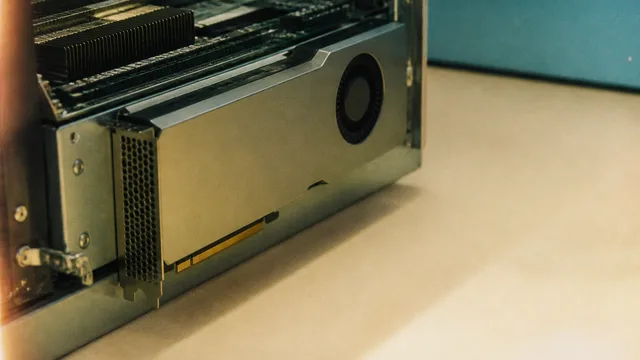
AMD Instinct MI350P: 144GB HBM3E in a PCIe GPU
AMD's Instinct MI350P brings 144GB of HBM3E and 3.6TB/s bandwidth to standard PCIe servers. Here's what it means for the mid-market AI infrastructure gap.

How Optimization Powers Modern AI and Engineering
From training ChatGPT to imaging black holes, optimization is the hidden engine behind modern AI and engineering. Steve Brunton's lecture explains how.