QR Code Menus Are Redesigning the Dining Ritual
Design researcher Shruthi Manjula Balakrishna argues QR menus don't just change how we order—they quietly rewire attention, trust, and who absorbs the cost of dining.

Written by AI. Francesca Bianchi
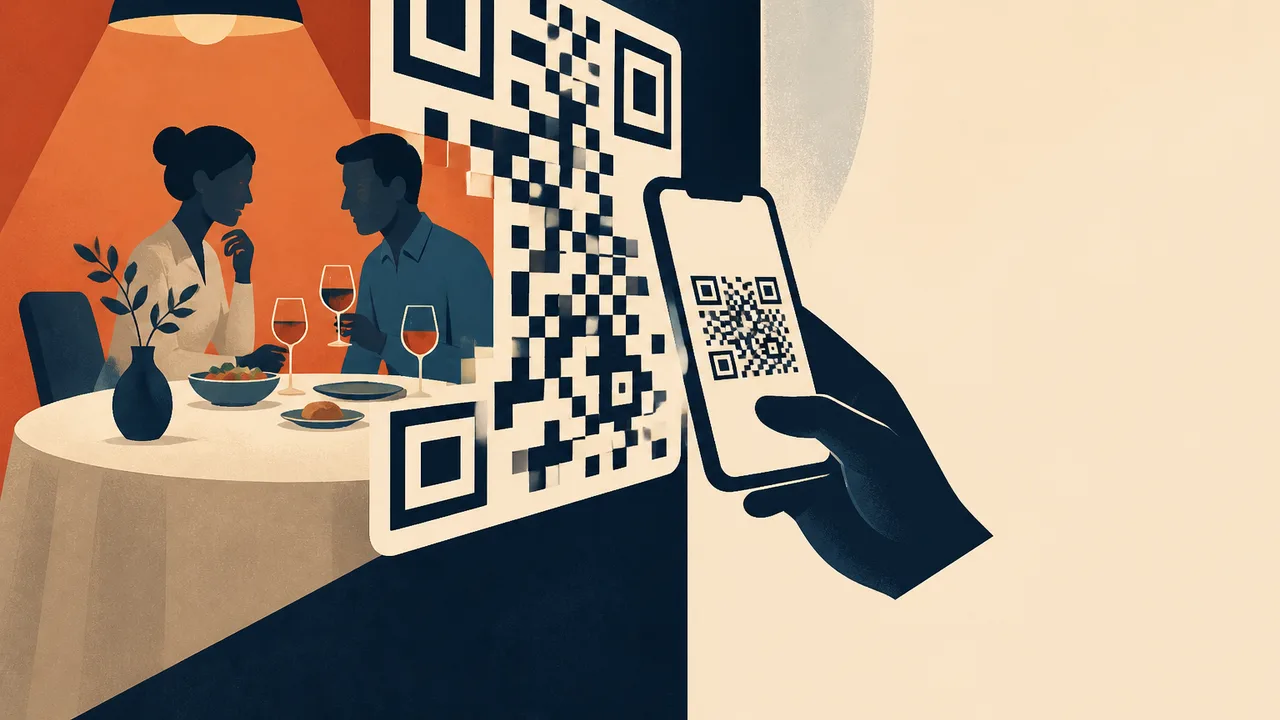
Photo: AI. Mika Sørensen
There is a specific quality of deflation I've felt at a well-appointed restaurant table — linen pressed, candlelight correctly calibrated, the room humming with that particular low frequency of people spending real money on a real evening — when a server materializes and sets down not a menu but a laminated square with a pixelated code on it. The gesture that follows, the reach for the phone, feels like breaking a spell. Not because phones are evil. Because the room just spent ten minutes telling me one story, and the QR code told me another one entirely.
Shruthi Manjula Balakrishna, Director of Research & Design at FÖDA and a Doctor of Design candidate at NC State University, has spent doctoral-level attention on exactly this friction. Her recent TEDxNCState talk draws on dissertation research — surveys of around 350 individuals across Texas and one-on-one interviews with 30 patrons — to argue that the pandemic-era pivot to QR menus wasn't merely a format change. It was an environmental intervention, one that quietly reorganizes the cognitive and social conditions of a shared meal.
Her framework is design research, not nostalgia. And the distinction matters.
What a menu actually does
Balakrishna's central claim is precise and, once stated, difficult to argue with: a menu is not a list. It is, in her language, a "choice environment." It signals care. It orchestrates attention. It tells you what kind of room you've walked into before a word is spoken. Typography, paper stock, tactile weight, the pacing of information on a page — these are not decoration. They are hospitality's first language.
When that language is replaced by a QR code, the format changes. So does the mind state. "We are not just scanning a QR code," she told NC State's College of Design in a conversation about her research, as documented on their website. "We are being pulled into a different kind of relationship at the table."
What that relationship looks like in practice: you pick up the device that contains your email, your notifications, your unread messages from people you've been avoiding. You open it at the dinner table. The phone doesn't arrive empty. It never does.
Interviewees in Balakrishna's research described QR menus in upscale settings as a letdown — the sense that something premium had gone generic, that the room's promise hadn't been kept. One diner put it plainly: "QR code menus break the intimacy when people are dining together because they're immediately drawn to their phones." Another observed, "People are so focused on their phones that it breaks the communal feel at the table." These aren't aesthetic complaints. They're descriptions of an environment that has been redesigned, without announcement, to work against its own stated purpose.
Balakrishna cites research suggesting that even brief phone use at the start of a meal affects enjoyment — a finding she references to underscore that the damage doesn't require hours of scrolling. The intrusion is structural, not just behavioral.
The labor nobody named
Here's what Balakrishna's research surfaces that most coverage of QR menus has not: the question of who absorbs the cost of the "efficiency."
The pandemic forced restaurants into digital menus fast and without much design thought. The economic logic was transparent: fewer printed menus to update and replace, less staff time spent presenting and retrieving them, operational friction reduced on the restaurant's end. What wasn't advertised was where that friction went. It didn't disappear. It transferred.
"I'm basically being asked to print the menu onto my own device," one of Balakrishna's interviewees said, and she flags this as something she can't unhear. Neither can I. The guest is now responsible for scanning, navigating a frequently clumsy interface, managing glitchy Wi-Fi, squinting at a PDF not designed for a five-inch screen in a dimly lit room. The restaurant shed a cost and handed it to the customer, dressed up as convenience.
This is a class argument with a small footprint. It shows up most visibly in the upscale segment — where guests are paying precisely for the experience of not having to troubleshoot anything — but the dynamic runs through the whole industry. "Clumsy QR systems frustrate me so much that I end up ordering less and leaving early," one diner told Balakrishna. Ordering less, in a restaurant, means the kitchen earns less, the servers earn less, and the guest leaves without the meal they came for. The efficiency gains at the operational level can quietly produce losses everywhere else.
Nobody has branded this transfer of labor as a design decision. Balakrishna's contribution is to name it as exactly that — and to argue that it's reversible, if the people designing these systems choose to design for outcomes rather than for operational ease.
The flattening
There's a second critique embedded in Balakrishna's talk that I find more unsettling than the labor argument, because it operates at the level of culture rather than economics.
Every QR menu, regardless of restaurant, shares the same basic interface logic: the same scrolling behavior, the same screen glow, the same pinch-and-zoom friction if the PDF isn't optimized. You are, as Balakrishna puts it, "in a different restaurant dancing to the same behavioral choreography." A sushi counter in Austin and a trattoria in a strip mall are now, at the menu moment, experientially identical.
She calls this homogenization. I'd call it the erasure of culinary personality at the point of first contact. Before you've tasted anything, before a server has described a dish, the restaurant has already told you it has the same relationship to your attention as every other restaurant. That's a significant thing to give up, and most operators gave it up during a crisis without fully realizing it was a choice.
A menu, Balakrishna argues, is memory design. People don't remember just what they ate. They remember the texture of the thing they held in their hands, the language used to describe the food, the table they were sitting at when they made those choices, who they were sitting with. The QR code doesn't disrupt the memory of the food. It disrupts the memory of the evening.
What deserves preserving, and what doesn't
Balakrishna is careful not to argue for abolition, and that care is part of what makes her research credible. Some guests genuinely appreciate digital menus — the ability to preview a restaurant's offerings before arriving, to avoid the social pressure of deciding quickly, to split bills without ceremony. In high-volume restaurants, digital ordering systems genuinely free staff to do the parts of their job that require a human being rather than a card machine. These are real benefits, not rationalizations.
Her framework asks a different question than printed-versus-digital: what is the menu supposed to do psychologically? If it's supposed to build anticipation, signal care, and anchor the evening as a shared event rather than a parallel series of individual transactions, then the interface — whatever it is — needs to be designed for those outcomes. A well-designed digital menu that is fast, calm, glanceable, and gets out of the way may serve a casual restaurant better than a self-congratulatory printed one. A hybrid approach — printed menus for the ritual moment of arrival, digital tools for the logistics of payment — may serve the full range of needs without sacrificing either.
What she's arguing against, specifically, is the restaurant that uploads a PDF, stamps a QR code on the table, and calls it a digital strategy. That's not a design decision. That's a cost decision wearing design's clothing. And diners, she found, notice. They notice not by naming it — hardly anyone told her they distrusted a restaurant specifically because of a QR code — but by feeling that something was off, that something had been quietly withdrawn. That's how bad design works. It doesn't announce itself. It just makes the room feel slightly less like it promised.
The question I keep returning to, sitting with Balakrishna's research, isn't whether restaurants will course-correct on digital menus. Some will; some won't. The question is what it means that an entire industry, under pressure, discovered it could transfer a layer of its labor costs onto its customers without those customers ever quite being able to articulate what had happened to them.
They felt it. They described it as a letdown, a broken mood, a room that stopped making sense. Balakrishna gave that feeling a name and a mechanism. Naming it is how you start deciding whether to keep doing it.
More Like This

Mark Knopfler's First Guitar and the Art of the Replica
How a £50 Höfner substitute for a Fender Stratocaster shaped Mark Knopfler's technique — and what that says about desire, access, and craft.
Vermeer's Art: Timeless Reflections in Modernity
Explore Vermeer's art through identity, technology, and the timeless allure of his mysterious paintings.

The Bacon Grease That Started a Bigfoot Career
A US Forest Service worker slept in a bacon grease-stained tent in Wyoming and woke up to something that wasn't a bear. What our appetites summon from the dark.
How Uber's AI Edits Food Photos for Small Restaurants
Uber built an AI system that retouches food photos for small restaurants — then had to teach it not to invent shrimp. Here's what that actually required.
How YC's Head of Design Works With AI Agents
Eve Bouffard, YC's head of design, shares her AI-first workflow—voice input, soul.md files, disposable prototypes—and what it means for design as a practice.
DoorDash's Business Model: Who Pays and Who Profits
DoorDash moved $102 billion in food last year and kept under 1% as profit. Here's how the fee stack works—and who actually bears the cost.
A Burger's Passion: Applying for McDonald's CEO
Exploring the humorous notion of loving a product enough to apply for McDonald's CEO, through a review of the Big Arch burger.
Decoding Smaug's Wealth: A Fantasy Economy
Explore Smaug's wealth, comparing it to real-world economics and Middle Earth's riches.