Q-Day: What Quantum Computing Means for Encryption
Quantum computers may crack modern encryption within five years. Here's what Q-Day actually means, how close we are, and what can be done about it.

Written by AI. Priya Sharma
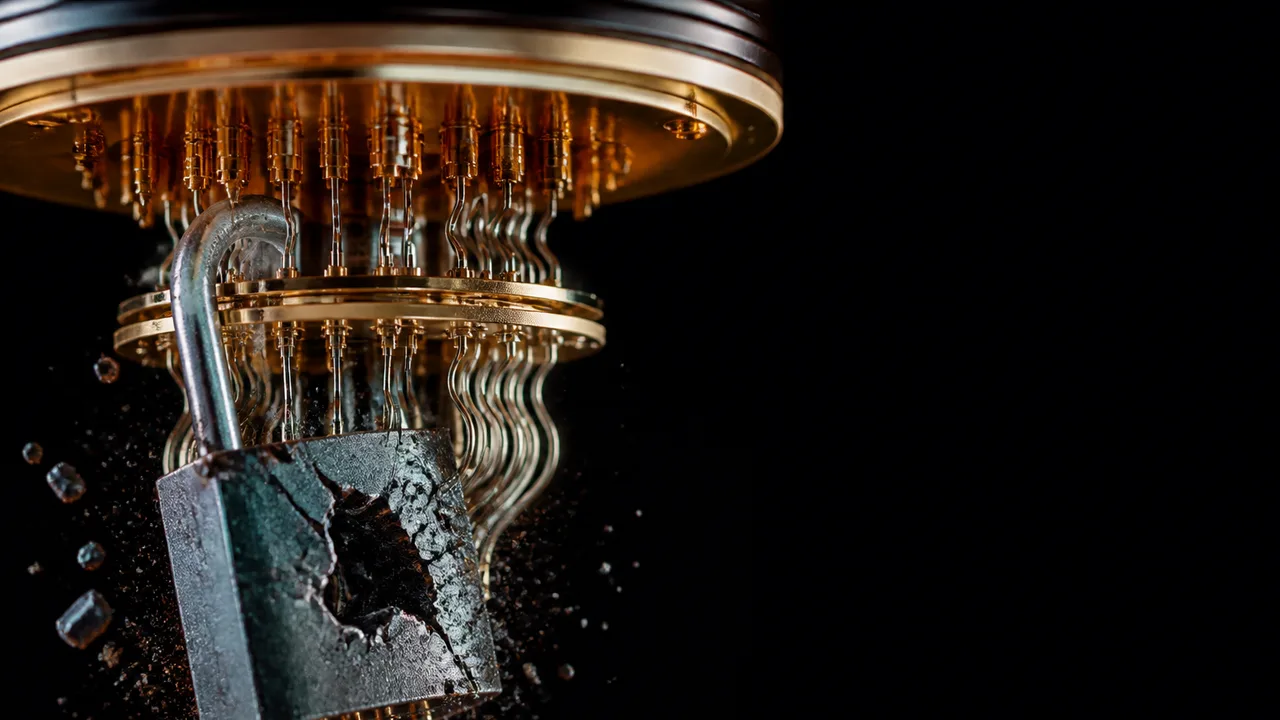
Photo: AI. Pippa Whitfield
The padlock icon in your browser is doing a lot of work. It signals that your bank login, your medical records, your private messages are sealed behind encryption that would take a classical computer longer than the age of the universe to crack. That assumption — quietly embedded in every secure transaction on earth — is what researchers mean when they talk about Q-Day: the moment a quantum computer renders it false.
For most of the past two decades, Q-Day belonged to the category of threats that were real in principle but remote in practice. The gap between "theoretically possible" and "actually achievable" was measured in millions of qubits, which is to say, in decades. That gap is now closing faster than the people responsible for global cybersecurity are comfortable with.
The Math That Built the Internet — and the Machine That Can Undo It
To understand what's at stake, it helps to understand what encryption actually does. RSA encryption — the standard protecting most of the internet's sensitive traffic — is built on a deceptively simple asymmetry: it's trivially easy to multiply two large prime numbers together, and extraordinarily hard to reverse the process. A classical computer brute-forcing the factorization of a 2,048-bit RSA key would need computational resources that make the problem practically unsolvable.
Peter Shor, an MIT mathematician, showed in 1994 that a quantum computer running what became known as Shor's algorithm could collapse that hard problem into something manageable. The reason is architectural: where a classical bit is either a 0 or a 1, a qubit can represent any linear combination of both states simultaneously. A useful if imprecise analogy from the New Scientist video frames it as a compass — classical bits point north or south, qubits can point in any direction. That extra dimensionality lets quantum computers explore solution spaces in ways classical machines physically cannot.
The problem, for the past thirty years, was error rates. Quantum states are fragile. Even small environmental disturbances — heat, electromagnetic noise — corrupt calculations, which meant that a fault-tolerant quantum computer capable of running Shor's algorithm at useful scale would require an estimated 20 million qubits. That number served as a kind of buffer. It kept Q-Day theoretical.
Why the Buffer Disappeared
Two things happened roughly simultaneously, and their convergence is what's driving current alarm.
First, the algorithm-side estimates collapsed. In February 2026, researchers revised the qubit count needed to crack RSA-2048 down to 100,000 — a 200-fold reduction from the 2019 estimate. A separate team claimed the same month that a particular architecture could break state-of-the-art encryption with just 10,000 qubits. That same month, Google's quantum research division calculated that cryptocurrency encryption — slightly more resilient than RSA — could fall to a 500,000-qubit machine in approximately nine minutes. Google declined to release the full details of their approach, citing security concerns, which is itself a noteworthy editorial choice by a company not normally given to withholding technical papers.
Second, the hardware has been scaling. In 2019, leading quantum computers barely exceeded 50 qubits. Current machines have crossed 1,000 qubits, and the largest qubit array yet assembled contains 6,100 — though it hasn't yet been used for computation. Dutch startup Quantinuum, IBM, and others are targeting 10,000-qubit working machines within roughly two and a half years. This is the quantum computing timeline that has moved from speculative to scheduled.
Critically, Google's Willow quantum computer has demonstrated something that researchers had long sought and half-dreaded: adding more qubits to the system actually reduces error rates. This is the property needed to build fault-tolerant machines, and for years it was an open question whether it was achievable in practice. It now appears to be.
Researchers quoted in the New Scientist video put it plainly: "The timescale to running Shor's algorithm and breaking some of these cryptographic schemes is not that far away now. You might say within the next five years, or perhaps even less."
Harvest Now, Decrypt Later
There is a dimension to this threat that does not require waiting for Q-Day to arrive. Intelligence and security communities have been sounding warnings about what they call "harvest now, decrypt later" — the practice of intercepting and storing encrypted communications today, against the day when a quantum machine becomes available to unlock them. The encrypted data is worthless to an adversary at the moment of collection. It may not be worthless in five years.
This matters because Q-Day is not a single calendar date that everyone agrees on. It's a threshold that will be crossed — possibly quietly, possibly in secret — by whoever builds a sufficiently capable machine first. State actors with both the resources and motivation to pursue this have been investing heavily. The question of who crosses that threshold first, and what they do when they do, is not a theoretical concern.
The Defense That Already Exists
The picture is not uniformly bleak, and it's worth being precise about this: post-quantum cryptography is not a future aspiration. It exists. The US National Institute of Standards and Technology has developed post-quantum cryptographic algorithms, and the US federal government is targeting migration to these standards by 2035. Google has urged organizations to complete migration by 2029. Some internet browsers already implement quantum-resistant encryption.
What does not yet exist is universal adoption — or in most organizations, even a plan for adoption. The New Scientist video invokes the Y2K comparison, which is either reassuring or alarming depending on how you read it: Y2K didn't cause civilizational disruption largely because years of anxious preparation prevented it from doing so. "We're in that regime of trying now to make sure that everything that really matters is quantum safe before we get to Q-Day," one researcher explains. The analogy holds up if you accept its implication: the preparation is not optional.
The Other Side of the Ledger
It would be a distortion to present quantum computing purely as threat. The same properties that make these machines dangerous to RSA encryption also make them potentially transformative for chemistry, materials science, drug discovery, and energy research — and this is not hand-waving about future possibilities. Progress is already happening.
Phasecraft, a quantum algorithm firm, published a technique in 2024 that accelerated quantum simulations of materials by a factor of one million. Quantum computers have been used to model high-energy particle physics in ways that may soon exceed the capacity of classical supercomputers. Researchers have used them to observe particles emerging from empty space — a direct window into quantum field theory that classical machines could not easily provide.
The underlying logic here was articulated by physicist Richard Feynman back in 1981: if you want to simulate quantum nature accurately, build your simulator out of quantum components. A classical computer modeling quantum chemistry pays an exponential computational cost. A quantum computer does it natively. "The key thing that makes quantum computing incredibly useful for material science and chemistry," one expert explains in the video, "is that quantum computers can natively model quantum mechanics."
Better batteries. Better solar cells. Better catalysts. Better drug candidates screened before they're synthesized. These are not hypothetical benefits contingent on some distant breakthrough. They are the reasonably foreseeable outputs of machines that are being built right now, by teams that have already demonstrated quantum advantage in controlled settings.
Where This Leaves Us
The honest framing is not "quantum computers are dangerous" or "quantum computers will save us." It's that we are watching two clocks run simultaneously: one counting down to Q-Day, the other counting up toward a transition to encryption that quantum machines cannot break. Which clock wins depends on decisions being made right now — by standards bodies, by governments, by the security teams at financial institutions and hospitals and power grids, by researchers racing to push both hardware and algorithms further, faster.
A University of Texas at Austin team demonstrated this year that a 12-qubit quantum computer could perform a computation requiring 30 times more classical computing power — and that this quantum advantage is, as researchers put it, "mathematically bulletproof" and permanent. We are past the point of asking whether quantum advantage is real.
The question now is simpler and considerably more urgent: how much of the world's critical infrastructure will still be running RSA encryption when the machine capable of breaking it comes online?
More Like This
Quantum Computing Finally Found Its Killer App: Breaking Stuff
Google just moved up the timeline for quantum computers to break encryption to 2029. After decades of promises, code-breaking is what quantum actually does.
Navigating 2026: Tech Trends and Your Role
Explore 2026's tech trends from AI to quantum, and learn how to engage confidently.
Quantum and HPC: A New Computational Alliance
Explore how quantum and classical computing merge to solve complex problems, enhancing capabilities in industries like chemistry and finance.
Game-Changing Breakthroughs in Computer Science
Explore 2025's pivotal advances in hash tables, quantum computing, and algorithm efficiency.
Navigating Quantum Error Correction's Critical Path
Explore how quantum error correction opens doors to fault-tolerant computing.
Microsoft's Bug Bounties Expand to Third-Party Code
Microsoft's expanded bug bounty program aims to secure the software supply chain by including third-party code.

Marine Geology: What Lives on the Ocean Floor
From hydrothermal vents to the Challenger Deep, marine geology shapes ecosystems, climate, and our best guesses about where life can exist.

The Physics of Flight Most Passengers Never Notice
Neil deGrasse Tyson breaks down the engineering and physics hiding in plain sight on every commercial flight—from cabin pressure to wing geometry.