Perplexity Details Ivy, Tulip and ROSE, Its GPU Embedding Stack
Perplexity has published an engineering account of its GPU embedding stack, Ivy, Tulip and ROSE. What the post claims, what it proves, and why serving matters.

Written by AI. Samira Barnes
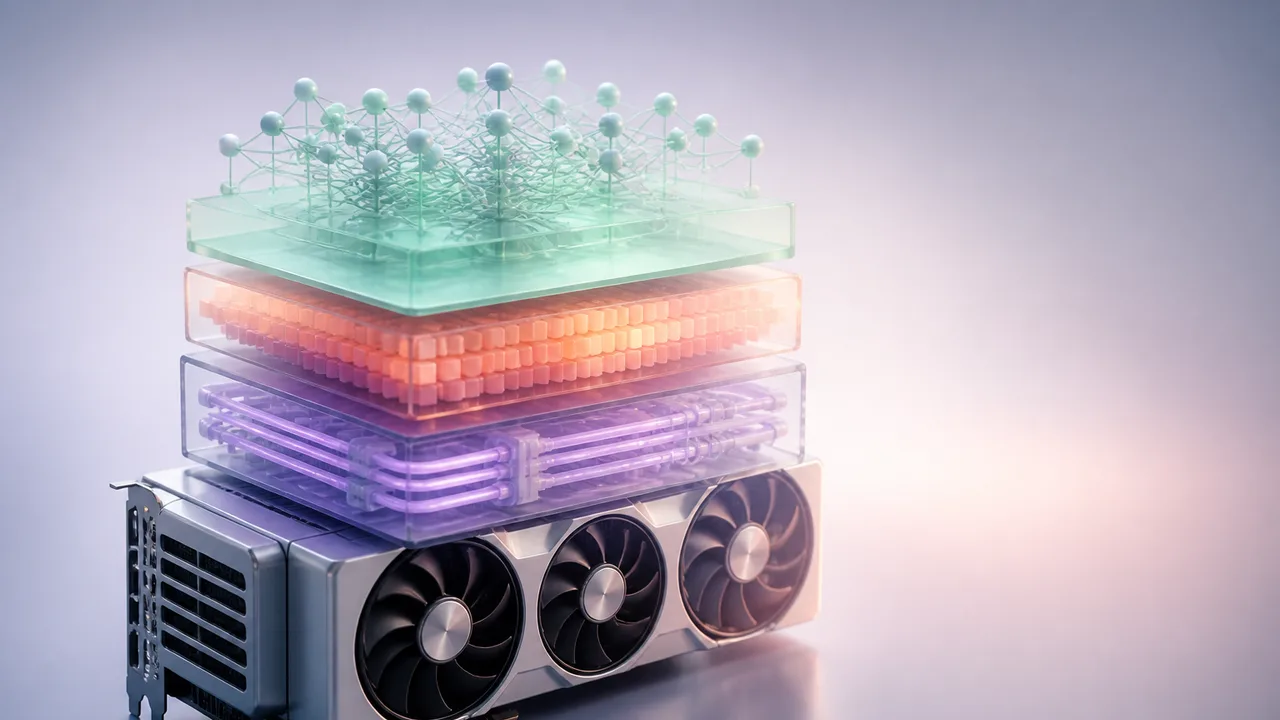
Perplexity's engineering team has published an account of the GPU infrastructure behind its embedding and ranking systems, according to marktechpost.com. The writeup describes a stack built around three components with garden-path names, Ivy, Tulip and ROSE, that serve embedding workloads for pplx-embed and the company's related ranking systems. No new model appears in the post. The subject is plumbing.
That choice of subject is the story. In AI search, the quality of retrieval depends on two things that pull against each other: how well an embedding model represents text, and what it costs to run that model across an index of billions of documents, millions of times a day. A team can train a state-of-the-art encoder and still lose, if the serving layer turns every query into a latency spike or an idle GPU bill. Perplexity's post, as summarized by marktechpost.com, is an argument that the second problem deserves as much engineering attention as the first.
What the Stack Actually Does
The published account organizes the serving layer into three parts. Ivy, Tulip and ROSE together handle the lifecycle of an embedding request: ingesting it, batching it efficiently onto GPUs, moving data between host memory and device memory, and scheduling competing workloads so one tenant's bulk indexing job does not starve another's latency-sensitive query. The components serve pplx-embed, Perplexity's embedding API offering, along with the internal ranking systems that sit behind its search product.
AlphaSignal framed the release more competitively, reporting that the ROSE serving stack beats vLLM on both latency and throughput. The comparison carries weight because vLLM is the de facto open-source standard for GPU inference serving; if a production team can demonstrate measurable wins against it on a real workload, that is a claim other engineers will want to test.
Readers should hold two claims apart, though. One claim is about infrastructure: Perplexity built a serving stack that, on its own workloads, outperforms a general-purpose alternative. The other claim, the one most readers of an AI search company actually care about, is whether any of this produces better search results. The material published so far establishes the first claim and does not establish the second. No benchmark in the supplied reporting shows a search-quality advantage over competing serving stacks or competing retrieval systems. That gap is not a knock on the engineering; it is a boundary on what has been demonstrated.
Why Serving is a Competitive Question, Not Just an Operational One
Embedding inference has an awkward economics. Unlike generative inference, where each request produces tokens that justify GPU time, an embedding request produces a single vector. The entire business of serving embeddings at scale is keeping expensive silicon busy: batching many requests together, keeping the weights resident so they are not fetched from host memory on every call, and shaping request flow so the GPU never idles between micro-batches. Small scheduling decisions compound into large cost differences at Perplexity's scale, because the same encoder must run both during bulk index construction and during interactive queries with millisecond budgets.
This is why the vLLM comparison matters beyond vanity benchmarks. vLLM was built primarily around the serving patterns of generative models, where paged attention and token streaming dominate the design. Embedding workloads have different shapes: fixed output size, extreme sensitivity to batch composition, and a mix of throughput-bound and latency-bound traffic hitting the same fleet. A serving layer purpose-built for that profile can beat a general-purpose one, and AlphaSignal's summary suggests Perplexity says it does. The open question is how much of the gain comes from the workload fit and how much would survive under independent replication with published configurations.
The Pattern Behind the Post
The release fits a broader pattern among AI infrastructure teams: publish the operational account, not just the model card. When companies describe their serving stacks in public, the audience is partly prospective customers and partly the engineering labor market. A detailed post about Ivy, Tulip and ROSE tells API buyers that the pplx-embed product line rests on purpose-built infrastructure, and it signals to infrastructure engineers that hard problems live inside the company. Neither motive invalidates the content, but both shape what gets disclosed. Cost figures, hardware counts and utilization percentages are the numbers that would make the account fully falsifiable, and the reporting does not indicate they were included.
There is also a competitive subtext. Perplexity operates in a market where search quality is the product, and search quality at scale is a retrieval problem before it is a generation problem. If embedding serving costs drop, a search company can afford to embed more of the web, refresh its index more often, or run heavier reranking models on more queries. Efficiency claims in this layer are claims about product strategy: more index coverage per dollar. Perplexity has not published numbers connecting the stack to any of those outcomes, so the strategic reading remains inference, in both senses of the word.
What to Watch Next
Three things would move this from case study to evidence. First, an independent reproduction of the ROSE-versus-vLLM comparison on a public embedding workload, with hardware and configuration pinned down. Second, published ablations showing what each component contributes; the three-name structure implies separable parts, and separable parts can be benchmarked separately. Third, and most important for users, any data tying serving efficiency to measurable retrieval improvements, such as index freshness or rerank depth at fixed cost.
Until then, the post stands as a documented look inside a fleet most companies keep dark, and AlphaSignal's summary gives it a concrete, testable headline claim. The wager Perplexity is making, in effect, is that the boring layer is where search is won. The industry will find out whether the wager pays the same way it always does: by asking for the numbers.
More Like This

Anthropic's Claude Code Update: AI Agents Get Planning Tools
Anthropic released Claude Code v2.1.92 with Ultra Plan for transparent AI project planning and Managed Agents for deployment without infrastructure.
Cline CLI 2.0: Open-Source AI Coding Tool Goes Terminal
Cline CLI 2.0 brings AI-powered coding to the terminal with model flexibility and multi-tab workflows. But open-source AI tools raise questions.

Perplexity Hybrid Compute on Mac: Privacy or Cost Offload?
Perplexity's new hybrid compute feature for Mac routes sensitive tasks locally. But who controls the routing, and what does that mean for user privacy?

OpenAI's Workspace Agents: The Governance Question No One Asked
OpenAI's new Workspace Agents automate team workflows—but the real product isn't the AI. It's the permission model enterprises can actually live with.

Perplexity Computer Might Actually Be the Agent We Need
Perplexity Computer solves AI agents' biggest problem—getting blocked by websites—while dynamically choosing the best model for each task. Here's what matters.

White House Science Chief Lays Out a Plan to 10x Research
Michael Kratsios outlines the Genesis Mission, AI-driven grant reform, and the case for treating scientific productivity as a national security issue.

AI Chip Smuggling and the US-China Tech Divide
FT's Eleanor Olcott investigates the black market for Nvidia AI chips reaching China despite US export controls — and what it reveals about the tech race.

Promptware: When AI Agents Become Attack Vectors
Prompt injection attacks on AI agents follow a structured kill chain — and existing legal frameworks have almost nothing to say about who's liable when it works.