Paris Wall Discovery Puts Caesar's Account to the Test
A burned Gallic wall beneath a Paris hospital may locate ancient Lutetia, while exposing the limits of using archaeology to verify Julius Caesar.

Written by AI. Helen Papadopoulos
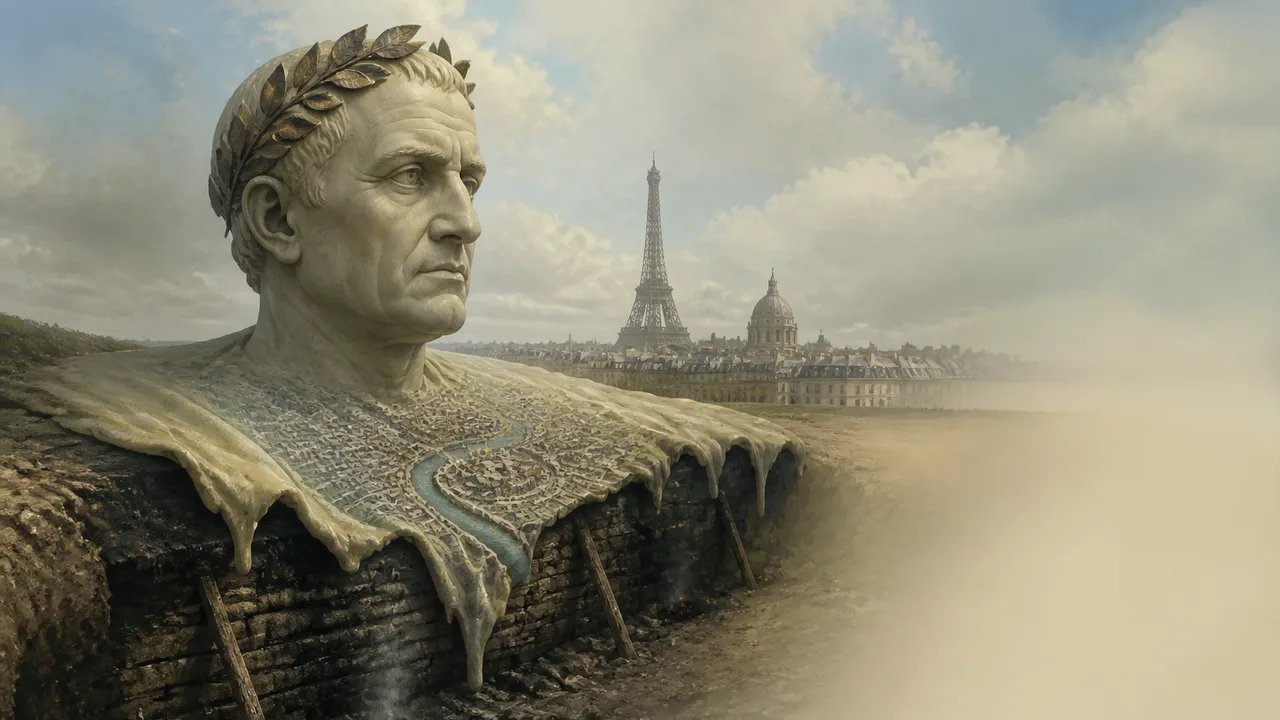
A 20-metre stone-and-timber wall beneath Paris’s Hôtel-Dieu hospital may be the strongest physical evidence yet for the lost Gallic settlement of Lutetia.
The wall was uncovered in the hospital courtyard on the Île de la Cité, close to Notre-Dame, during an excavation that began in February 2026 as part of the site’s restructuring. Its location is immediately suggestive. Julius Caesar described Lutetia as a town of the Parisii situated on an island in the Seine, but that economical sentence left generations of scholars with rather more river than address.
The excavators have more than geography. They found a defensive structure built with large stone blocks and interlocking wooden beams, charred surfaces, burned seeds, the remains of a burned wooden building and a Gallic spearhead at the wall’s foot. A thick platform of sand and gravel behind the wall also points toward a defensive function. Dorothée Chaoui-Derieux of the Île-de-France Regional Archaeology Service said its interlocking-beam construction immediately suggested a wall in the Gallic tradition.
Initial carbon-14 results place the wooden elements between 200 and 10 BCE. The Battle of Lutetia occurred in 52 BCE, comfortably inside that range. Comfort, however, is not identity. A dating window spanning nearly two centuries cannot assign the burning to a single campaign, and a spearhead beside a fortification does not reconstruct the circumstances in which either object arrived there.
That combination of fit and uncertainty makes the discovery more instructive than a simple announcement that archaeologists have “found Caesar’s fort.” It offers a demonstration of how ancient history changes when a famous text meets stubborn matter.
What Caesar Said Happened in 52 BCE
Lutetia belonged to the Parisii, a Gallic people living along the Seine. During the Gallic Wars, fought from 58 to 50 BCE, Roman forces confronted the Parisii in 52 BCE, the great revolt year that dominates Book 7 of Caesar’s account.
Caesar describes Roman troops approaching “Lutetia, a town of the Parisii, situated on an island in the river Seine.” He then says the Gallic forces “ordered Lutetia to be set on fire” and had its bridges cut down.
The destruction formed part of a deliberate defense. Burning the settlement deprived the advancing army of an intact position and severing the bridges complicated access. It did not prevent Roman victory in the wider battle. The Romans defeated the Gallic force, while the town they sought had already been sacrificed by its defenders. Victory and possession came apart: Rome won, but Lutetia could not be taken intact.
That sequence helps explain why the settlement became so elusive. Caesar supplied an island and a river, followed by fire and demolition. Later rebuilding, occupation and the eventual development of Paris further complicated the archaeological search. The Île de la Cité remained an obvious candidate, yet direct evidence for a Gallic fortified center had been scarce.
The new wall changes that evidentiary landscape because several clues converge at one location. The construction resembles Gallic fortification; the material dates to the late Iron Age; the site sits on a Seine island; and the remains preserve substantial burning. Stéphane Deschamps, a regional curator of archaeology, said the find may hold “the key to the mystery” of Lutetia’s debated location.
The phrase “may hold” is doing useful labor. Catherine Pégard, France’s culture minister, called the convergence of evidence remarkable while adding that the structure’s function and chronology still require verification. Accounts of the ministry’s announcement also describe continued excavation and analysis rather than a completed identification.
Caesar Enters the Witness Box
Ancient texts often survive because powerful people possessed the means to write, circulate and preserve their version of events. Caesar’s account comes from the conquering side, and he was not personally present at Lutetia; the operation was commanded by his lieutenant Labienus. That does not make the narrative useless. It identifies the questions that archaeology can test: Was there a Gallic fortified site on a Seine island? Did it burn in the relevant period? Does its architecture belong to the community Caesar named?
The wall provides provisional answers of “plausibly,” “yes, within a broad range” and “apparently.” It cannot yet answer whether the Parisii ordered this fire in 52 BCE, whether another conflict or accident caused it, or whether every part of Caesar’s sequence unfolded as he wrote it.
This is how corroboration usually works outside detective fiction. Historians rarely receive one artefact bearing a helpful label that says, “Burned on Labienus’s approach, 52 BCE.” They assemble associations. Location, construction, chronology and destruction can strengthen an identification together even when none settles it alone.
The reasoning also runs in both directions. Caesar’s text makes the burn layer more historically suggestive, while the burn layer gives his terse geographical notice a possible physical setting. Neither source should swallow the other. Treating the wall as an illustration of Caesar would reduce archaeology to decorative footnotes. Treating the text as irrelevant would discard the reason this combination of island, fortification and fire commands such attention.
A Wall and a Cemetery Answer Different Questions
Archaeologists had previously found a necropolis possibly connected with Lutetia beneath a bus-station area on mainland Paris. That discovery and the Hôtel-Dieu wall offer a useful comparison because ancient cities extended beyond the places where people slept, traded and governed.
A cemetery can establish that a community buried its dead in an area and can reveal practices, chronology and population. Its location does not necessarily identify the community’s fortified center. The hospital excavation supplies a different category of evidence: substantial defensive architecture on the island described in the written account.
The two finds therefore need not compete as rival “birthplaces of Paris.” They may belong to different parts of a broader settlement landscape, although the available evidence does not establish their precise relationship. Modern expectations encourage us to look for one pin on a map marked LUTETIA. Ancient communities could distribute fortifications, habitation, roads and burial grounds across a wider area.
That comparison also disciplines the phrase “origins of Paris.” The newly uncovered structure belonged to the pre-Roman Parisii and may illuminate the place from which later Paris developed. Calling it simply the first Paris risks placing the modern city at the center of a society that knew neither France nor the civic identity later attached to the name. The people who built the wall deserve to appear as historical actors, rather than as Romans waiting to happen or Parisians born prematurely.
What the Fire Can and Cannot Establish
The burned wall fits Caesar’s narrative unusually well, but the current dating range remains the chief restraint. Somewhere between 200 and 10 BCE includes 52 BCE; it also includes many other years. Further analysis may narrow the chronology or clarify whether the wall served as an enclosure for an oppidum, the fortified settlement described by the ministry.
Fire has preserved the historical question while damaging the structure that raised it. The remains are reportedly too fragile for complete preservation. Archaeologists plan to document them through 3D photogrammetry, create a replica and reconstruct removed portions with recovered original elements where possible.
That afterlife introduces an apt final complication. The public object will eventually combine surviving ancient fabric, digital recording and modern reconstruction. Like the identification of Lutetia itself, it will rest on a chain of evidence rather than untouched antiquity.
Caesar left a sentence about an island and a fire. The Parisii left charred timber, stonework and a spearhead. After two millennia in which the conqueror did most of the talking, the wall has entered the argument.
More Like This
Bank Cards Are Built From Cold War Spy Tech
From CIA security passes to a Soviet bug hidden in a wooden seal, the technology inside your bank card has a wilder history than you'd expect.
Casa del Desierto: Barstow's Forgotten Harvey House
Barstow's Casa del Desierto is a stunning 1911 Harvey House in the Mojave Desert—and one of America's least-visited Amtrak stations. Here's why it still matters.