Oracle Will Offer Google TPUs Through Its Cloud in 2027
Oracle plans to offer Google TPUs in 2027, opening a new route to AI compute while leaving questions about capacity, Nvidia's place and Google's chip economics.

Written by AI. Marcus Chen-Ramirez
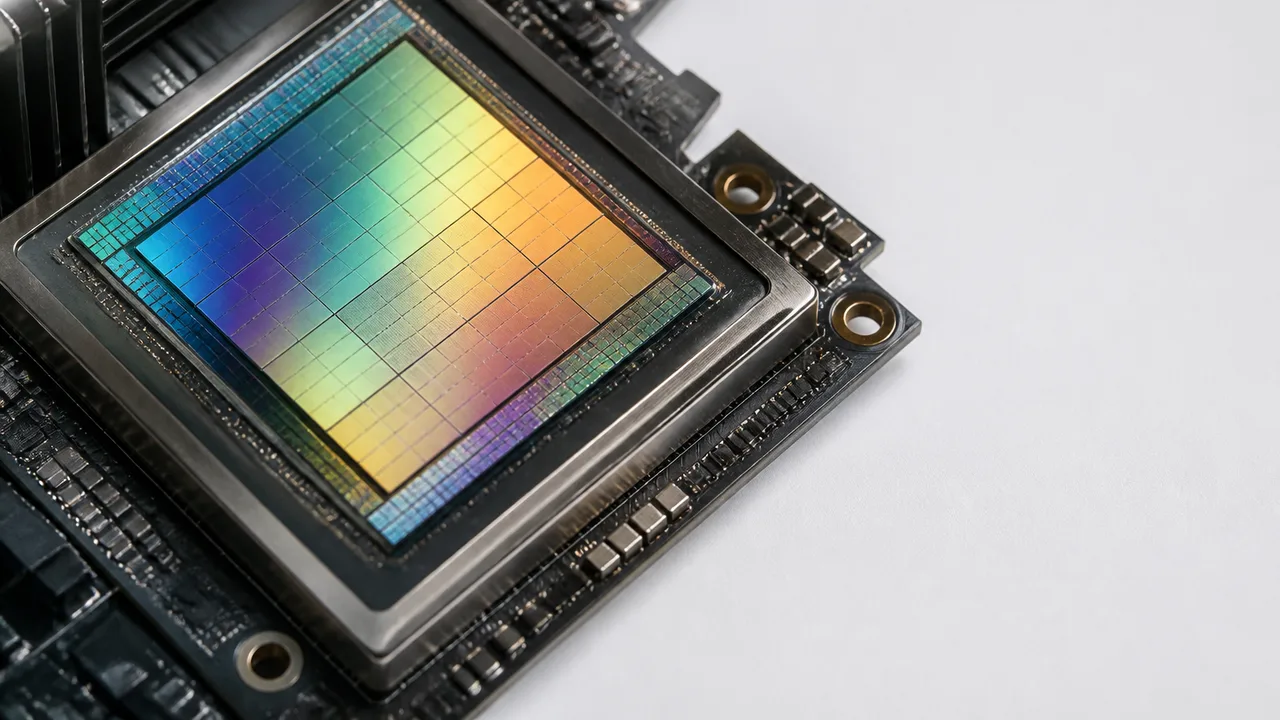
Oracle plans to put Google’s AI chips in its cloud in 2027. The agreement announced Tuesday would make Oracle the first hyperscale cloud outside Google to offer tensor processing units, or TPUs, to its customers. Oracle will house the chips in its own data centers and provide the power, cooling and networking. Capacity is supposed to grow over several years, but Oracle has not disclosed how many chips customers can expect at the start.
For a company trying to train or run an AI model, the immediate news is a future option on a familiar cloud platform. For Google, it is a test of something larger: whether a chip developed for its own computing systems can become a product customers choose through someone else’s infrastructure. A second storefront can reach buyers Google might otherwise miss. It also leaves Google relying on Oracle to turn a planned chip supply into usable capacity.
TPUs are processors built for AI work. Oracle says Google’s eighth generation will include the TPU 8t for training, the compute-intensive process of building a model, and the TPU 8i for inference, which runs a model after training. Those are different purchasing problems. A team that needs a large training cluster may care about how many chips it can reserve together; a service running an existing model may care about how much work it can process for its spending. Oracle’s promise to offer both varieties addresses both jobs, but the undisclosed starting quantity makes it hard to judge what either customer could actually book in 2027.
From Google’s Servers to Another Cloud’s Catalog
Google began developing its own silicon in 2013. For years, its pitch combined chips, models and cloud services in one place. It opened TPU sales to outside data centers in the second quarter of 2026. The Oracle arrangement adds a different route: customers would select Google chips within Oracle Cloud Infrastructure while Oracle operates the facilities around them.
That sequence explains why the partner is consequential even before its first TPU goes live. Selling hardware to an organization that operates its own data center asks that buyer to handle the surrounding infrastructure. Offering chips through Oracle places them in another cloud provider’s catalog. Google gets another path to customers, while Oracle gets a processor it did not develop.
Google also has a reason to keep chips close. At a September conference, Google Cloud chief Thomas Kurian said servers using Google’s own silicon reach payback in roughly half the time of its AI servers overall because the company can optimize the full system. That is his account of Google’s internal economics, rather than a forecast for hardware operated by Oracle. If outside demand grows, Google has to decide how much silicon to direct to its own services and how much to distribute through partners. Oracle’s deal makes that allocation question more concrete.
Oracle is Still Buying Nvidia
Oracle’s Tuesday announcements included Nvidia Vera Rubin systems and CPUs, which it said were generally available on its cloud, plus plans for another Rubin server configuration. It is adding Google TPUs to a catalog that still includes Nvidia hardware. Oracle Cloud Infrastructure president Mahesh Thiagarajan said customers need flexibility to choose infrastructure for different workloads.
That is a persuasive case for Oracle’s approach. An AI provider may want one processor for a training run and another for a deployed model, or may value a second supplier when capacity is tight. More choice could also give customers leverage over price. Those potential benefits depend on what customers can obtain and how their software runs on each option. A menu with a new item arriving next year does not tell a customer its price, its portion size or whether the kitchen can keep up.
The clearest comparison is Anthropic, which has already made a substantial commitment to Google’s silicon. It agreed in October 2025 to use up to one million TPUs in a deal worth tens of billions of dollars. Anthropic also said in an October 2026 filing that it uses chips from Google, Amazon, Nvidia and AMD, selecting among them for the price, performance and efficiency of each workload. Its arrangement shows how a major AI developer can commit to TPUs while retaining other suppliers.
Oracle’s offer serves a different relationship. Anthropic is a large chip customer with a stated ceiling on its commitment; Oracle would be a cloud operator offering TPUs to its own customers. The one-million figure is an upper bound on Anthropic’s deal, not a count of chips running today, and Oracle has given no comparable quantity. Putting the figures side by side would suggest a scale comparison neither arrangement permits.
OpenAI offers another variation, with an additional caveat. It plans to buy Google TPUs, The Information said Tuesday, citing a person familiar with the matter; CNBC subsequently confirmed the plan. The terms and quantity have not been disclosed. A purchase would differ from renting compute through a cloud, but a reported plan is not an installed cluster. OpenAI had begun renting Google chips in June 2025, Reuters said; OpenAI soon said it had no active plans to use them in its products. Commercial access and product use can follow different paths, even for the same buyer.
The three arrangements show what Google is trying to build around TPUs: Anthropic’s agreement, OpenAI’s reported purchase plan and access through a rival cloud. They also put Google in business with companies whose AI products compete with its own. The possible payoff is a larger chip customer base. The cost is that some of those customers can use Google silicon to improve competing models.
TD Cowen estimates an operating margin of about 20% for external TPU sales, compared with an overall Google Cloud margin of about 35% in the previous quarter. Those are an analyst’s estimates for different businesses, not the realized margin on the Oracle arrangement. They suggest a tradeoff Google may accept: earning less per dollar of chip sales than it does across its cloud business could still be attractive if partner sales substantially expand the market for TPUs. Keeping everything inside Google’s cloud would preserve more control over the hardware and software together, but would leave Oracle’s customer relationship to Oracle.
For customers, the practical test begins when Oracle can say how many TPUs are ready, where they can be booked and on what terms. For Google, the test is whether a chip designed inside its own systems can win work in a cloud it does not run. Oracle has offered that chip a place on the menu. The first orders will show what that place is worth.
More Like This
Microsoft's Maia 300 Puts AI Inference on Its Own Chips
Microsoft plans to make Maia its primary AI inference system. Its rollout history, Nvidia ties and AWS's two-chip plan show what the 2027 ambition will require.

AMD's World Labs Deal Is a Bet on AI's Next Workloads
AMD's $8.2 billion World Labs deal buys research, talent and an early view of future AI workloads, but the commercial case remains unproven across markets.

TSMC's Cross-Node Strategy Keeps AI Chip Supply Moving
TSMC's cross-node utilization strategy lets older fabs support newer chip production—and a fleet of trucks is holding it all together while new fabs come online.
The Helium Crisis That Could Choke AI's Chip Supply
A missile strike in Qatar has cut off a third of the world's helium supply. AI chip makers now face a supply chain crisis with no easy fix.
Nvidia's Nemoclaw Wraps Security Around OpenClaw for Enterprise
Nvidia's new Nemoclaw solution adds enterprise-grade security to OpenClaw, addressing the AI agent platform's biggest adoption barrier with smart data routing.
Furiosa AI: Redefining Efficiency in AI Chips
Furiosa AI's Warboy chip offers a power-efficient solution to AI's energy challenges, reshaping data center economics.

Data Science Case Study Interviews Are Getting Harder
Data science interviews now test business judgment, not just code. Here's what the shift toward case study formats means for candidates and hiring managers alike.

Google AI Teaches Quantum Computers to Learn From Errors
Google researchers have built an AI system that keeps quantum computers calibrated mid-computation. Here's what that actually means—and why it matters.