OpenAI's 88-Hour Math Claim and the Credit Fight Behind It
OpenAI claims AI agents solved the Navier-Stokes Millennium Prize problem in 88 hours, but a credit dispute and a data-use caveat raise harder questions.

Written by AI. Marcus Chen-Ramirez
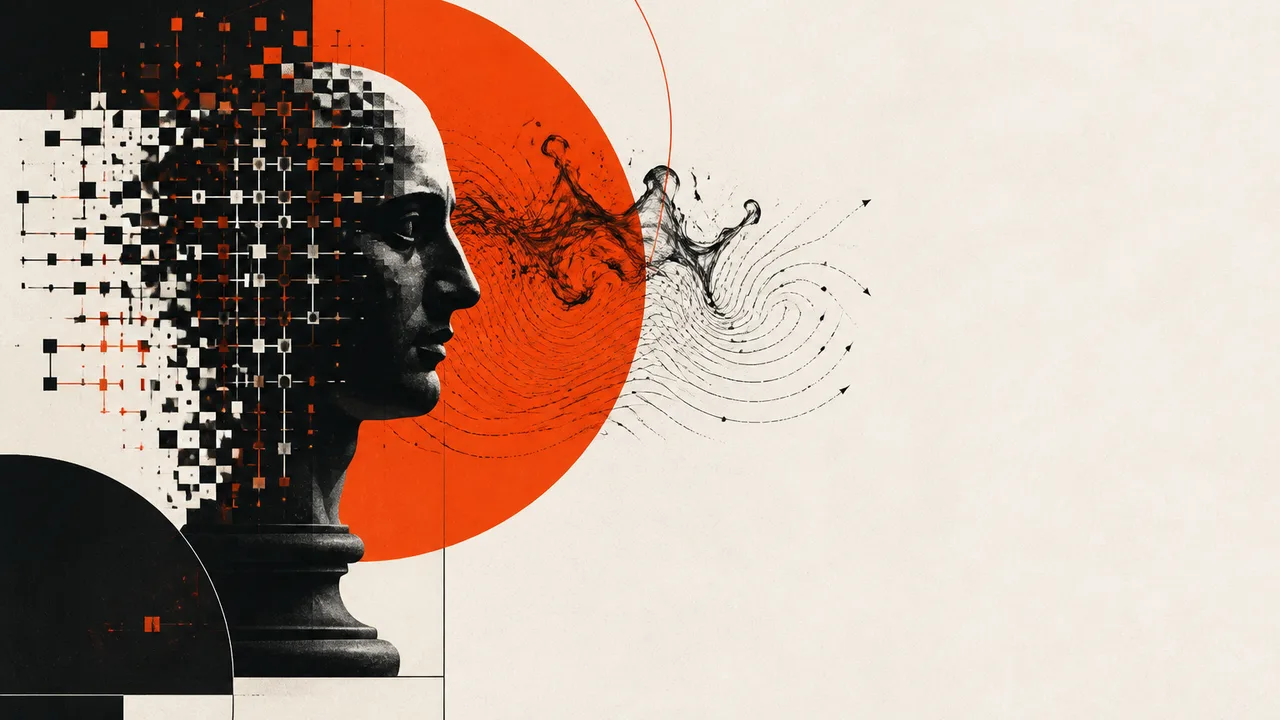
Photo: AI. Ondine Ferretti
OpenAI says a group of AI agents running on an unreleased next-generation model produced a solution to the Navier–Stokes Millennium Prize problem in 88 hours, working from September 1 to September 5 and burning through 4.9 million agent messages and 300 billion output tokens along the way. If that claim survives scrutiny, it would mark the first time an AI has cracked one of the seven problems the Clay Mathematics Institute has held open with a $1 million bounty each, some for over 90 years.
But the announcement arrived tangled in a dispute about who actually earned the credit, and that dispute may end up teaching us more about the AI industry than the math itself.
Why the Navier–Stokes Problem Matters
The Navier–Stokes equations describe how fluids move: water through pipes, air over a wing, ocean currents, smoke curling through a room. A vast share of modern engineering, from aircraft design to chip cooling to weather prediction, leans on them. The Millennium Prize version asks a deeper question: do smooth solutions always exist, or can a fluid theoretically blow up into infinite complexity? Nobody has answered that in the century since the equations were formalized.
That is why the claim of a solution carries weight beyond mathematics. As Indian Defence Review reports, the experiment is being read as a signal that AI can now attack foundational scientific problems rather than only trivia and code completion. Skeptics urge caution: as my colleague's earlier Navier-Stokes claim coverage noted, mathematicians want a formal, verifiable proof checked by the community before anyone calls a Millennium Problem solved. A company blog post is not peer review.
The Dispute over Credit
Here is where the story gets uncomfortable. Two mathematicians, Tristan Buckmaster and Levent Alpöge, spent about a year working on a related fluid dynamics problem, storing their drafts in OpenAI's Codex tool while using AI assistance themselves. By mid-August they had proven something previously unproven.
According to Matthew Berman's video on the episode, the timeline then turned tense. On September 3, rumors reached the pair that OpenAI knew about their work; Buckmaster emailed to clarify the project was personal, not an official Anthropic effort (Buckmaster works at Anthropic). On September 6, OpenAI called to say its own AI had produced a major proof on the next, harder version of the same problem, using what Berman describes as the same unusual approach the mathematicians had taken. Buckmaster says OpenAI's first prompt toward that problem went out only a day after the company learned of their progress.
Buckmaster published a statement on September 8 accusing OpenAI of rushing the solution into public to control the credit narrative. OpenAI answered with a categorical denial: "We, the researchers and the agents, did not see any of their work through any means until they released it publicly. In particular, no specific user data was accessed in order to solve this problem."
Then came the caveat that reframes the whole story: "While unlikely, we cannot rule out that de-identified data derived from their usage of our products helped improve our models."
Sebastian Bubeck, who led the Navier–Stokes initiative at OpenAI, later posted his side of the conversations, saying he reached out to coordinate releases, never asked for Alpöge's removal from authorship, and found the meetings difficult because Alpöge refused to attend. International Business Times covered the same standoff, framing it as two researchers raising questions about credit over a claimed million-dollar solution.
The Line that Should Worry Every Builder
Set aside who is right; neither side's full record is public. Read OpenAI's sentence again with a different hat on, say, a startup founder's. Any business built on a frontier API now operates under an explicit disclaimer: your usage data, de-identified, may improve the vendor's models. The vendor's future model may then internalize your domain expertise and compete with you, or simply absorb the differentiation you thought you had.
This is textbook platform risk, and OpenAI has essentially admitted it in writing. The practical responses are unglamorous: read the data-retention and training policies before shipping anything sensitive, minimize what you send to hosted models, and weigh self-hosted or open-source models for high-value intellectual property. TechBuzz notes that the backlash over the 88-hour claim has intensified exactly these questions about data handling and credit.
Assisted Discovery Versus Autonomous Discovery
Berman's video also reaches for the frame of recursive self-improvement: AI discovering new math that feeds back into making AI stronger. He notes OpenAI has published work on using AI to accelerate its own research, and that models like GPT-5.5 reportedly helped build successors. But the honest reading of the Navier–Stokes episode cuts the other way too. Two human mathematicians framed the problem, developed the unusual approach, and validated a result over a year of work. The AI then ran very fast in the direction humans pointed. That is acceleration, not a closed loop where the machine chooses its own questions, designs its own experiments, and patches itself.
Both labs have incentives to blur that distinction, and observers do too. Valency's analysis of the episode frames it as a preview of AI-accelerated science generally, which is probably right, but the preview still has humans holding the camera.
Where This Leaves People
Berman closes with the chess analogy: engines surpassed the best humans decades ago, yet people still watch Magnus Carlsen because human competition is the point. Math and science have no such spectator culture. What society wants from research is the fastest best answer, and if AI delivers it, human discovery may go the way of the chess engine: still practiced, no longer decisive.
I find that framing persuasive as far as it goes, but the credit dispute underneath this story suggests a third outcome nobody is planning for. If machines do the proving while humans supply the framing, the fighting will be over attribution, data provenance, and who owns the drafts left in someone else's tool. That fight, not the proof itself, is the part of this story with precedent. The Navier–Stokes claim will be verified or discarded by mathematicians on their own timeline. The question of what a model company owes the people whose work passes through its servers has no committee waiting to judge it.
More Like This
Should Your Kid Use AI? A Tech Parent's Honest Answer
A tech journalist who codes for a living explains why he won't let his 8-year-old use AI unsupervised—and why the environmental argument misses the point.

OpenAI Launches GPT-5.6 Sol, Terra, and Luna Models
OpenAI's GPT-5.6 family—Sol, Terra, and Luna—is rolling out globally. Real users, real tasks, real questions about what "capable" actually means.
Power Users Are Breaking OpenClaw in Interesting Ways
Matthew Berman spent 200 hours optimizing OpenClaw. His setup reveals how AI agents work when you push past the defaults—and what breaks along the way.

Mathematicians Ask What Math Is For in the Age of AI
Top mathematicians at ICM 2026 debate AI proofs, the double-peak homework crisis, and whether math is really about storytelling rather than proof.
Terence Tao on the Six Pillars of Mathematics
Fields Medalist Terence Tao breaks down six core mathematical ideas, explains why math keeps predicting reality, and asks what AI might cost science.
Anthropic's Self-Improving AI Paper Has a Regulator Problem
Anthropic's new paper on recursive self-improvement reveals an oversight gap that existing AI regulation—EU AI Act, executive orders—was never designed to address.

Data Science Case Study Interviews Are Getting Harder
Data science interviews now test business judgment, not just code. Here's what the shift toward case study formats means for candidates and hiring managers alike.

Google AI Teaches Quantum Computers to Learn From Errors
Google researchers have built an AI system that keeps quantum computers calibrated mid-computation. Here's what that actually means—and why it matters.