Ohio's AI Data Center Boom and Who Pays for It
Ohio attracted $55B in AI data center investment—and handed out billions in tax breaks. A look at the real costs: electricity bills, few jobs, and community backlash.

Written by AI. Marcus Chen-Ramirez
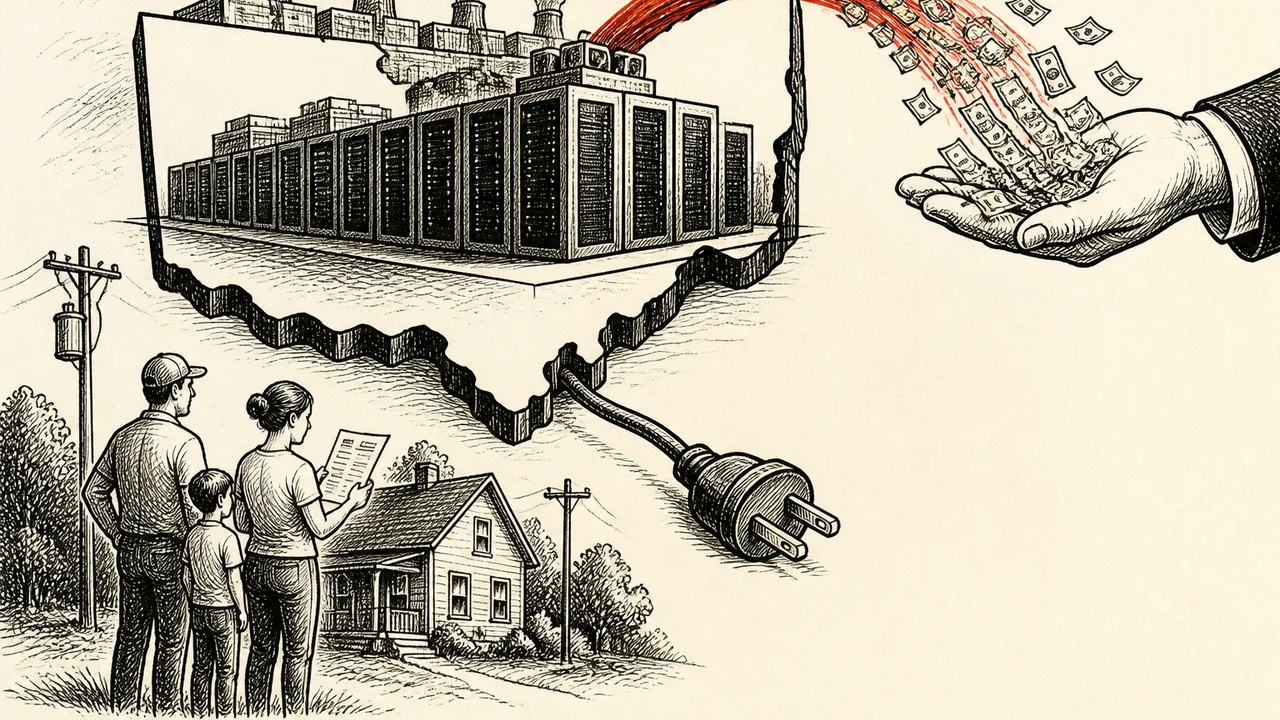
Photo: AI. Eira Pendragon
The Rust Belt's recurring nightmare has always been the same: a promising industry arrives, politicians hold press conferences, and communities reconfigure their expectations around a future that doesn't quite materialize. Ohio has lived that story before. The question the Economics Explained channel poses in a recent video — whether the state's $55 billion AI data center boom is a genuine revival or a more sophisticated version of the same trap — is worth sitting with.
Ohio's pitch to the data center industry was, structurally, a gift. Decades of deindustrialization left the state with three things hyperscalers need: cheap flat land, grid infrastructure capable of handling enormous loads, and local governments so hungry for investment they'd sign almost anything. Columbus sits within a 10-hour drive of 47% of the U.S. population, which matters because latency — the milliseconds it takes data to travel from server to screen — is a real competitive constraint. The city also sits at the intersection of major fiber routes and inside the PJM Interconnection, the largest grid operator in North America. The geography is genuinely favorable.
What Ohio added on top of the geography was a subsidy structure that economists would recognize as a race-to-the-bottom incentive package. The state waived its 5.75% sales tax on equipment purchases for data centers entirely — a single exemption that, projected over 40 years, Economics Explained estimates at more than $2.3 billion. Qualify with a large enough capital investment and the state will also consider eliminating up to 100% of property taxes for 15 years, with job creation credits layered on. Locals call the overall disposition toward tech capital "the Columbus way": move fast, ask few questions.
The agglomeration effect worked as advertised. Amazon arrived in New Albany, grid capacity deepened, Google followed, Meta followed that, and Ohio became one of the largest data center markets in the country. The logic is self-reinforcing once it starts. On paper, CNBC ranked Ohio the number one state in America to do business — the first time in the ranking's history.
The job math doesn't close
Here is where the video's central argument earns its keep. A factory doesn't just employ workers inside its walls; it builds a local economy around itself. Suppliers, logistics, the diner feeding the night shift — all of that generates income tax, property tax, sales tax, and spending that circulates through the community for decades. A data center is a different creature. It is, as Economics Explained describes it, "a very large room full of servers and a very large cooling system to stop those servers from overheating." The servers are the workers. And servers don't buy groceries.
The employment figures bear this out starkly. Ohio's 217 data centers collectively employ roughly 12,000 people, per figures cited in the video. Ohio's manufacturing sector — the one data centers are often described as replacing — employs around 687,000. "Replacement might be a generous word," the video notes, and it's hard to argue otherwise.
Construction jobs are real and shouldn't be dismissed; building a large-scale facility employs significant numbers of workers for a year or more. But construction employment has an end date engineered into it. The day the crane comes down, those workers move to the next site. That is a structurally different proposition from the 30-year employment anchor that a car plant or steel mill once represented.
Intel's semiconductor fabrication announcement in New Albany offered a brief window into what a more labor-intensive tech investment might look like. Unlike a data center, a fab requires substantial workforce density — Intel projected thousands of direct jobs, with supply chain effects extending further. President Biden called it "a field of dreams in the middle of Ohio, where America's future will be built." In practice, Intel subsequently cut its dividend, undertook significant global layoffs, and paused large portions of the Ohio project. The facility's production timeline has slipped considerably from its original targets. The field of dreams is still mostly a field.
Who pays for the grid
The electricity picture is where the abstract fiscal argument becomes concrete for Ohio households. The state's average electricity bill has grown more than 53% since 2021, against a national average increase of roughly 32% over the same period, according to Economics Explained. The gap is not incidental.
A data center pays for the electricity it consumes. It does not, under Ohio utility regulation, pay for the infrastructure required to deliver that electricity at scale — the upgraded substations, new transmission lines, expanded generation capacity. That cost gets socialized across the grid, meaning it lands on every other electricity customer in the region.
PJM, the regional grid operator, runs capacity auctions where large consumers forecast their future power needs years in advance so the grid can contract adequate generation. Economics Explained describes the mechanism plainly: "Think of it as an RSVP system. PJM asks the data centers how many people are coming to the party, so it knows how much food to order. The problem is that data centers tend to reserve a lot, and then not all of them show up." The infrastructure gets built regardless. The host is stuck with the bill.
PJM's own market watchdog has estimated the resulting higher electricity costs at roughly $23 billion across the Mid-Atlantic and Midwest region through at least 2028, per figures cited in the video. Data center demand has accounted for a substantial share of recent capacity auction costs, including demand from facilities not yet built.
In March 2026, Amazon, Google, Meta, and Microsoft signed a pledge to cover their own grid upgrade costs rather than passing them to other customers. The pledge was non-binding. Three months later, Ohio utility companies had cut electricity to hundreds of thousands of households for past-due bills.
The tax math, and the veto
The argument that data centers still generate meaningful tax revenue requires ignoring what Ohio gave away before the first server was switched on. Meta negotiated its Ohio tax incentives through a shell company called Sidecat LLC; the state approved incentives without knowing who was asking, and the company revealed itself only after the governor had signed off. Amazon secured a 30-year property tax abatement in New Albany, paying nothing for the first 15 years. In Jerome Township, two Amazon data centers operating under those abatements have called local emergency services dozens of times since 2021, placing real operational demands on public services they aren't funding through the property tax base.
Ohio projected one level of sales tax exemptions for data centers in 2025 and paid out a figure many times larger, according to Economics Explained. The state legislature eventually voted to end the sales tax exemption — not on principle, but to offset costs elsewhere. The governor vetoed it, citing the need to remain competitive with other states for technology investment.
That veto message is itself an illustration of the structural problem. The competitive logic that drives individual states to offer ever-larger exemptions produces an aggregate outcome that benefits the industry at collective expense. No single governor can unilaterally step off that treadmill without watching the next investment announcement go to a neighboring state.
The moratoriums
What communities can do in the short term is limited, but it isn't nothing. Jerome Township imposed a moratorium on new data center construction. Lordstown followed. Washington Township followed that. The moratorium is a blunt instrument — it doesn't rewrite deals already signed — but it means future projects require local approval rather than arriving as a fait accompli from the state level.
The structural remedies the Economics Explained video gestures toward — binding employment minimums as conditions for tax exemptions, mandatory cost-sharing agreements for grid upgrades, some kind of federal floor that stops states from racing each other into fiscal self-harm — are considerably further from implementation. The AI industry's political spending is substantial, and at least one Ohio gubernatorial candidate has built a platform around expanding the data center presence while holding personal investments across the industry he would regulate.
Ohio has been through this before, though the particulars were different. The mills closed. The auto plants closed. Between 1990 and 2016, the state lost more than half its manufacturing workforce. Something finally came back. The question the state is now working out, at township hall meetings and county referendums, is whether investment and prosperity are actually the same thing — and who gets to answer that question when they're not.
More Like This

Eminent Domain Is Being Used to Build Data Centers
Power companies in Georgia and Pennsylvania are using eminent domain to seize private land for AI data center infrastructure. Here's what that actually means.

Youth Economic Inactivity Is a Structural Problem
262 million young people are NEET worldwide. Unemployment figures miss most of them. Here's what the data actually shows about youth economic disengagement.

Can an AI Agency Actually Exit for $100M?
Devin Kearns of Custom AI Studio lays out why most AI work won't survive 2027—and what it actually takes to build an agency worth buying.

Dubai's Crisis Has a Worker Problem No One's Covering
Dubai's economic model was built on migrant labor with almost no rights. Now, with airstrikes and a blockaded strait, those workers face the worst of the fallout.

AI Data Centers Are Draining the Drought-Stricken West
Tech companies claim AI data centers use little water. Researchers say indirect consumption from power generation is 10 times higher — and communities are paying the price.

The True Cost of Clickbait on Main Street
Explore how clickbait impacts global economics and Main Street businesses, questioning traditional economic metrics.

Gemini Nano Gets Faster on Pixel Without Retraining
Google's frozen Multi-Token Prediction retrofits speed gains onto existing Gemini Nano models—no retraining needed. Here's what that means for on-device AI.

Google's Open Knowledge Format for AI Agents
Google's Open Knowledge Format promises to fix how AI agents navigate knowledge bases. Here's what it actually does, what it doesn't, and why the structure matters more than the tool.