NASA's Artemis Program: What Returning to the Moon Actually Takes
After Artemis 2's successful circumlunar mission, NASA faces extraordinary technical and biological challenges before astronauts can land on the lunar South Pole.

Written by AI. Mei Zhang

Photo: AI. Mika Sørensen
Kennedy's famous line — "we choose to go to the Moon not because it is easy, but because it is hard" — gets quoted so often it's become wallpaper. But in a recent lecture for the Osher UC San Diego Distinguished Lecture Series, Professor Neil Farber made a case that the original Apollo program, for all its genuine heroism, was the easy version. What NASA is attempting now is something categorically more difficult. And the gap between "we did it once" and "we're doing it permanently" turns out to be enormous.
Farber's talk, recorded in May 2026, traces the full arc from Sputnik to the present moment — and the historical scaffolding is doing real work. The space race wasn't just geopolitical theater; it was a pressure cooker that forced genuine engineering breakthroughs in about half the time anyone thought possible. Mercury, Gemini, Apollo: three programs stacked inside nine years because Kennedy had said the words out loud in front of Congress. People at NASA cheered. Other people at NASA, as Farber puts it, said, "Is he out of his mind?"
Both reactions were correct.
The Apollo we remember vs. the Apollo that actually happened
The Apollo missions get remembered as a seamless triumph. The reality Farber describes is messier. Contractor problems plagued early missions. Gemini 6's target docking vehicle exploded before reaching orbit — rushed manufacturing. On Gemini 9, someone forgot to remove a strap from the docking adapter before launch, leaving astronauts circling an object they couldn't dock with. These were embarrassing. They were not fatal.
Apollo 1 was fatal. Three astronauts died in a pad fire caused by faulty wiring, a pure-oxygen cabin atmosphere, and a hatch that opened inward and took 90 seconds to open. That combination — each individually a known risk, together catastrophic — is the failure mode that haunt engineers in every subsequent era. Apollo 13, the near-disaster that became a Hollywood movie, came down to a contractor communication breakdown that nobody caught in time.
The reason this history matters isn't to relitigate the past. It's because Farber is using it to frame what "moving fast" costs — and to explain why the current program's deliberate pace is the right call.
What Artemis 2 actually proved
On April 1st, 2026, Artemis 2 launched from Kennedy Space Center on a circumlunar mission lasting 10 days. CNN's live coverage described it as going flawlessly. The mission set a record: according to KCRA News, it carried humans farther from Earth than any mission in history. Christina Koch became the first woman to travel on a circumlunar flight. By any external measure, a success.
But Farber's lecture is most interesting not when it celebrates Artemis 2, but when it explains what came before it. The unmanned Artemis 1 mission in 2022 found heat shield damage that would have endangered a crew — caused by a "skip reentry" technique that heated the shield, let it cool and become brittle, then heated it again. The solution (revert to Apollo's straight-in trajectory) took three years to implement after engineers also discovered that hypergolic thruster fuel — carcinogenic, capable of causing serious respiratory damage — was positioned adjacent to the crew cabin's air inlets. Ocean water splashing during recovery could mix with residual hydrazine and be drawn inside. That redesign alone, Farber notes, was "considered quick" at three years.
This is why the timeline matters. Getting Artemis 2 right required fixing problems that weren't visible until Artemis 1 flew without anyone on board. The program's sequencing isn't bureaucratic foot-dragging; it's the lesson Apollo taught in blood.
Three unsolved problems standing between here and the Moon
Artemis 3, planned for mid-2027, won't go to the Moon at all. It will stay in Earth orbit and practice the hardest parts of what comes next. Farber lists them bluntly: "How do you achieve and stay in a non-rectilinear halo orbit? How do you do rendezvous and docking in a non-rectilinear halo orbit? How do you safely do orbital fuel transfer?"
None of these have been done before.
The orbit problem. Apollo's command module circled the Moon on a standard orbit, which meant it spent roughly half of every two-hour loop on the far side — out of contact with both Earth and any astronauts on the surface. For a three-day stay at the equator, that was manageable. For a week-long expedition at the South Pole, it's not. Artemis 4 will use a near-rectilinear halo orbit: a path anchored to the gravitational balance point between Earth and the Moon — a Lagrange point — that keeps the spacecraft in near-continuous communication with both the surface and home. The James Webb Space Telescope uses an analogous Lagrange point between Earth and the Sun. Nobody has ever put a crewed vehicle at one near the Moon.
The lander problem. The Starship Human Landing System is, as Farber describes it, a monster — roughly 100 to 150 feet tall next to an Orion capsule that's about 15 feet across. It needs to carry two astronauts, a rover, supplies, and experiments for a full week on the surface, then return them to the orbiting Orion. The fuel load required is beyond what any single launch can deliver, which leads directly to the third problem.
The fuel transfer problem. To fill the Starship HLS tank in orbit will require approximately half a dozen heavy-lift launches of fuel alone, then transfer of super-cold cryogenic propellant between vehicles in microgravity — an environment where liquid fuel floats freely rather than pooling, meaning any transfer requires careful acceleration to direct the flow. This has never been attempted. The physics are understood. The execution is not.
The body problem nobody wants to lead with
Radiation exposure in deep space is where my beat — genetics and biology — intersects directly with the engineering questions Farber raises. Outside Earth's magnetosphere, astronauts face unshielded cosmic radiation and solar particle events that damage DNA, accelerate bone loss, and carry real cancer risk during extended missions. For the Apollo lunar surface stays of up to three days, these were acceptable risks. For week-long expeditions followed by regular annual missions and eventually a permanent Moon base, the calculus changes entirely.
What concerns me isn't just that radiation is dangerous — that's already known. It's that we're planning for permanent human habitation on the Moon before we've solved what sustained deep-space radiation exposure does to human biology over mission timescales of weeks, months, or years. A Moon base isn't a destination; it's a new baseline. And the genomic and physiological toll of living at that baseline remains an open research question, not a solved engineering spec.
The Moon they're going back to
The Apollo landing sites cluster around the lunar equator — the easiest approach geometrically. Artemis 4 targets the South Pole, a completely different operational environment. Sunlit surfaces can reach 300°F. The permanently shadowed craters that astronauts will want to explore — because that's where water ice is likely to be — sit at a constant -300°F. A 600-degree temperature range across a single mission. Suits, instruments, and rovers all need to function across that gradient. The whole point of the South Pole is those craters, because water ice means the possibility of extracting fuel and oxygen in place — which is the resource logic underpinning a permanent base.
The geopolitics of that ice are worth noting. The 1967 Outer Space Treaty prohibits national ownership of the Moon, but it predates any serious commercial lunar activity. Who owns extracted lunar water? Who controls access to the best extraction sites near the pole? Multiple nations and private companies have designs on the same territory, and the legal framework for resolving those competing interests doesn't exist yet. A geopolitical race for rocket fuel on another world, with no governing body and no clear property law — that's not a future problem. It's the situation we're already building toward.
The timeline, honestly assessed
Artemis 4, the actual crewed lunar landing mission, is nominally targeted for around 2029. Farber thinks it will slip. Artemis 5 — currently slated for 2030, bringing four astronauts for up to a month on the surface — he pegs more realistically at 2032 or 2033. The originally planned Gateway lunar space station has been canceled, simplifying the mission architecture but removing one layer of redundancy. Blue Origin's Blue Moon Lander replaces Starship for Artemis 5, using the same orbital refueling concept with a slightly different implementation.
The SLS itself is worth a moment of appreciation: at 8.8 million pounds of thrust, it outperforms the Saturn V by more than a million pounds, which it needs to do because the Orion capsule it carries is about 50% larger than the Apollo command module. Farber calls SLS a "Frankenstein rocket" — its core derives from the Space Shuttle, its solid boosters are upgraded shuttle boosters, its upper stage is adapted from the Atlas, and the Orion capsule echoes Apollo. New components assembled from proven lineage, running on flat-screen navigation instead of analog switches. It works. The question is whether the entire stack — rocket, lander, fuel logistics, orbit, and base construction — can be made to work together in sequence, on a timeline that Congress will continue to fund.
Kennedy said we should go to the Moon not because it is easy, but because it is hard. What he didn't say — what nobody says in the triumphalist version — is that "hard" has to include a plan for what comes after you land.
More Like This

How Maxwell Unified Electricity and Magnetism
A compass needle twitched in 1820 and set off a chain of discoveries that now powers every wireless signal in your life. Here's the physics behind it.
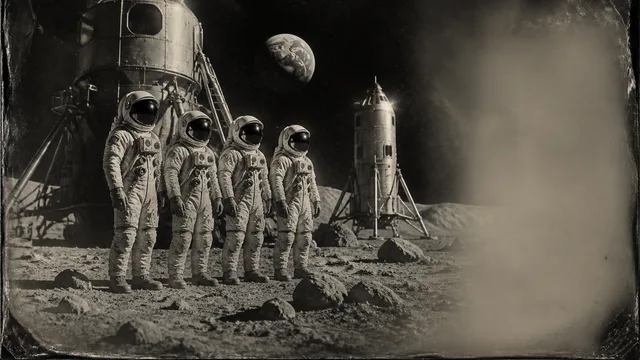
NASA Names Artemis III Crew for 2027 Moon Mission
NASA has named the four-person crew for Artemis III, a complex multi-launch test mission targeting 2027 that will rehearse docking with both Blue Origin and SpaceX landers in low Earth orbit.

California's Heat Waves Are Getting Deadlier at Night
Scripps scientist Sasha Gershunov explains why California's heat waves are shifting—more humid, more nocturnal, and more deadly than ever before.

Black Hole Paradox: Are Reference Frames the Key?
Exploring how reference frames might resolve the black hole information paradox.

Neil deGrasse Tyson on UFO Whistleblowers and Alien Life
Neil deGrasse Tyson takes the UFO whistleblowers seriously—but his demand is simple: stop describing aliens and produce one. A rigorous look at what he actually said.
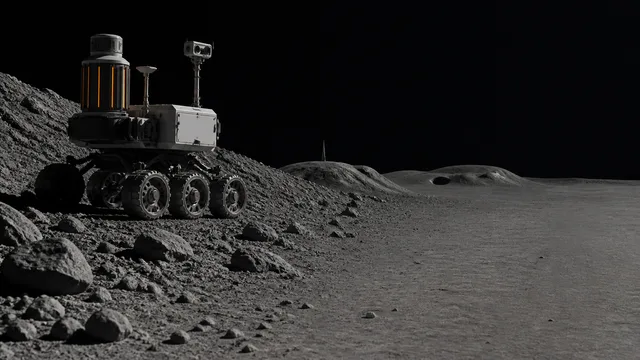
NASA's PROMISE Rover: A Mars Machine Headed to the Moon
NASA is considering repurposing a spare nuclear-powered Mars rover called PROMISE for the lunar south pole. Here's what that plan actually involves.

Human Behaviors Science Still Cannot Fully Explain
From yawning to déjà vu, the human body runs on mechanisms science can measure but not fully explain. Here's what researchers actually know—and don't.

Black Holes, Colliding Galaxies, and the Chaotic Universe
Astrophysicist Mordecai-Mark Mac Low joins StarTalk to unpack galaxy collisions, planets orbiting black holes, dark matter, and why the universe is messier than we thought.