Why the Mona Lisa's Smile Vanishes When You Look at It
NOVA's Decoding da Vinci explains the neuroscience behind the Mona Lisa's shifting smile, plus what digital pigment reconstruction reveals about her original colors.

Written by AI. Leo Santana
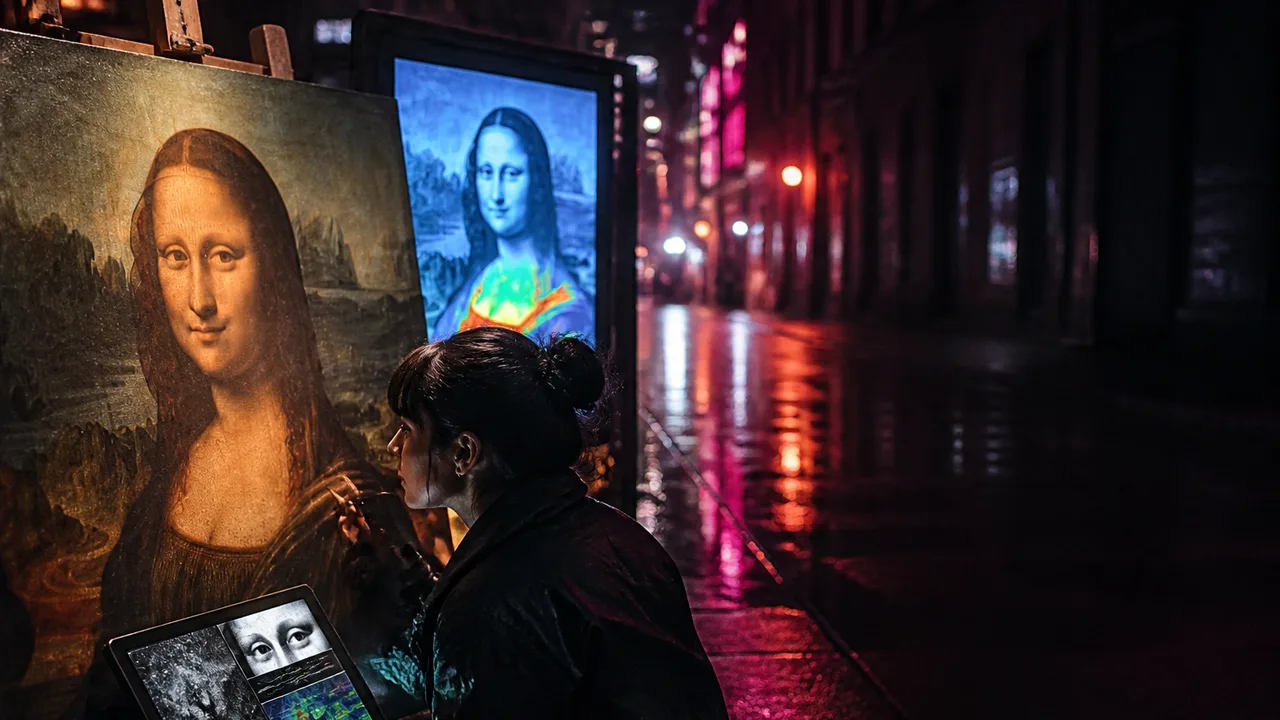
Photo: AI. Kai Hargrove
Look straight at the Mona Lisa's mouth and she stops smiling. Look at her eyes, or the background, and the smile reappears in your peripheral vision. That flicker has been argued about for five centuries, and a recent NOVA documentary, "Decoding da Vinci," makes the case that it is a designed effect: Leonardo da Vinci built the ambiguity into the paint, exploiting how human vision actually works.
The episode, condensed in a short video on the NOVA PBS YouTube channel, pairs neuroscience with conservation science, and the two halves make an interesting argument about the same object: the Mona Lisa is a machine for producing a moving face, and she is also a painting that has been changing color for 500 years.
The Smile Lives in Your Blind Spot
Harvard Medical School neurophysiologist Margaret Livingstone is the documentary's key scientific voice. Her work on the painting rests on a basic fact of retinal anatomy. The center of the human retina is packed with photoreceptors that resolve fine detail; the periphery has far fewer of them, so peripheral vision registers movement and rough shape but very little sharpness. Most people never notice this because their eyes move constantly, about three times a second, and the brain stitches the high-resolution samples into a seamless world.
Livingstone tested just how poor peripheral detail is on camera: a participant briefly glanced at four Mona Lisa reproductions, one accurate and three distorted, using only peripheral vision, and correctly identified the real one just once out of four tries. "Most people don't know how bad peripheral vision is," Livingstone explains, "because as soon as something happens in their peripheral vision, they look at it and then they bring the high resolution part of their visual system onto it."
Her hypothesis about the smile followed from that. Using a photo app, she filtered the painting to approximate what peripheral vision sees, and the result, in her words, showed the sitter "grinning from ear to ear." As the NOVA narrator puts it: "When you look away from her mouth, it enters your peripheral vision, and Mona Lisa appears to smile. But look directly at the mouth, and the smile vanishes." Livingstone summarized the mechanism for Science Friday: "A clear smile is much more apparent in the low spatial frequency [blurrier] images than in the high spatial frequency image."
In other words, the smile is real in both states. It is painted with soft, blurred curves that peripheral vision reads as a broad grin, and with subtler shading that central vision reads as a nearly closed mouth. Your eye movements cycle between the two readings, and the sitter seems to change expression. As Livingstone says, "She seems like she's alive cuz she looks different depending on where you're looking."
Was It Intentional?
This is where the evidence gets interesting, and where I want to be careful about how much we can claim.
The strongest support for intentionality comes from researchers at Sheffield Hallam University, who compared the Mona Lisa's smile technique with Leonardo's "La Bella Principessa." According to Artnet News, the team claimed to have proved the "now you see it, now you don't" effect was deliberate on Leonardo's part, naming it "the uncatchable smile." Their experiments, reported by the Daily Mail, digitally increased the blur in both paintings and found the smiles grew stronger in each, consistent with a shared technique rather than a one-off accident.
There are honest limits here. The attribution of "La Bella Principessa" itself has been contested in the art world, so building the argument partly on that drawing makes the claim harder to settle than a headline suggests. What is safer to say: Leonardo explicitly studied optics and perception, the documentary notes he wrote on how colors and sharpness change with distance, and the sfumato technique (from the Italian for smoke, as louvre.guide notes) produces exactly the soft gradients that peripheral vision over-reads. Whether he sat down and reverse-engineered the retina, or simply iterated on portraits until one felt uncannily alive, the mechanism and the effect line up. Ambiguity, deliberately engineered or stumbled into and then kept, is the painting's engine. As one voice in the film puts it: "The great artists know how to draw you in, but not to tell you what to think. They offer the tease."
The Painting You See is Not the Painting He Painted
The documentary's second thread moves from perception to chemistry. Conservator Cynthia Pasquali's work on the "Bacchus," another Louvre painting long associated with Leonardo, shows what cleaning can reveal: removing yellowed varnish uncovered what she calls "the quality of the blue. It's a wonderful blue," along with the atmospheric perspective (the shift in color, sharpness, and contrast with distance) that Leonardo used to paint air itself. But the restoration also exposed harsh facial shading with no sfumato, leading Pasquali to conclude the "Bacchus" cannot be attributed to Leonardo's own hand, though workshop execution under his design remains plausible.
The "Bacchus" cleanup raises the obvious question about its neighbor: should the Mona Lisa be cleaned too? The film's answer is effectively no, at least not physically. "I think French governments have fallen for less cause than trying to take the Mona Lisa out of circulation and clean it," one expert observes. The risks are real: removing historic material, and pulling the world's most visited painting off its wall.
So engineer Pascal Cotte is attempting a workaround, a digital restoration. He scanned the painting in the Louvre's basement laboratory under intense light, analyzed the pigment chemistry, and built software to reverse the aging. The sky, he explains, was painted with white lead and lapis lazuli, so the software removes the yellow-brown cast to recover the genuine hue, pixel by pixel. The result, per the film: a greenish sky turns brilliantly blue, and a bit of flush returns to Lisa's cheeks. One commentator in the documentary notes this is "not just photoshopping it and messing around with the colors, which you and I could do and get tolerable results, but this is based on pigment analysis." The varnish darkens the picture, and so do the pigments and oil in the paint itself, which is why simple color correction would miss part of the story.
What Digital Restoration Can and Cannot Settle
Here I find myself of two minds, and I think readers should hold the same tension. Cotte's reconstruction is grounded in measurable evidence about pigments and optics, which makes it far more accountable than a designer's color-grade. But a digital Mona Lisa is still an interpretation wearing the costume of data. Any model of how lead white and lapis lazuli aged over five centuries involves assumptions, and different assumptions produce different Lisas. The physical painting remains the only artifact everyone agrees on, even if nobody agrees on what she looked like in 1503.
The film also sidesteps a design question: the varnished, greenish Mona Lisa is the image billions of people know through reproductions. Restore her to Renaissance blue, physically or digitally, and you risk replacing one iconic face with another, unseating the smile that made her famous in the first place.
The documentary closes by conceding that even with all the science, the painting exceeds the sum of its explanations. I would put it more sharply. Leonardo painted a portrait that refuses to resolve, and five centuries later we are still doing the same thing: scanning it, filtering it, modeling its pigments, arguing about it. The smile vanishes when you look at it directly. So does the painting's final meaning. That may be the most durable design decision in the whole object.
More Like This
Alfonso Cuarón: Mastering Chaos Through Preparation
Explore Alfonso Cuarón's unique directing method, balancing meticulous preparation with creative chaos to craft cinematic masterpieces.

How Ancient Athens Actually Invented Democracy
Mass graves, marble lottery machines, and a reformer with divine backing: NOVA's Athens documentary reveals democracy's stranger-than-expected origins.

Lee Cronin's The Mummy Wears Egypt Like a Mask
Lee Cronin's The Mummy sells Egypt and delivers Evil Dead. The visual identity gap between what it promises and what it shows is where the film collapses.
Netflix's Bold February: A Visual Culture Dive
Explore February's Netflix lineup through a design lens, from heists to satire.
Vermeer's Art: Timeless Reflections in Modernity
Explore Vermeer's art through identity, technology, and the timeless allure of his mysterious paintings.

Claude Design's 4 Tools That Change How You Build
Claude Design adds visual editing, annotation, and drawing tools to AI-generated assets. Here's what those four tools actually do—and where Claude Chat still wins.

Canvas UI Renders HTML Inside Canvas Elements
Canvas UI, built on Chrome's new HTML-in-Canvas API, lets developers render interactive HTML inside canvas—water ripples, 3D objects, and all.

The Next Generation of Windows Is Already Here
From squid-inspired liquid panes to transparent wood, new window technologies promise dramatic energy savings—but how close are they to your wall?