Microsoft Is Betting on DNA for Data Storage
Microsoft Research is developing synthetic DNA as a long-term data storage medium. Here's what the science actually says, and what remains unresolved.

Written by AI. Mike Sullivan
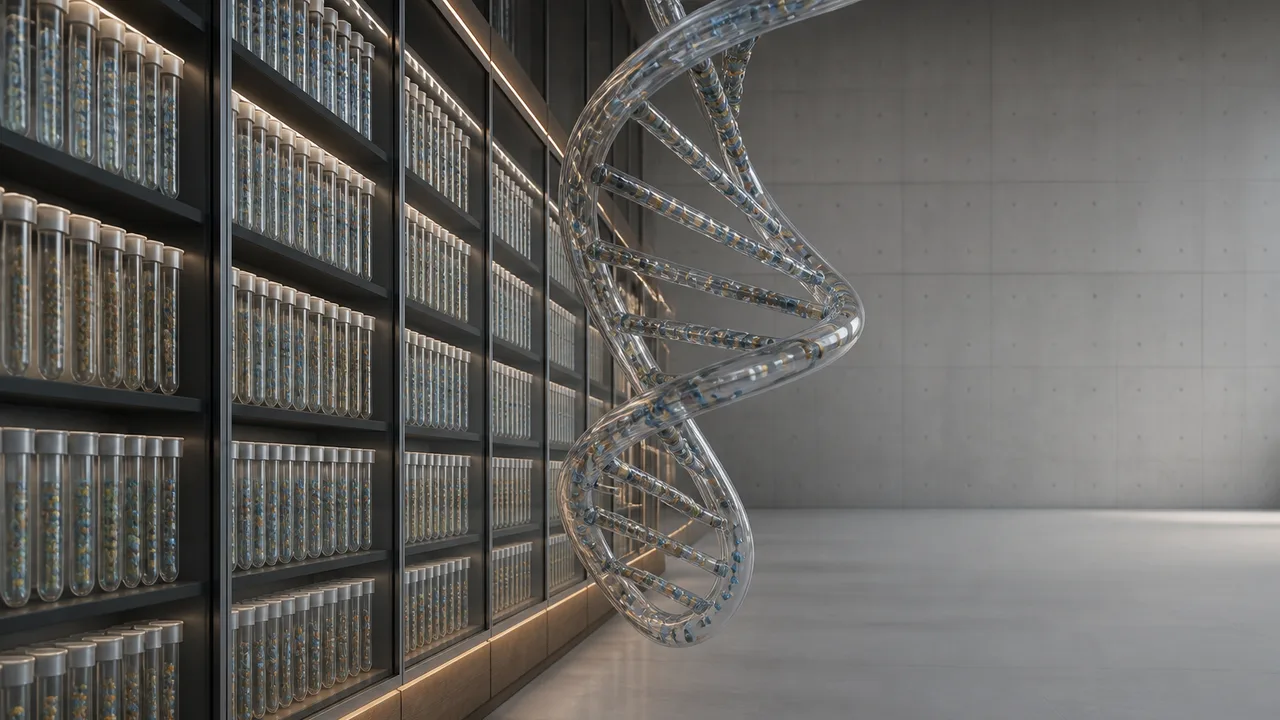
Photo: AI. Hayden Cross
Here's a sentence I did not expect to type in 2025: Microsoft might store your files in a molecule.
Not metaphorically. Not as a branding exercise. Actual synthetic DNA — the same four-letter chemical alphabet that encodes biological life — being used as a medium for digital data. A recent Update Unpacked documentary covers Microsoft Research's work in this space, and while the framing leans toward the evangelical ("the next revolution in computing may not be made of silicon, but of life itself"), the underlying science is real, the research timeline is long, and the infrastructure problem driving it is genuinely worth understanding.
Let me try to separate the signal from the inspirational poster.
The Actual Problem Is Not Glamorous
The storage crisis that DNA research is meant to address isn't particularly exciting to talk about, which is probably why it doesn't get much coverage until someone attaches a biology angle to it.
The short version: the world produces vastly more data than it did a decade ago, and the physical infrastructure required to store that data — warehouses full of hard drives and SSDs, running on enormous amounts of electricity, requiring aggressive cooling systems to prevent overheating — is scaling in ways that are becoming environmentally and economically unsustainable. Moore's Law, the rough principle that transistor density doubles roughly every two years, has been slowing down. Squeezing more storage out of silicon gets harder and more expensive with every generation.
This isn't a hypothetical future problem. It's a present and worsening one. AI training runs, scientific datasets, high-resolution video, genomic databases — all of it needs to live somewhere, and "somewhere" increasingly means a building-sized facility that drinks power like a sports stadium.
That context matters because it explains why a company like Microsoft — not a scrappy biotech startup, but a hyperscaler with one of the largest cloud infrastructures on the planet — is funding research into something as apparently exotic as biological storage. This isn't a moonshot for its own sake. It's an attempt to get ahead of a wall that's coming.
What DNA Storage Actually Does
The mechanism, stripped of the awe, is conceptually tidy. Every digital file is already a sequence of ones and zeros. DNA is already a sequence of chemical bases — adenine, cytosine, guanine, thymine, abbreviated as A, C, G, T. Mapping binary to base-four encoding is a translation problem, and it's one researchers have been working on for longer than most people realize. The Update Unpacked documentary notes that "scientists discovered that digital information can also be written into synthetic DNA," which is accurate, though it undersells how much of that discovery happened in academic labs well before Microsoft got involved.
The density argument for DNA is the part that makes engineers pay attention. According to Wikipedia's entry on DNA digital data storage, theoretical estimates for DNA's storage density vary widely by study and encoding scheme, but researchers have cited figures in the hundreds of petabytes per gram range. Even if real-world implementations land well below those theoretical peaks — and they will — you're talking about a medium that makes a terabyte SSD look like a floppy disk.
There's also the durability angle. Properly preserved DNA — cold, dry, dark — can remain stable for thousands of years. We know this because researchers have successfully sequenced DNA recovered from woolly mammoth bones. Your hard drive, by contrast, has a mean time between failures measured in years, not millennia. For archival purposes — think national records, scientific datasets, cultural heritage — the durability difference is not trivial.
Writing and Reading: The Harder Problems
The density argument is compelling. The engineering is where it gets complicated.
Writing data into DNA is currently slow and expensive. Microsoft's research has focused on automating this process using electrochemical synthesis — essentially, building machines that can translate binary code into DNA sequences without requiring a lab full of human technicians for every write operation. The documentary describes this as an area of active development, with researchers working to make the systems smaller and more automated. That framing is honest. It's a work in progress, not a shipping product.
Reading is a separate challenge. Retrieving data from DNA requires sequencing — essentially, running the molecule through a process that determines the order of its base pairs and translates that back into binary. The technology that makes this increasingly practical is nanopore sequencing, where DNA strands are threaded through tiny protein pores and identified by the electrical signals they produce. It's fast, it's getting cheaper, and the sequencing hardware has been shrinking dramatically over the years.
The Update Unpacked documentary also highlights a subtler problem: random access. In conventional storage, retrieving a specific file doesn't require reading everything else on the drive. DNA storage, in its early forms, didn't work that way — you'd essentially have to sequence the entire archive to find the document you wanted. Researchers are developing methods to tag and selectively retrieve specific DNA sequences, which would make the system genuinely practical rather than just theoretically impressive. That work is ongoing.
Who Else Is in This Space
Microsoft isn't alone, which is worth noting because the documentary's framing can make it sound like a solo project. Academic groups at the University of Washington, ETH Zurich, and elsewhere have been publishing DNA storage research for years. Startups like Catalog and Twist Bioscience have been working on the synthesis side of the problem. The field is real and reasonably active, even if it hasn't broken into mainstream technology coverage.
Microsoft's angle is specifically oriented toward long-term archival — the "cold storage" tier where you're not accessing data frequently, but you need to be certain it still exists in a hundred years. That's a different use case than the hot-storage demands of, say, a streaming service's content library. No one is arguing that DNA storage will replace the NVMe drive in your laptop. The realistic near-term target is the deepest, coldest tier of the archive: data that must be preserved but is rarely read.
The Questions the Video Doesn't Linger On
The documentary briefly acknowledges that moving critical data into biological storage raises questions about security, ownership, and access — and then moves on fairly quickly. Those questions deserve more than a passing nod.
Biological materials require specialized handling infrastructure. A power outage doesn't corrupt your DNA archive the way it might corrupt a spinning disk, but a temperature excursion, a contamination event, or a failed preservation protocol could. The error modes are different from what IT infrastructure teams are trained to manage. That's not a reason to dismiss the technology, but it's a reason to think carefully about governance and redundancy.
Ownership is thornier still. If your organization's data is encoded in a synthetic biological medium, who controls the sequencing keys? What does a data breach look like when the medium is a molecule? These aren't questions that have obvious answers from the existing cybersecurity playbook, and the research community is only beginning to work through them.
There's also a cost curve that needs to close significantly before any of this becomes commercially viable. The documentary acknowledges that "as costs continue to fall, DNA storage is moving closer to real-world use" — which is true, and also describes a technology that isn't there yet. The history of tech is littered with promising storage technologies that hit an engineering wall before they reached the cost inflection point. Holographic storage was going to revolutionize archiving in the 1990s. It didn't.
What to Make of All This
DNA storage is not vaporware. The science is published, peer-reviewed, and genuinely advancing. Microsoft's involvement brings serious engineering and commercialization resources to a research area that was previously confined largely to academia. The infrastructure problem it's trying to solve is real and growing.
But "the science works in a lab" and "this will be in your data center by 2030" are separated by an enormous gap filled with cost curves, engineering challenges, regulatory questions, and the general difficulty of turning biology into reliable enterprise infrastructure. The documentary is more comfortable in the former territory than the latter, which is worth keeping in mind.
The most honest framing is probably this: DNA storage is the kind of idea that looks like science fiction until it quietly becomes an industry. Whether we're five years from that moment or twenty-five is a question that no one — not Microsoft, not the researchers, not the documentary — can answer with confidence yet.
What we can say is that someone with serious money and serious infrastructure problems thinks the question is worth pursuing. That alone puts it in a different category than most "next revolution in computing" pitches I've seen cycle through a news feed.
More Like This
Do You Really Need an $80 HDMI Cable? Maybe Not
Tech reviewer Adam tests a premium HDMI 2.1 cable. We examine what you're actually paying for and whether most users need it.
When Agents Generate Their Own UI: The Three Flavors Explained
CopilotKit's Tyler Slaton maps the spectrum of generative UI—from pixel-perfect control to agents writing raw HTML. Each approach makes different tradeoffs.
Can Unreal Engine 5 Run on a $500 MacBook? Sort Of.
Testing Unreal Engine 5.7 on the MacBook Neo reveals what happens when professional software meets budget hardware—and why friction matters.
Microsoft Majorana 2: Bold Claims, Thin Evidence
Microsoft's Majorana 2 chip promises a 1,000x reliability leap and a 2029 quantum computer. Scientists say the paper doesn't back any of it up.
Why Your Computer Uses 12 Types of Memory
Your computer's memory hierarchy isn't just a performance trick—it determines what data survives a wipe, a seizure, or a subpoena. Here's what you need to know.
What "Fundamental" Actually Means in Science
Curt Jaimungal's latest video unpacks "the nature of reality" across physics, philosophy, and math — and the distinctions hit differently when you cover CRISPR for a living.
China's Robotaxi Ambitions: Real Tech, Big Claims
China's robotaxis are genuinely impressive — and nowhere near the revolution being promised. A skeptic's look at what's real and what's familiar noise.
FCC Kills TV Ownership Cap in Win for Big Broadcasters
The FCC's vote to repeal the 39% TV ownership cap replaces a hard limit with "case-by-case review." We've seen this movie before — in radio.