Micron's Memory Expansion Offers No Quick Price Relief
Micron expects more memory shipments and tighter supply through 2028. Raspberry Pi's price increases show why factory plans cannot yet promise cheaper devices.

Written by AI. Bob Reynolds
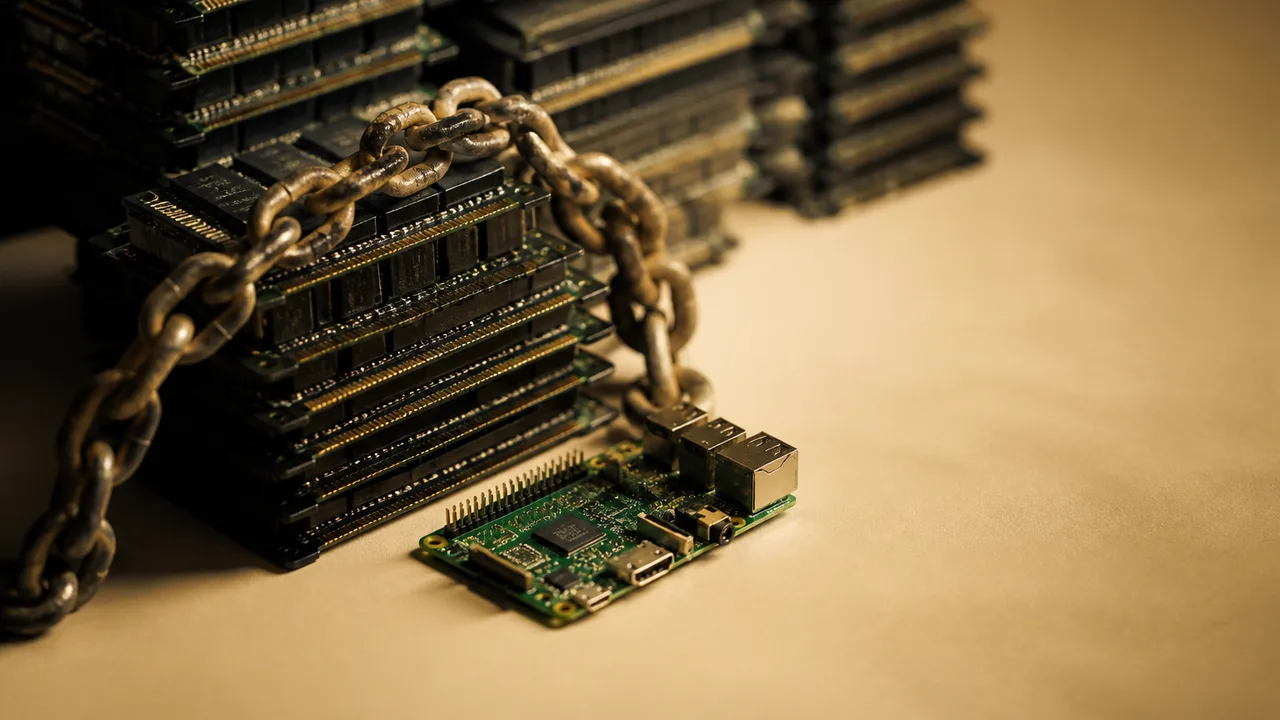
Micron expects demand for memory chips to exceed supply in both 2027 and 2028. Chief executive Sanjay Mehrotra told investors he expects the industry to be tighter in those years than in 2026 and has no timetable for supply and demand to return to balance. Micron also expects to ship more memory. A household pricing a computer, or a device maker trying to secure parts, needs to know whether the extra chips are the ones it can buy.
The 2 GB Raspberry Pi 4 now costs $67.50. It once cost $35, then rose to $45 during the pandemic. Raspberry Pi has now added $12.50 to the prices of both its 2 GB Pi 4 and Pi 5, citing rapidly rising memory costs; the Pi 5 costs $77.50. The pandemic increase is a reminder that this board had a price history before the current memory squeeze. Its full climb from $35 cannot be charged to today’s chip market. Still, a customer who put off buying the 2 GB model during April’s wider Pi price increases has now lost that reprieve too.
Micron expects DRAM and NAND shipments to grow in the low-to-mid-20-percent range over the next two years, while forecasting constrained industry supply in both years. DRAM is working memory; NAND stores data. More shipments leave a market tight when buyers seek still more chips. And a projection that combines different categories gives a board maker no delivery date for the memory its next production run requires.
Capacity Already Has Customers
About 75% of Micron’s 2027 memory output is already spoken for. Mehrotra said much of next year’s high-bandwidth memory, or HBM, is sold out, and most current sales discussions concern 2028. HBM is stacked memory used with AI chips. Micron can increase shipments to customers who have secured supply while a buyer seeking an additional allocation still struggles to obtain one. That is a consequence of committed production, not a prediction about the price of every computer.
Mehrotra also told investors that customers would pay “much higher prices” than in 2026. The company has good reason to discuss demand with confidence: its latest reported quarter produced record results and an 86.8% gross margin. That figure describes Micron’s business, not the share of a Raspberry Pi price attributable to memory. For a buyer, the more immediate question is whether a higher-volume year brings any uncommitted supply of the required part.
Micron plans new factory clean rooms in 2028. Separately, it plans about $25 billion in capital spending during the first half of its new financial year; that is a company spending plan, not a budget assigned to those clean rooms. Mehrotra said output from new clean rooms will ramp up gradually, so they will not quickly ease supply. A device maker placing 2027 orders cannot fill them with production from a clean room planned for 2028. Even after it opens, the pace of usable output remains a question for customers rather than an answer supplied by the construction schedule.
The type of memory made with that capacity matters as well. Micron expects HBM shipments to grow faster than conventional DRAM shipments. Samsung executive Kim Taewoo estimated that HBM would use almost 30% of industry DRAM wafer capacity in 2027, up from 20% this year, Reuters reported, as cited by The Next Web. HBM and conventional DRAM serve different uses while drawing on DRAM manufacturing capacity. A larger HBM share could limit how much of an overall production increase reaches buyers of conventional memory.
The Samsung estimate is a share of wafer capacity, not a count of conventional chips removed from the market. Expanded factories could produce more of both products. Nor does the estimate establish why Raspberry Pi raised a particular board’s price. It does give a useful question to ask of any claim about rising output: rising output of what? A maker of AI hardware and a maker of small computers may both hear that memory production is increasing while facing different supply choices.
When Old Stock Runs Out
Raspberry Pi’s recent prices show another limit to reading factory plans as retail forecasts. Much of the Pi 4 and Pi 5 range rose in price in April 2026, but the 2 GB models escaped that round. In the latest increase, the 1 GB Pi 4 and Pi 5 and the 2 GB Compute Module 4 and 5 kept their prices. Customers shopping within the same product family therefore encounter different changes, even though the company cites rising memory costs for the 2 GB boards.
Raspberry Pi says memory purchased at lower prices in 2025 helped its first-half results and that the inventory advantage has largely been exhausted. Gross profit per board rose during that period, helped by both the earlier purchases and price increases. Stock bought before costs rose can postpone the effect of replacement prices on a finished product. Once that stock runs down, the company faces a different purchasing position. That sequence helps explain why a board can miss one round of increases and catch the next; it does not measure how much of the latest $12.50 rise came from any one category of chip demand.
The Pi 4’s path from $35 to $45 during the pandemic and then to $67.50 also puts a limit on promises of a return to an old price. Raspberry Pi boss Eben Upton says the company looks forward to reversing its increases when memory prices subside. He has not supplied a date, and Micron says it cannot see when supply and demand will return to balance. A future fall in component costs would still meet whatever inventory and pricing decisions Raspberry Pi faces at that point. Neither company’s statement sets a date for a cheaper 2 GB board.
A buyer making a decision now can compare the unchanged 1 GB models or older Pi boards with the memory a project needs. A device maker has a harder version of the same problem: securing the right component at a workable price for its production schedule. Micron’s shipment forecast describes how much more it expects to send out; its commitments and product mix say more about who may receive it. For someone looking at a $67.50 Pi 4, a new clean room in 2028 is still a long way from a lower sticker price.
More Like This

Xiaomi's AI Cube vs DGX Spark: Reading the Specs Honestly
The viral bandwidth claim comes from one chip, the memory from another. What actually separates Xiaomi's prototype from NVIDIA's shipping DGX Spark.
Raspberry Pi 6 Won't Arrive Until 2028
Raspberry Pi engineers did an AMA and confirmed Pi 6 is 2+ years away, no NPU, no M.2. Here's what that actually means for your next board purchase.
Nvidia and AMD Are Both Raising GPU Prices in 2026
Nvidia and AMD are both raising GPU prices in 2026, hitting budget cards hardest. Here's what's driving the hikes and what it means for PC gamers.

Micron's AI Memory Boom Faces an Old Cycle Question
Micron's memory rally runs on AI data center demand and tight supply. Here is what would have to hold for the good times to last, and what to watch.

The AI Compute Crisis No One's Talking About—Yet
AI infrastructure is running out of compute. DRAM prices are spiking, GPUs are sold out through 2028, and your cloud provider is now your competitor.

Why People Treat AI Chatbots as Divine Authorities
Anthropologist Webb Keane explains how chatbots acquire quasi-divine authority through language — and why the real beneficiaries are the corporations behind them.

Claude Fable 5 Access Is Changing: How to Use It Now
Claude Fable 5's subscription access is ending soon. SEO consultant Julian Goldie outlines how to make the most of it before the window closes.