Meta Muse Voice Transcribe Unifies ASR, Diarization, Endpointing
Meta Superintelligence Labs released Muse Voice Transcribe, a single model handling speech recognition, speaker diarization, and endpointing in real time.

Written by AI. Dev Kapoor
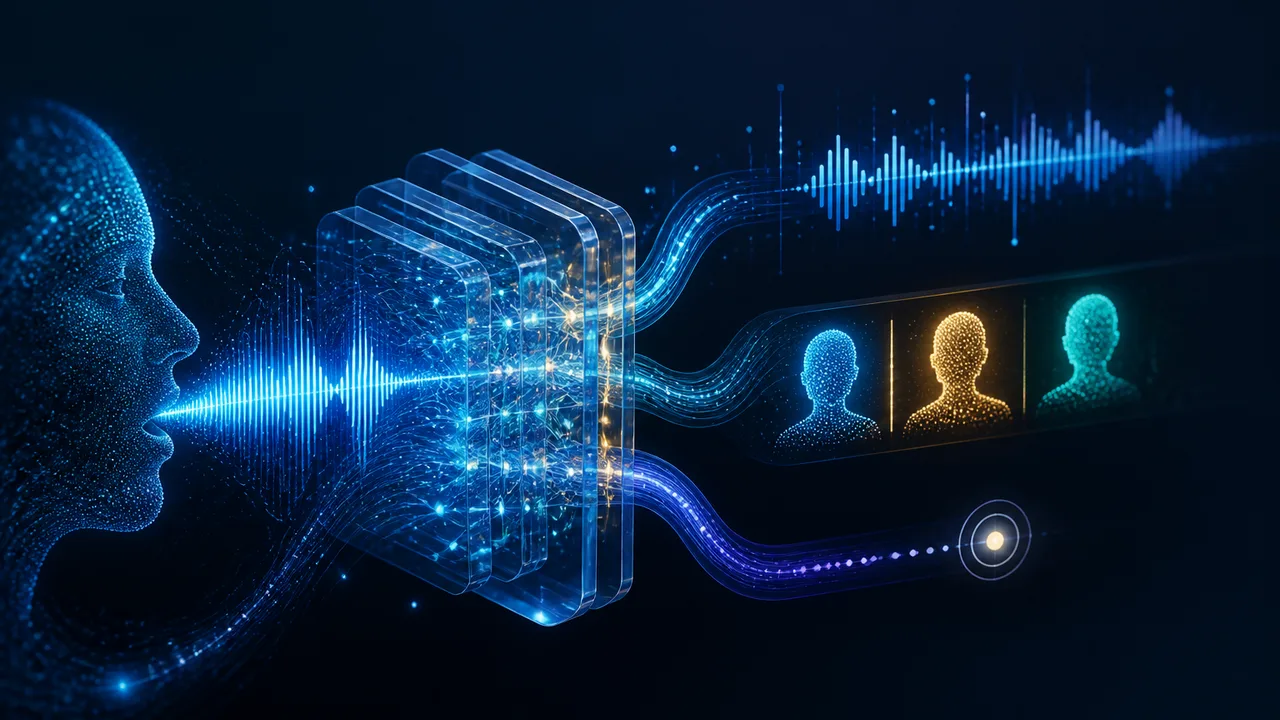
Meta Superintelligence Labs released Muse Voice Transcribe on September 1, 2026, collapsing three historically separate voice processing tasks into a single model: automatic speech recognition (ASR), speaker diarization, and endpointing.
If those three terms blur together, here is what each one does in practice. ASR converts spoken audio into text. Speaker diarization answers the question "who said what" by segmenting audio by speaker identity, which matters any time more than one person is talking. Endpointing decides when a speaker has finished a turn, the signal that tells a system to stop listening and start responding. In a standard pipeline, each function runs as its own model, passing outputs to the next stage. Each handoff adds latency, and each boundary is a place where errors compound. According to marktechpost.com, Muse Voice Transcribe integrates all three into a unified system specifically designed for real-time streaming.
Engadget reports that the model can distinguish between multiple speakers and multiple languages simultaneously, which positions it for multilingual conversational contexts rather than single-speaker transcription alone.
Why the pipeline architecture mattered, and why it was a problem
For anyone who has spent time around voice infrastructure, the cascaded pipeline model has always been a tension between practicality and performance. You pick best-in-class components, stitch them together, and pay in latency at every seam. A conversation with a 400ms response lag feels unnatural. Push that to 600ms and users start talking over the system. The latency problem compounds in multi-speaker scenarios: diarization models need enough audio to build speaker embeddings before they can reliably separate voices, which means they often lag behind the ASR model that feeds them. Endpointing models, meanwhile, are making probabilistic guesses about silence duration and prosody at the tail end of the pipeline, by which point accumulated errors from upstream models have already muddied the signal.
The multi-model approach also creates a fragmentation problem from a maintenance and deployment standpoint. Organizations running voice applications have to version-manage and update multiple models with separate compute profiles, separate failure modes, and sometimes separate vendors. A bug in the diarization layer does not announce itself as a diarization bug; it surfaces as a garbled transcript or a misattributed speaker and takes real debugging time to localize.
Muse Voice Transcribe's pitch is that joint training across all three tasks allows the model to share representations that are useful for each function simultaneously. An acoustic feature that helps identify a speaker's voice also provides context for recognizing their speech patterns; an endpointing decision is better informed if the model already understands whether the speaker is mid-sentence or trailing off. The architectural bet is that this mutual reinforcement compensates for the specialization advantages of separate dedicated models.
Whether that bet holds at scale is a question the published sources do not fully answer. Benchmarks on benchmark-friendly data do not always survive contact with noisy real-world audio: overlapping speech, heavy accents, low-bandwidth codecs, or the particular quality of a phone call through a hotel lobby. The sources available at publication do not include independent third-party evaluation results, so the performance claims rest on Meta's own framing for now.
The context around Meta Superintelligence Labs
Muse Voice Transcribe comes from Meta Superintelligence Labs, the research division Meta rebranded toward in 2025 as it consolidated AI research efforts and positioned itself more aggressively against OpenAI and Google DeepMind. The naming matters because it signals where Meta wants this work perceived: adjacent to frontier model research rather than product engineering, even if the downstream applications are squarely commercial.
Meta has a substantial stake in voice as an interface layer. The Ray-Ban Meta smart glasses product line leans heavily on voice commands and voice AI, and WhatsApp voice messages are a primary communication format across large parts of Latin America, Africa, and South Asia, markets where real-time transcription with reliable multilingual support would have direct product value. Muse Voice Transcribe fits that portfolio even if Meta has not yet announced specific integration plans.
Meta has a mixed but real track record with open releases: LLaMA changed the accessible-weights landscape for large language models, and its speech research has historically fed back into open source tooling. The sources do not specify whether Muse Voice Transcribe will be released with weights or as an API-only product. That decision will determine how much of the architectural work benefits the broader developer ecosystem versus staying inside Meta's infrastructure. If the weights ship openly, expect rapid community benchmarking that will either validate or complicate Meta's performance narrative.
What competing approaches look like
The unified model approach for voice is not entirely without precedent. OpenAI's Whisper is a single-model ASR system, but it was not designed for real-time streaming and lacks native diarization. AssemblyAI and Deepgram offer commercial APIs that integrate diarization with ASR, but typically as pipeline products rather than jointly trained unified models. Google's Speech-to-Text v2 added diarization features incrementally. The framing around Muse Voice Transcribe implies joint training from the ground up, which is architecturally different from bolting components together post-hoc, even if external validation of that claim is still thin.
For enterprise developers building on voice infrastructure, the practical question is whether Muse Voice Transcribe's latency and accuracy profile in real conditions is actually better than a well-tuned Whisper plus pyannote.audio pipeline, which many teams already run and understand. Switching costs are not trivial. A model that is 20% better on a benchmark but requires rebuilding integrations needs to clear a higher bar than its spec sheet suggests.
The open questions the sources leave unanswered
The sources do not specify what languages the multilingual support covers or how performance varies across language families. Multilingual speech models often perform well on high-resource languages (English, Spanish, Mandarin) and degrade on lower-resource ones, and that gap matters enormously depending on the deployment context.
The sources also do not address privacy architecture. Voice data is among the most sensitive categories of personal information: it carries speaker identity, location inference, emotional state, and conversational content simultaneously. For enterprise customers in regulated industries, knowing whether Muse Voice Transcribe processes audio server-side, what retention policies apply, and whether training data policies cover customer audio are prerequisites to deployment, not afterthoughts.
Meta has not, as of publication, released a paper or technical report that would let researchers examine training data composition, model size, or evaluation methodology. That may come. But releasing a model without accompanying documentation has become a pattern worth noticing in AI lab announcements, where the press cycle runs ahead of the reproducibility materials.
The unified architecture direction for voice is sound. Whether Muse Voice Transcribe delivers on it in the conditions that actually stress voice infrastructure is a question that will get answered in deployment, not in press releases.
More Like This
Matt Wolfe's YouTube Playbook: Money, AI & Workflow
Matt Wolfe opens the books on his YouTube AdSense, AI video workflow, and why he thinks faceless AI channels are mostly a losing bet.
Google's TurboQuant Claims Don't Survive Closer Inspection
Google's TurboQuant promised 6x memory savings for AI models. The fine print tells a different story about baselines, benchmarks, and research integrity.
Dark Code: When AI Writes Software Nobody Actually Understands
AI-generated code is shipping to production with no human comprehension. It's not a security problem—it's an organizational capability crisis.

Superwhisper's S1-mini Cleans Up ASR Transcripts On-Device
Superwhisper's S1-mini is a 462 MB open-weights model that strips fillers and fixes self-corrections in speech-to-text output—entirely on your device.

Meta Enters AI Coding with Muse Code Agent
Meta launches Muse Code, a terminal-based AI coding agent taking on Anthropic's Claude Code and OpenAI's Codex. Here's what it actually does and what it means.
Meta's Avocado Model Tests Whether Speed Beats Perfection
Meta's new Avocado AI model performs well before post-training, but the company's Llama 4 disaster raises questions about its comeback strategy.

Open Source Infrastructure Projects to Watch in 2026
Brandon Lee of VirtualizationHowto maps seven OSS infrastructure projects gaining traction in 2026—from Pi-hole HA to Pangolin—and what they reveal about where self-hosting is heading.

GPT-5.6 Sol, Fable 5, Grok 4.5, GLM 5.2 Compared
Four major AI models dropped within weeks of each other. Here's what actually separates them—and why the open-weight option changes the calculus.