Meta Faces New Class Action Over AI Training and Face Recognition
A new class action alleges Meta used Facebook and Instagram photos to train AI and build NameTag face recognition. Here's the legal terrain and Illinois precedent.

Written by AI. Marcus Chen-Ramirez
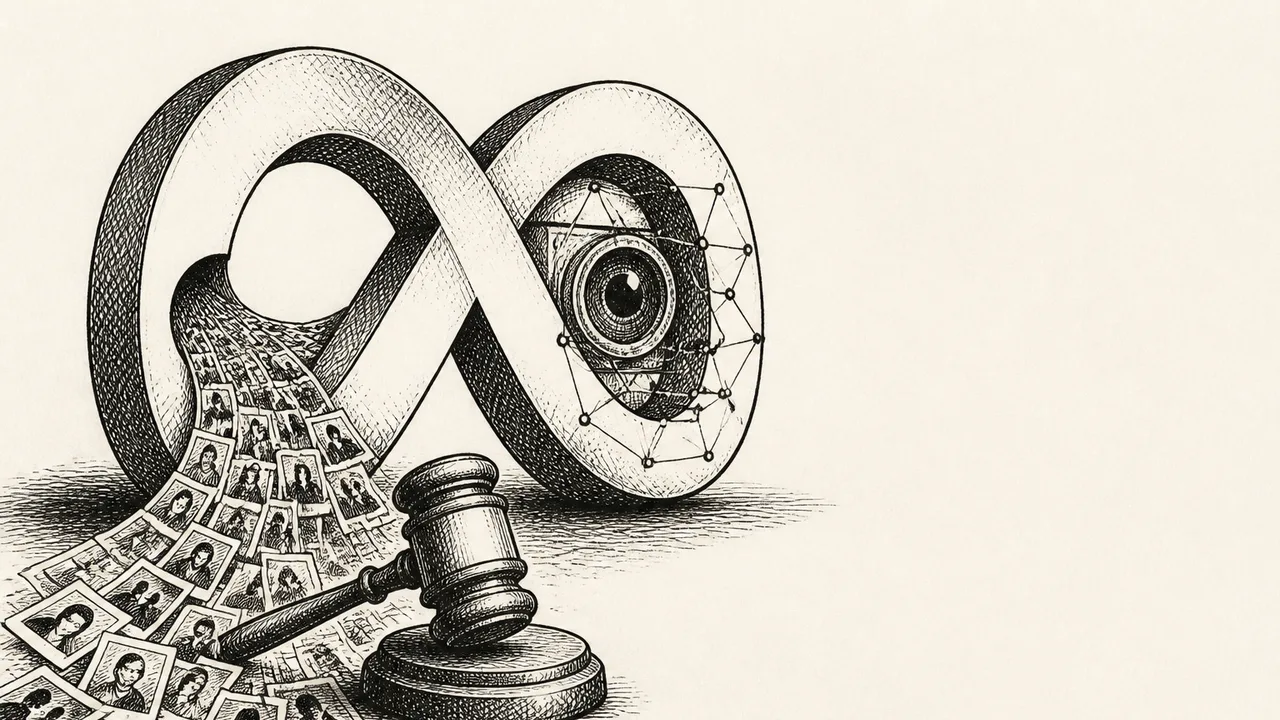
A proposed class action filed against Meta alleges the company harvested Facebook and Instagram photos to train its image-generation systems and to develop NameTag, an unreleased face-recognition feature, according to Wired. Those are allegations, not findings. But the lawsuit lands on ground where Meta has bled before, and where the legal map around photographs has grown more complicated than most users realize.
Two Uses, One Photo Pile
The complaint, as Wired summarizes it, ties together two things the public often treats as one issue: teaching a generative model to make images, and building a system that identifies who is in an image. They overlap in data but diverge in law. Generative training raises copyright and contract questions about how pictures were obtained. Face recognition raises biometric-privacy questions about the person depicted. A single vacation snapshot can sit at the center of both disputes, and a court may have to untangle which rules apply to which use.
That distinction matters for anyone trying to follow the case. A generative model generally learns statistical patterns from millions of images; the output is a new picture, not a name. A face-recognition system produces something closer to an identifier: a match between a face and an identity. Regulators and courts have treated the second as far more intrusive, and Illinois is the reason why.
The Illinois Precedent
The strongest precedent hanging over this case comes from Facebook's own history. In 2015, users sued under Illinois' Biometric Information Privacy Act, known as BIPA, a law that lets private citizens sue companies for collecting biometric identifiers, including face geometry, without written consent. The statute carried statutory damages per violation, which is why the case became a corporate nightmare rather than a cost of doing business.
It ended, in 2020 and 2021, with what the American Bar Association describes as a landmark resolution: a $650 million settlement arising from alleged facial-recognition violations under Illinois law. The IAPP framed that deal as a make-or-break moment for the statute itself, and it has since become the template for biometric-privacy litigation across the country.
Meta's response at the time was instructive. In November 2021, the company announced it would shut down Facebook's face-recognition systems and delete the stored face prints of more than a billion users. Reuters reported at the time that Meta planned to delete more than a billion face templates while keeping the underlying technical capability intact. That last clause, capability retained, templates deleted, is the hinge on which the new lawsuit may turn. If NameTag exists in development, the plaintiffs will ask where its training data came from and whether deleting templates in 2021 actually ended anything.
What the Plaintiffs Will Argue, and What Meta Will Say
The plaintiffs' strongest version of the case is straightforward: users uploaded photos for sharing with friends, not for training commercial generative models or powering an identification feature that Meta never announced. Consent language buried in a terms-of-service update, they will argue, does not cover biometric processing in states with statutes that demand explicit agreement.
Meta's strongest response is equally predictable. Its terms of service have, for years, licensed user content broadly for improving its services, and courts have repeatedly narrowed how BIPA's private right of action applies. The Illinois Supreme Court has weighed in on BIPA questions multiple times since the Facebook settlement, sometimes tightening the law, sometimes easing the path for defendants. Whether the statute even reaches face data scraped from photos, as opposed to face scans captured by dedicated hardware, has been contested in other BIPA cases involving social media and data brokers.
There is also the matter of who is in the class. The 2021 settlement covered Illinois users, because BIPA is an Illinois statute. This new suit, as reported, does not appear to rest solely on that law; Wired's summary points to claims about unlawful harvesting generally, which suggests a mix of privacy, contract, or consumer-protection theories. A multi-state class is harder to certify, but broader if it survives. Early motions, and then class certification, will decide whether this becomes a sweeping challenge to Meta's data practices or a narrower fight over one feature.
The Open Questions
Several things the public debate gets wrong, or simply doesn't know yet, are worth separating from what the filings actually claim.
First, nobody outside the litigation knows, at this stage, whether the training-data claims and the NameTag claims will be treated with equal seriousness by the court. Plaintiffs often stack claims; judges prune. The generative-training allegations could survive while the biometric ones fail, or the reverse.
Second, the scope of Meta's image collection is enormous, and nobody outside the company can audit it. Facebook and Instagram hold hundreds of billions of photos across two decades. If a court accepts that the platform's own users consented, via the terms of service, to service-improving uses, the fight shifts to where the line sits between improving a photo-sharing product and building an identification system.
Third, the regulatory landscape has moved since 2021. The EU's AI Act, the expanded GDPR enforcement posture, and a wave of state biometric laws following Illinois' lead have all raised the stakes for exactly the practices this lawsuit describes. Meta is defending in multiple forums at once, which cuts both ways: a loss in one arena gives ammunition to regulators in another, but a win anywhere gives cover everywhere.
Why This One Might Matter
Company announcements are advertising; lawsuits are under oath. That's the simplest reason to watch this case rather than the press releases. In 2021, Meta told users it was ending face recognition on Facebook and deleting the underlying templates. Reuters reported the deletion plan; Meta's own announcement confirmed the shutdown while keeping options open. If the new complaint is right that a face-recognition feature was under development using platform photos, then the 2021 retreat starts to look less like a change of philosophy and more like a change of paperwork.
That framing is argument, not established fact, and it will be tested. But the structure of the dispute is clear: the same collection of personal photographs, two very different uses, and a company with a documented history of paying nine figures for the second of them. The plaintiffs' lawyers know the BIPA playbook well; Meta's lawyers have won plenty of early rounds in cases just like this. Class certification is the chokepoint where most of these cases die, and the ones that survive tend to settle.
For users, the practical question the lawsuit poses is the one that platform terms of service have never answered cleanly: when you hand a company a photograph of your face, what have you actually licensed? The answer has been whatever the company's lawyers could defend. This case, whichever way it goes, may narrow the space in which that answer can hide.
More Like This
Claude Marketing Skills Ranked by GitHub Stars (2026)
Which Claude Code marketing skill repos actually earn their stars? We map the top packages—from CRO to paid media—and ask what GitHub popularity really measures.

AI's Inference Crisis: Why Sora Died Burning $15M Daily
OpenAI killed Sora after six months. The reason reveals AI's shift from training races to inference economics—and what breaks next.

Instagram Now Labels AI-Generated Profiles. What Changes?
Instagram is renaming its AI creator label and threatening reach reductions for undisclosed AI profiles. Here's what the policy actually covers and what it doesn't.

Data Is Now the Hard Part of Building AI
At a recent YC Paper Club session, three AI researchers made the case that training data—not models or chips—is where the real work of building AI happens now.
Meta Faces Lawsuit Over AI-Driven Layoff Decisions
26 former Meta employees allege AI scoring systems—not managers—decided who got laid off. Here's what that means for anyone who wants to work in tech.
Meta's AI Glasses Will Recognize Your Dinner Guests
Meta has patented AI glasses that use facial recognition to identify people and auto-edit highlight reels. A look at what's filed, what's already in code, and what's missing.

Authors' Mixed Verdict on Anthropic's $1.5B Copyright Ruling
Anthropic will pay $1.5B to hundreds of thousands of authors for copyright infringement. Why are so many of them uneasy about winning?

Data Science Case Study Interviews Are Getting Harder
Data science interviews now test business judgment, not just code. Here's what the shift toward case study formats means for candidates and hiring managers alike.