Mary Poppins TV Reboot Centers Travers' Original Books
A proposed Mary Poppins TV series draws on P.L. Travers' stranger novels, with her estate holding the rights and Disney's involvement uncertain for now.
Written by AI. Theodore "Teddy" Ashworth III
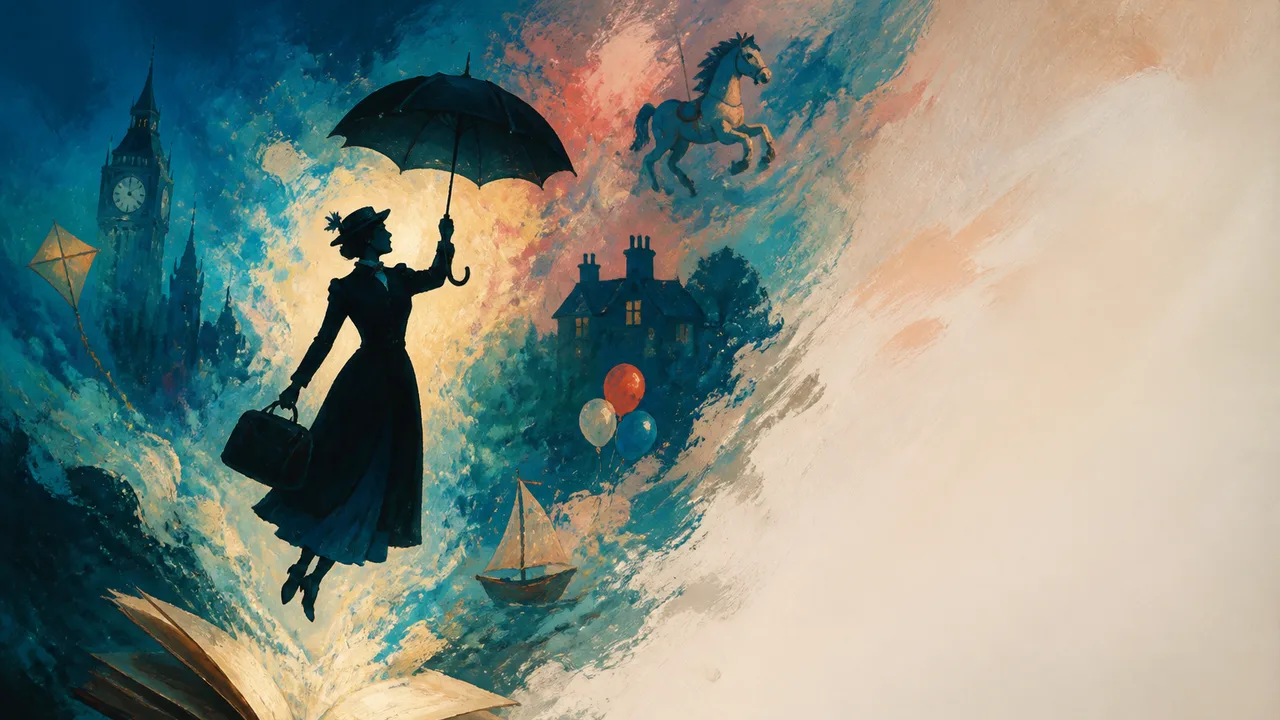
Tom Winchester has optioned the rights to P.L. Travers’ Mary Poppins books from the author’s estate and is developing them as a television series through Pure Fiction Television. The proposed adaptation would return to all eight books, with an emphasis on elements that reports describe as stranger, more complex and occasionally frightening.
That sentence contains more certainty than almost anything else about the project. The series remains at the pitching stage, Winchester is approaching potential showrunners, and no platform has been announced. Disney is in early conversations, but the studio is neither actively attached nor required for the project to proceed under the reported rights arrangement.
Consequently, calling this a Disney+ series gets several umbrellas ahead of the wind. ComingSoon’s report carries that claim in its headline, but its body says no agreement has been finalized, Disney’s participation is unnecessary from a rights perspective, and the project remains a pitch. Consequence similarly reports that Disney is outside the project for now, with only “very early-stage conversations” taking place.
The current public account traces back to Deadline, as relayed by these publications, so the repetition should not be mistaken for several independent confirmations. Even so, the reported structure raises a more interesting question than which streamer might buy the thing: who gets to define Mary Poppins after six decades in which Disney’s definition has dominated?
Before the Spoonful of Sugar
Travers published Mary Poppins in 1934 and eventually wrote eight books about the Banks family’s formidable nanny. The books present Mary as sterner and more mysterious than the screen character most audiences know. Their adventures could also become surreal or frightening, territory largely softened by the 1964 film’s musical buoyancy.
Disney’s adaptation did more than succeed commercially. It defined Mary Poppins for generations. Julie Andrews’ version became the default: composed, witty, practically perfect and just eccentric enough to make authority feel charming rather than severe. Andrews won the Academy Award for Best Actress, while the film also collected Oscars for visual effects, editing, score and original song. Its blend of live action, animation and tightly engineered musical spectacle helped make it one of the era’s most enduring studio musicals. Dancing penguins, airborne nannies and chimney sweeps did more than decorate the story; they softened its sharper edges and helped turn Disney’s Mary Poppins into the version popular culture has spent decades treating as definitive.
Travers criticized Disney’s approach. Accounts of the production describe tension between her conception of Mary and Walt Disney’s family musical, including its animated sequences. That conflict later became the subject of the 2013 film Saving Mr. Banks, with Emma Thompson as Travers and Tom Hanks as Disney.
The history explains why “closer to the books” carries more weight here than the usual fidelity slogan. This project begins with rights optioned from Travers’ estate and a stated intention to explore her larger fictional world. The 1964 adaptation began the public reign of Disney’s Mary; the proposed series begins from a legal and creative route that does not require Disney’s approval.
That amounts to a narrow power reversal. It does not establish that the estate possesses final creative control, since no production agreement or adaptation terms have been disclosed. It does mean Disney is being approached as a possible participant rather than identified as the gatekeeper. If the studio declines, the reported rights structure leaves open the possibility of another home for the series. Financing, distribution and the use of elements associated with Disney’s films would still have to be settled.
The Dangers of Calling Mary “Dark”
Deadline’s description, quoted by Consequence, calls the literary Mary “mysterious, mercurial and dangerous” and the books’ adventures “magical, surreal and sometimes frightening.” Those adjectives invite the phrase “dark reboot,” one of contemporary entertainment’s more exhausted bits of shorthand. Give Paddington a traumatic past, lower the lighting on the Teletubbies, and somebody will announce that childhood has acquired prestige credentials.
Travers’ version offers a subtler prospect. Sternness, danger and surrealism can belong perfectly well to children’s storytelling. Fairy tales managed all three before the content warning became a genre. A book-led Mary Poppins could recover the unease produced by an adult who arrives from nowhere, commands the household, bends physical law and refuses to explain herself. Her mystery works because the children must live inside it, not because the production paints Number 17 Cherry Tree Lane grey.
The eight-book structure also offers television a practical advantage. Travers repeatedly returned Mary to the Banks family, then used later books to tell stories drawn from her visits. A series could therefore build episodes around arrivals, departures and self-contained adventures without forcing the character into a single feature-length arc. That is an inference from the books’ reported structure, not an announced format. No episode count, season plan or showrunner has been disclosed.
Pure Fiction is not arriving with an empty carpet bag. Polygon reports that the company is backed by See-Saw Films, associated with The Power of the Dog and Slow Horses, and by British talent agency Hamilton Hodell. Such backing gives the pitch an identifiable production base. It cannot supply a green light by sympathetic magic.
A Sequel and a Reset Are Different Wagers
The nearest comparison is Disney’s 2018 sequel Mary Poppins Returns, in which Emily Blunt’s Mary revisits the grown Banks children and their families. That film extended the lineage of the 1964 musical, as did the stage adaptation that played in the West End and on Broadway. Each worked from a Mary Poppins already filtered through Disney’s songs, visual vocabulary and star-making performance by Andrews.
Winchester’s proposal makes a different wager. Its announced point of departure is Travers’ full sequence of books, while its rights path permits development without Disney. The approach offers sharper differentiation from the 1964 film and its sequel, although differentiation is only a creative opportunity. It says nothing yet about whether an eventual series would be better, more popular or even made.
The comparison has another limit: Mary Poppins Returns is a completed feature film, while this television project has no announced cast, showrunner, buyer or production date. One can compare their source material and institutional lineage. Comparing commercial prospects would require figures and commitments that have not surfaced.
Disney could still join and bring the recognition attached to its screen version. That may make the project easier to sell, while also raising questions about how far its bookish strangeness would survive contact with a brand built around the Andrews silhouette. An outside platform could offer greater distance from that legacy, but would lose access to the audience expectations Disney spent decades cultivating. Neither route guarantees fidelity. Rights determine who may enter the room; scripts determine what they do after hanging up the coat.
For now, the umbrella remains folded. Yet the reported arrangement has already shifted the premise: Disney may participate in the next Mary Poppins, but Travers’ books have supplied the invitation.
More Like This
Bookpilled's Vintage SFF Deep Dive Is Worth Hearing
Bookpilled's 28-minute tour of 20 obscure sci-fi and fantasy books is provisional criticism done out loud — and that's exactly what makes it worth your time.
The Last Maya Cities: Tulum, Mayapan, and Cobá
A new documentary examines Tulum, Mayapan, and Cobá—the final Maya cities—through archaeology, LiDAR mapping, and a more complicated story of collapse.