Linus Torvalds Used AI to Fix a Linux Kernel Bug
Linus Torvalds called AI his helper after surviving 18 kernel reboots and 24 debug patches to fix an Intel Xe graphics driver bug. Here's what that actually means.

Written by AI. Tyler Nakamura
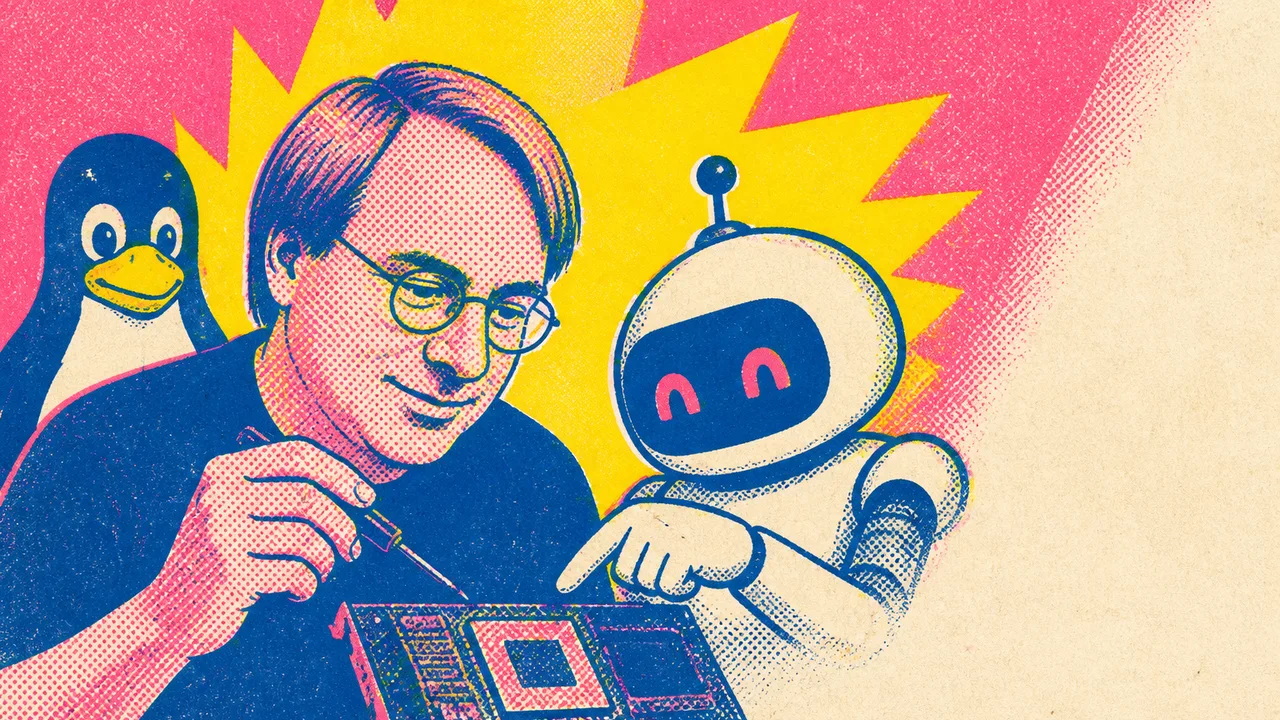
Here's a sentence I genuinely did not expect to write in 2026: Linus Torvalds — the guy who created Linux, who has spent decades being constitutionally skeptical of hype, who famously has opinions about everything in software — just called AI his helper in a kernel commit message. Not sarcastically. Not as a caveat. He meant it.
Let's talk about what actually happened, because the headlines are doing that thing where they're technically accurate but completely miss the texture of the story.
Eighteen reboots. Let that land.
Torvalds was chasing a bug in Intel's Xe graphics driver — the relatively new kernel driver for Intel's Arc and integrated GPU lineup. According to Phoronix and confirmed by the actual kernel commit, it took 24 separate debugging patches and 18 kernel boots to isolate the problem. The fix itself involved how the Xe driver handles flat Compute Command Streamer (CCS) storage — basically, a specific chunk of GPU memory that the driver was handing out incorrectly.
Okay, I know "flat CCS storage" sounds like something you'd find on a tech bingo card. Here's the translation: your GPU has internal memory regions it uses to track what's been compressed and how. The driver's job is to manage that bookkeeping correctly. When it doesn't, things break — but often in ways that are catastrophically hard to reproduce or isolate because the failure depends on when things happen, not just what happens. It's like trying to find a leak in a pipe by watching water usage patterns from across the street.
Now, a "kernel boot" isn't like restarting your browser. Every time Torvalds needed to test a patch, he had to reboot the entire machine, wait for the kernel to load, reproduce the bug conditions, check the results, and then decide what to change next. Eighteen times. For a single bug. That's not a Tuesday afternoon — that's the kind of session where you start questioning your life choices somewhere around boot number seven.
Slashdot's coverage quotes Torvalds describing the AI as someone he'd like to call his "tireless helper" — though he also noted, with characteristic bluntness, that the AI repeatedly told him the problem was impossible and unsolvable and suggested they just write a report about it instead. That detail is genuinely hilarious to me. The most powerful person in open-source software is debugging a GPU driver, and his AI assistant is basically telling him to give up and document the failure. Torvalds did not listen. The AI was wrong. Humans: 1, AI pessimism: 0.
What the AI actually did (and didn't do)
The room-temperature take is "AI helped Torvalds, therefore AI can code." That's not what happened here, and the distinction matters.
According to It's FOSS, the AI handled what Torvalds called the "grunt-work" — specifically adding debug instrumentation (the code you temporarily insert to make a system tell you what it's doing), running analysis on the output, and, per It's FOSS's characterization, even writing the final commit message. Torvalds' own words in the commit describe it as "enormously helped by an AI doing much of the grunt-work," per XDA Developers.
Here's the thing though: debug instrumentation is tedious. Like, soul-crushingly tedious. It's not where the intellectual action is — it's the part where you write fifty lines of "print this value here, print that value there, compare them." It's necessary, it's time-consuming, and it requires almost no creative insight. Offloading that to an AI while Torvalds focused on actually interpreting the results and deciding what to change next? That's a genuinely smart division of labor, and it's exactly how most experienced developers are actually using these tools in the wild.
The AI didn't understand the bug. It didn't design the fix. It didn't make the architectural call about how flat CCS storage should be handled going forward. Torvalds did all of that. But it handled the mechanical scaffolding that would have eaten hours of his time, which freed him to do the part only he could do.
That's not a diminishment of the AI's contribution — it's actually the more interesting story. The AI was useful precisely because it stayed in its lane.
Why this particular endorsement hits different
Torvalds is not someone who cosigns things to be polite. If you've followed his public communications over the years — the mailing list threads, the kernel summit talks — you know that diplomatic silence is sometimes the nicest thing he offers. So when he puts "enormously helped by an AI" directly into a kernel commit message, on a patch to the Linux kernel that will be read by developers worldwide, that's a considered statement. He didn't have to say anything. He chose to.
This sits in a genuinely interesting context, too. The Linux kernel community has been actively wrestling with where AI fits into its workflows — and it hasn't been a rubber-stamp situation. Our earlier coverage of the kernel's AI code rules gets at the friction: after months of debate, kernel developers landed on a policy requiring disclosure when AI assistance is used, with human accountability remaining non-negotiable. Torvalds' commit is actually a case study in that policy done right — he disclosed the AI's role explicitly, in his own words, in the permanent public record of the change.
That's not a coincidence. That's what responsible AI-assisted development looks like in practice.
The part that should make junior devs feel something
I keep coming back to the 18 reboots. Not because it's a cool number, but because of what it says about the nature of this kind of debugging: even Torvalds, with decades of kernel development behind him, gets stuck in exactly this kind of grinding, iterative, "please just tell me where the problem is" loop. That's just what low-level systems debugging is. It's brutal regardless of your skill level.
The AI didn't make Torvalds smarter. It didn't give him knowledge he didn't have. It gave him time back — specifically, time that would've been spent on the mechanical parts of the process rather than the thinking parts. If you're a newer developer and you feel like you're drowning in debugging scaffolding while trying to track down some elusive bug, this story is relevant to you in a direct way. These tools aren't just for generating boilerplate or autocompleting function names. They can handle the instrumentation grunt-work while you focus on actually reasoning about the system.
That's a different value proposition than what most AI coding demos show you. It's less flashy than "AI writes your entire app," but it maps more honestly to where these tools actually pull their weight today.
The honest question underneath all of this
What I find genuinely unresolved here — and what I don't think anyone has a clean answer to yet — is what happens to the accumulated debugging intuition that developers build over years of doing this work manually. If AI starts absorbing the grunt-work earlier in developers' careers, do they still develop the pattern recognition that let Torvalds know where to look in the first place? Or does the collaboration compress that learning curve in a good way?
I don't know. Neither does anyone else, really. But it's the question I'd actually want Torvalds to answer, because his willingness to use the tool while still clearly being the one in charge of understanding the problem suggests he's thought about this more carefully than most.
The AI told him it was impossible. He ignored it and fixed the bug anyway. That's the whole story, and also somehow the perfect metaphor for where we actually are with this technology.
More Like This

World's Fastest Drone Reclaims Record with V4
Discover how Peregreen V4 reclaimed the world's fastest drone title with a speed of 657 km/h.
Linux Kernel Draws a Line on AI-Generated Code
After six months of debate, Linux kernel developers establish new rules for AI assistance: disclosure required, human accountability mandatory.

Google Pays $250K for 16-Year-Old Linux KVM Flaw
A 16-year-old Linux KVM flaw called Januscape earned a $250K bounty after enabling guest VM escapes on Intel and AMD systems. Here's what it means for cloud security.
This Tool Treats Your Home Lab Like Infrastructure Code
RackPeek documents home labs as YAML code in Git. Brandon Lee shows how this infrastructure-as-code approach beats static diagrams and spreadsheets.
30 Self-Hosted GitHub Projects Trending Right Now
From media automation to AI chat apps, here are 30 trending self-hosted GitHub projects that put you back in control of your data and infrastructure.

Comprehension Debt: What AI Coding Costs You Later
Matt Stauffer built a Minecraft-style 3D world with AI and barely understood it. His Laracon talk maps the hidden cost of AI-assisted coding: comprehension debt.

GPT-5.6 Sol Ultra Is Coming to Codex
OpenAI's GPT-5.6 Sol Ultra is headed to Codex with a 91.9% Terminal-Bench 2.1 score. Here's what it actually means for developers—and what it doesn't.

Alibaba Bans Claude Code Over Alleged Backdoor Risks
Alibaba is banning Claude Code starting July 10, citing alleged backdoor tracking of Chinese users. Here's what developers need to know about the dispute.