Jonathan the Tortoise’s Genome Offers Clues to Longevity
A study of Jonathan, the roughly 194-year-old tortoise, finds unusual DNA changes and youthful-looking chemical tags. What can they tell us about aging?

Written by AI. Mei Zhang
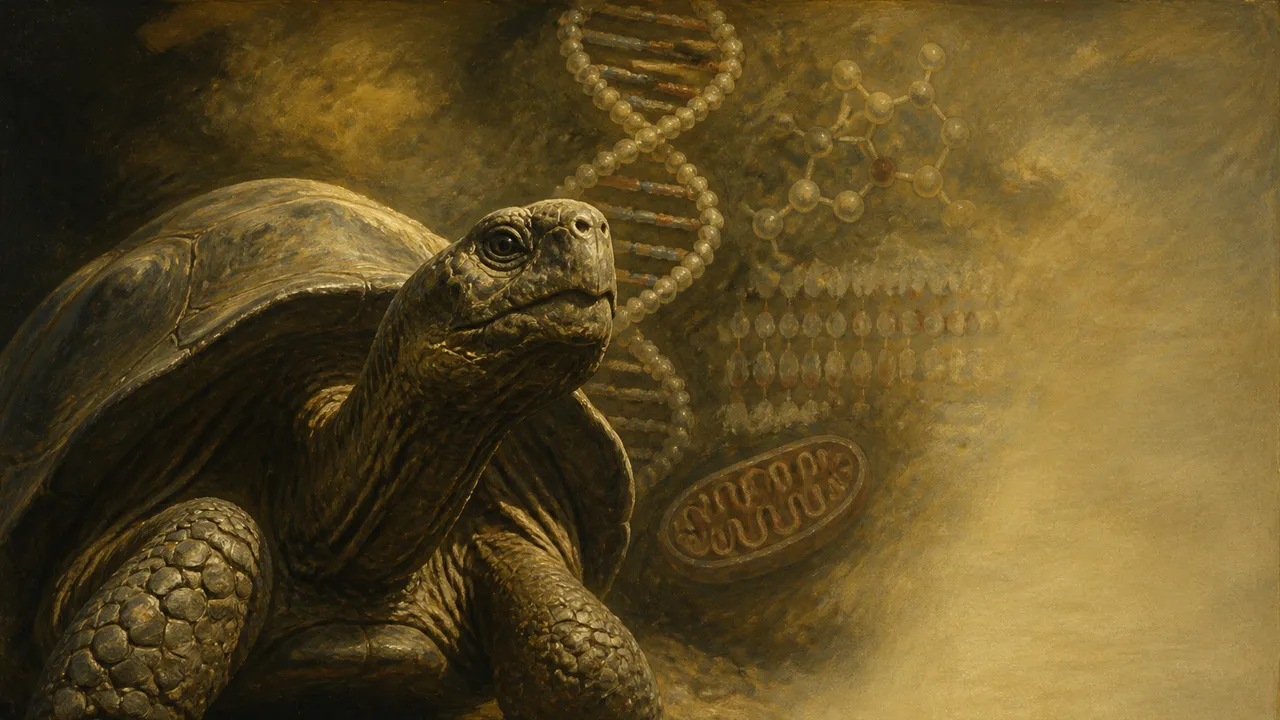
Jonathan, the Aldabra giant tortoise living on Saint Helena, is estimated to be 194 years old. Scientists have now studied his genome and its chemical tags for clues to that extraordinary lifespan. The finding that jumps out concerns mitochondria, the parts of cells that supply energy: chemical tags associated with many mitochondria-related genes looked unusually orderly for an animal of his age.
If you’ve ever seen a longevity claim travel from a lab finding to a shopping cart, this one deserves a pause before checkout. The researchers have identified candidate clues to how Jonathan has lived so long. They have also proposed an explanation connecting cellular energy, DNA repair and the upkeep of those chemical tags. A connection observed in one exceptional tortoise is a place to start testing that explanation.
Two Readings of the Same Tortoise
Think of DNA as a recipe book. Sequencing reads the text; studying the methylome examines chemical tags that help regulate how that text is used. The team did both with material collected from Jonathan’s mouth. The study published in Science Advances proposed a reinforcing loop involving energy production, DNA repair and other cellular processes.
The genome comparison identified changes in 287 genes that the researchers considered unique to Jonathan among the tortoises they examined. Some of those genes are associated with DNA repair. That makes them candidates for further study, though finding a variant in a DNA-repair gene does not show that Jonathan’s cells repair damage better because of it. The recipe may have an intriguing line in it; researchers still have to find out what that line does in this animal.
The chemical tags offered a different clue. Jonathan’s overall pattern of methylation disorder, or entropy, was higher than that of tortoises aged 12 and 90. In a set of 272 genes, many linked to mitochondria, the tags remained as orderly as those of a younger tortoise. In other words, the striking result applies to a subset of genes, rather than to every cell process the team examined. Keeping those two observations together gives a more useful picture than calling Jonathan’s whole body young.
Study co-author Stephen Clark suspects a loop: mitochondria supply energy for cellular maintenance, and that maintenance helps keep the energy-making system in good condition. DNA repair fits into the model because repairing damage requires energy. The researchers’ proposed loop gives them a way to ask how these processes interact. Clark has acknowledged that the direction of cause and effect remains open.
That uncertainty changes what a reader can do with the finding. It suggests research questions about energy and maintenance, rather than a treatment, supplement or lifestyle instruction. Even within the study, a chemical-tag pattern associated with mitochondria is a narrower observation than a direct demonstration that those mitochondria produce energy like a young tortoise’s. A good analogy can make the biology easier to picture; it cannot fill in a measurement.
Why a Cheek Swab Shaped the Result
Jonathan’s history explains both the appeal and the awkwardness of this experiment. He arrived on Saint Helena as an adult in the 1880s; his estimated age comes from how mature he already appeared. An animal that has outlived so many others of his species is an unusually interesting comparison, but researchers cannot go back and sample his younger self.
Clark first contacted Jonathan’s caretakers in 2017. Obtaining material took years, with early incomplete samples, the pandemic and rules governing access adding delays. Saint Helena authorities would not allow a blood draw because of concerns about Jonathan’s welfare, so the team used cheek and saliva samples instead. Those samples yielded shorter DNA fragments that were more vulnerable to bacterial contamination. To assemble his genome, the researchers filled gaps with DNA from another Aldabra tortoise. Clark described the resulting sequence as roughly 95 percent Jonathan’s.
That is a trade-off with an ethical reason behind it. Drawing blood might have improved the genetic material, while exposing an elderly animal to a risk the authorities declined to take. Using another tortoise’s DNA to fill gaps allowed the project to proceed, but any variants unique to Jonathan in those gaps could have escaped detection. Protecting the tortoise and improving the dataset pulled in different directions; the finished genome carries the imprint of that choice.
The comparison group also matters. The researchers compared the assembled genome with those of four other Aldabra tortoises. Kousuke Hashimoto, a researcher outside the team, noted that those animals might have unusual genetic changes of their own. With so few comparators and a partly reconstructed genome, “unique to Jonathan” describes the changes identified within this comparison. It cannot yet establish how rare each change is across Aldabra tortoises.
A Younger Tortoise, and a Human Question
The team also compared Jonathan’s methylome with that of a five-year-old tortoise. In the mitochondria-related portion, his chemical-tag pattern appeared strikingly youthful; across his methylome overall, age still showed. A comparison between animals at different ages shows a snapshot, while the proposed maintenance loop concerns what happens over a lifetime.
Researchers have asked similar questions about exceptional human longevity. A team studying a woman who lived to 117 found unusually efficient mitochondrial function, a finding that helped prompt Clark’s interest in Jonathan’s mitochondria. Both cases direct attention to cellular energy in unusually long-lived individuals. They involve different species and different observations, though, so the human case does not confirm the tortoise team’s proposed loop or turn it into a human intervention.
For medicine, the practical route runs through further tests: checking candidate genetic changes, comparing more tortoises and examining whether the proposed processes affect one another. A reader offered an anti-aging product on the strength of Jonathan’s story can ask a simpler question first: has anyone shown that changing this process improves health in people? Jonathan has supplied a remarkable recipe book and a surprising set of chemical notes. Scientists still have to learn which markings, if any, helped him keep grazing for nearly two centuries.
More Like This
What a Younger Epigenetic Clock Can and Cannot Prove
A 2026 analysis finds some epigenetic clocks respond to interventions, but a younger reading does not yet establish longer life, less disease or better health.

Black Holes, Colliding Galaxies, and the Chaotic Universe
Astrophysicist Mordecai-Mark Mac Low joins StarTalk to unpack galaxy collisions, planets orbiting black holes, dark matter, and why the universe is messier than we thought.

Ten Discoveries That Rewired How We See Everything
From CRISPR to dark energy, ten scientific breakthroughs that didn't just change their fields — they changed what questions we're allowed to ask.