Jimmy Wales on Wikipedia, Trust, and the AI Question
Wikipedia founder Jimmy Wales talks to ZME Science about trust, AI traffic erosion, and why 25 years of public argument is actually a feature, not a bug.
Written by AI. Priyanka Desai
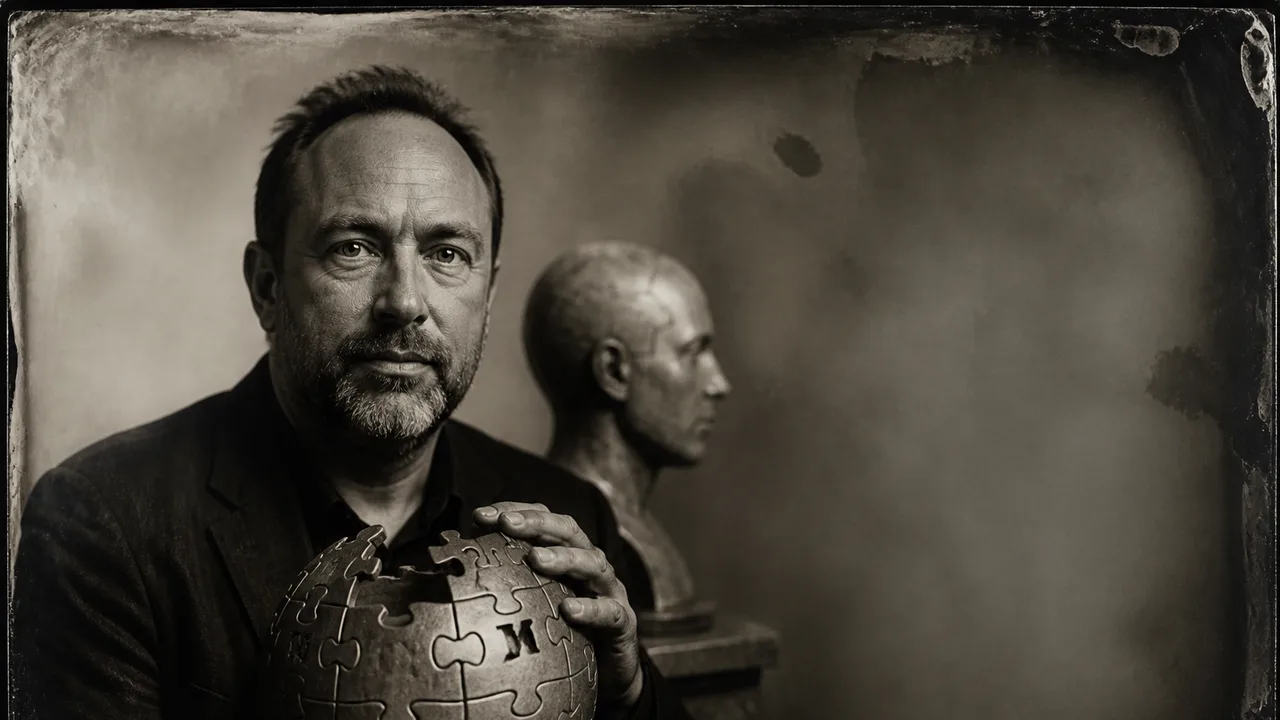
Photo: AI. Otieno Okello
Start with a number that shouldn't be possible: 11 billion. That's how many times, according to the video description for ZME Science's recent interview with Jimmy Wales, people view English-language Wikipedia every single month. Not the whole site. One language edition. The entire operation runs on a budget that would embarrass a mid-size tech startup, maintained by a volunteer community that Wales cheerfully describes as "nerds who write an encyclopedia as a hobby."
That structural absurdity is exactly the thing Wales wants you to sit with, because it's the setup for his argument in The Seven Rules of Trust, his new book: the same 25-year period that produced Wikipedia's improbable ascent also produced a near-universal collapse of public trust in journalism, politics, and institutions. The contrast isn't decorative. It's the thesis.
The transparency advantage
Wales's explanation for why Wikipedia's credibility improved over time is disarmingly simple: it got better, and it showed its work. "We've just been hard at work for 25 years trying to make Wikipedia better," he told ZME Science's Andrei Mihai. "We've got a great community of people who care about reliable sources and trying to get it right."
What he's describing, in operational terms, is a system where every editorial disagreement is logged publicly on talk pages, every revision is timestamped and attributed, and the article on Wikipedia's own reliability (which Mihai quotes directly in the interview) doesn't bury the criticism. Wales calls that transparency a feature, not a liability. The article documenting Wikipedia's mixed early reviews and its gradual improvement, he says, "is showing the transparency of Wikipedia. We're very happy to tell you all the things that are wrong with Wikipedia."
That's a specific structural claim, not a vague aspiration. You can actually click through to see what Wikipedians are arguing about on any given article. Compare that to the opaque confidence of a language model, which presents a synthesized answer with no audit trail, no dissenting edits, no visible history of anyone saying "wait, did we get this wrong?" Wales frames that contrast directly: the human element of "really challenging things, really chewing on ideas, really being open to someone coming and saying, 'Hey, I think you got this wrong,'" is precisely what generates trust over time.
Fortune's coverage of Wales captures his core AI position in the headline: "AI can generate answers. It still can't earn trust." The distinction matters. Earning trust, in Wales's framework, requires a visible track record of being wrong, being corrected, and updating. Systems that don't expose their errors can't accumulate that record.
The 90% scenario, examined
The AI traffic question is where the interview gets most concrete, so it's worth following the arithmetic Wales lays out rather than paraphrasing past it.
Wales distinguishes between two traffic segments. The first: short-form queries, people who ask Google a quick question and get an AI-generated summary at the top of the results page without ever clicking through. He acknowledges Wikipedia is already seeing some erosion there. The second: deep-read traffic, people who arrive wanting sources, context, full article history, related topics. Wales's position is that LLMs don't effectively substitute for that use case.
Then he entertains the stress scenario: "If traffic were to fall by 90%, that could be an issue for fundraising, but I don't think it would be an issue for the community." This is a careful separation. The Wikimedia Foundation's fundraising model depends on reader volume, so a 90% traffic collapse would be a genuine financial problem. The editorial community, which is volunteer-driven and not traffic-dependent in the same way, would, Wales argues, continue regardless.
Whether that separation is as clean as he suggests is an open question. Volunteer editor communities are not immune to the psychological effects of platform relevance. There's a documented pattern in open-source and volunteer-driven projects where contributor participation is correlated with perceived impact and audience size; the research on this is well established even if Wales doesn't invoke it here. The claim that community health is fully decoupled from traffic health is plausible as a floor, but probably not as a steady state.
What Wales is more cautious about, notably, is using LLMs to generate Wikipedia content directly. He's explicit: contributors "should probably not try to use an LLM to try to write something for Wikipedia because they hallucinate, they get things wrong, they also have a very annoying style." The use case he's actually interested in is narrower: LLMs as editorial scanners, flagging discrepancies between articles, surfacing inconsistencies. That's a quality-control function, not a content-generation one. As of this interview, it's experimental, not implemented.
Trust as infrastructure, not sentiment
Wales's framing of the broader trust crisis is where the interview stretches beyond Wikipedia. He identifies two compounding causes: social media platforms optimized for engagement over accuracy, and politicians who deliberately undermine institutional credibility rather than engage it critically. He draws the distinction carefully. Criticizing a news organization's editorial slant is legitimate. Labeling all journalism "fake news" is something different: it attacks the shared factual basis that makes any subsequent argument possible.
He quotes Christiane Amanpour making the structural version of this point: "We have to have a shared basis of facts. And then what you do about the facts, of course, you can debate about that. But that shared basis of facts, if you don't even have that, then the rest of the debate is absolutely pointless."
This is not a new argument, but Wales is making it from an unusual position. Wikipedia is not a journalistic institution in the traditional sense. It's a synthesis layer that depends on journalism to generate the sourced reporting it then aggregates. If journalism's credibility erodes, Wikipedia's source base erodes with it. The two are more structurally entangled than Wales's framing always acknowledges.
On social media, he differentiates by platform rather than painting the category uniformly. He gives credit to YouTube for actively working against its own algorithm's tendency toward radicalization, at least more so than some competitors. He names Elon Musk directly in the interview as an example of platform ownership that appears ideologically motivated: "maybe they are ideological themselves, Elon, and really want to promote certain views and they're happy to use their platform to do it." That's his characterization, in his words, not an inference.
What the fundraising banners are actually saying
One of the more clarifying moments in the interview is Wales's explanation of those perennial Wikipedia donation banners. He's careful here: "We don't want to scare people. We think, donate because you want to keep us healthy, not because we're about to go out of business."
That's a meaningful reframe. The banners are not distress signals; they're infrastructure maintenance asks from an organization that runs lean by design. Wales describes the Wikimedia Foundation as building reserves against technological uncertainty, not bleeding out. The vulnerability implied by the banner aesthetic is, apparently, partly a fundraising aesthetic choice.
The New Yorker's profile of Wales positions him as the accidental architect of something that wasn't supposed to work at the scale it does. Wales himself leans into that: he describes switching from a top-down editorial model to the wiki model early on and watching two weeks of community output surpass nearly two years of the previous approach. The model wasn't planned for scale; it scaled because the openness of it unlocked contribution energy that couldn't have been predicted in advance.
Rule one in The Seven Rules of Trust, the one Wales singles out as the distillation of the book: "Make it personal." Think about the other person, how they're feeling, what they're experiencing. It reads simply, but the operational logic behind it is what Wikipedia's talk pages actually enact, thousands of times a day, across dozens of languages: a contributor challenges an edit, someone responds by engaging with the concern rather than reverting it, a small trust deposit accumulates.
Wikipedia's active editor count has remained relatively stable over the past decade, hovering in the tens of thousands for English Wikipedia according to Wikimedia Foundation metrics, even as the article count has grown past 6.7 million in English alone. That ratio, a small editorial core maintaining an enormous and growing corpus, is the actual stress test of Wales's trust model. It's not holding because of sentiment. It's holding because the accountability architecture, the talk pages, the revision history, the sourcing norms, makes defection costly and contribution legible. That's the thing worth measuring: not whether people feel good about Wikipedia, but whether the editing community keeps showing up. So far, it does.
More Like This
Karpathy's Self-Evolving AI Wiki Tests New Memory Model
Andrej Karpathy released an architectural blueprint for AI agents that maintain their own knowledge bases. Does it solve AI's memory problem or create new ones?
Building an LLM Wiki from Karpathy's Blueprint
Nate Herk demos an AI-powered personal wiki built on Karpathy's LLM knowledge base idea. Here's what the architecture reveals about how context shapes AI reasoning.
AI Memory Wars: When Your Assistant Forgets Everything
Karpathy's wiki and OpenBrain solve AI's memory problem from opposite directions. The choice you make determines whether your AI gets smarter or just noisier.

Rina Hidaka and Yūma Uchida Announce Birth of First Child
Voice actors Rina Hidaka and Yūma Uchida welcomed their first child. Here's what the arc of Hidaka's career tells us about what comes next.

2026 Booker Prize Longlist: What 13 Novels Reveal
The 2026 Booker Prize longlist names 13 novels from 163 submissions, including two past winners and three debuts. Here's what the selection actually signals.

Spider-Noir Breakdown: Easter Eggs & Ending Explained
Spider-Noir's color coding, WWI villain origins, and comic Easter eggs mapped and analyzed—what Lord and Miller actually built in 8 episodes on Prime Video.
Public Trust in Science Is Fragile and Complicated
Trust in science is eroding—but the data is more complicated than the panic suggests. Here's what's actually happening, and why it matters.

How Low-Budget Films Achieve High Production Value
Budget doesn't determine production value — craft does. Here's how filmmakers use light, sound, and design to make cheap movies look expensive.