iOS 27 Siri Redesign: What the Leaks Actually Say
Bloomberg's Mark Gurman reports iOS 27 will overhaul Siri with Dynamic Island integration, AI model choice, and deep personal context. Here's what we know.

Written by AI. Marcus Chen-Ramirez
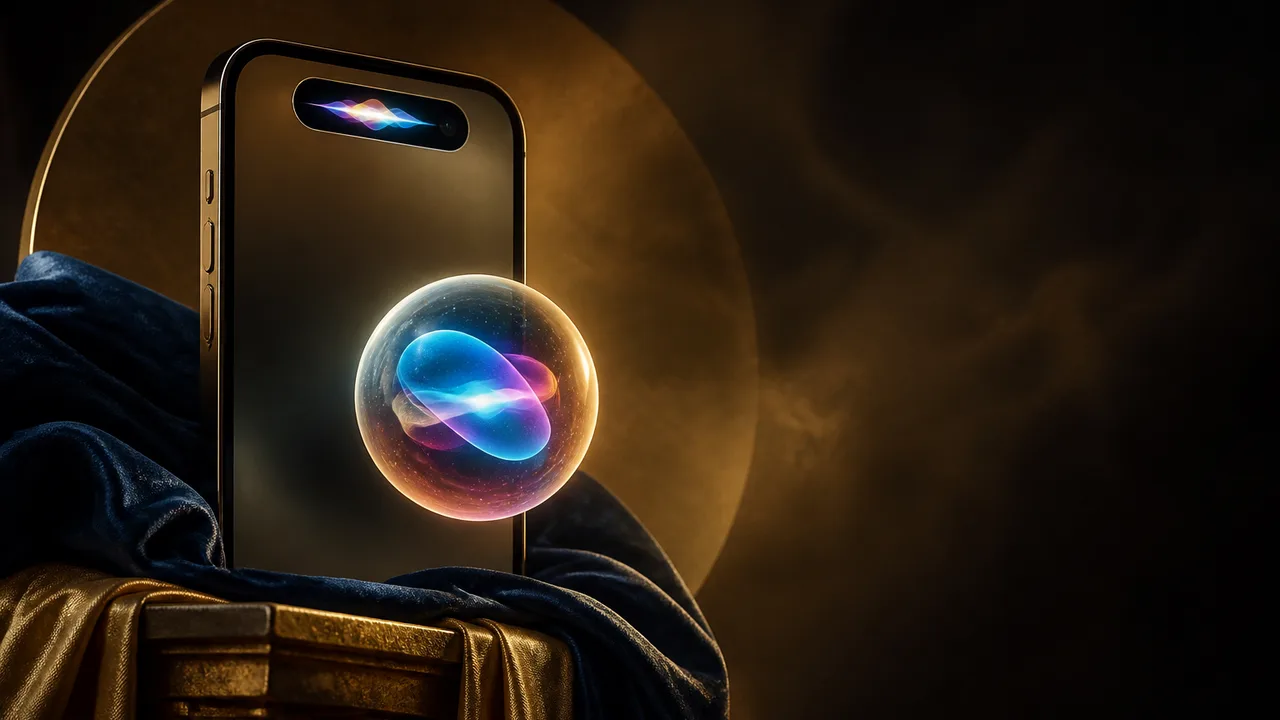
Photo: AI. Liora Goldstein
Apple has a Siri problem that predates the current AI moment by roughly a decade. The assistant that debuted in 2011 as a cultural event—remember those launch ads?—spent most of the following years being quietly, consistently outrun by competitors. Google Assistant got smarter. Alexa colonized living rooms. And then ChatGPT arrived in late 2022 and rendered the entire prior generation of voice assistants aesthetically quaint overnight. Apple's response, Apple Intelligence, landed with iOS 18 and looked more like a holding pattern than a strategy: glowing screen borders, AI-generated emoji, image generation tools, and a tunnel to ChatGPT that couldn't even remember what you'd talked about in the previous session.
Now, with WWDC less than two weeks out, Bloomberg's Mark Gurman is reporting that iOS 27 will bring what Apple is apparently framing as its most significant Siri overhaul ever. The 9to5Mac breakdown of Gurman's reporting is worth taking seriously—not because every pre-WWDC leak lands intact, but because Gurman's track record on Apple specifics is unusually reliable, and the architecture he's describing represents a coherent theory of what Siri was always supposed to become.
The Dynamic Island Bet
The headline change is positional: Siri moves into the Dynamic Island. That sounds like a UI tweak, but the implications run deeper than screen real estate.
Right now, invoking Siri is a context-destroying act. The assistant colonizes your screen, shoving whatever you were doing into the background while it processes your request. Apple has made incremental improvements here—iOS 26 reportedly lets you interact with background content even while Siri is active—but the fundamental problem remains. You lose your place to ask a question.
Anchoring Siri to the Dynamic Island changes the negotiation. The island expands and contracts based on what a query requires; your content stays intact underneath it. Fernando from 9to5Mac frames it this way in his breakdown: "Siri is no longer going to overtake your entire screen... having this live in the dynamic island still gives you full access to your phone whenever you do need to use it if you are doing things simultaneously."
That's a meaningful UX shift. It also recasts the Dynamic Island from a clever notification display into something closer to a persistent command surface—which is probably what Apple envisioned when it introduced the notch cutout in 2022 and needed to justify making it a feature rather than a flaw.
Accompanying the Dynamic Island integration is what Gurman describes as a "Search or Ask" interface—essentially a Spotlight-style swipe-down that reaches not just into your apps and files, but outward into web searches and AI-generated answers, while simultaneously pulling from your notes, messages, contacts, calendar, and email. The pitch is a single query surface that understands both what you're looking for and who you are. 9to5Mac's read: "This is Apple trying to create one big universal command center that lives in your phone, on your phone, on device, but can then also leave your device if needed, hopefully in a secure fashion."
That "hopefully" is doing meaningful work in that sentence, and we'll return to it.
The Model Choice Question
Perhaps the most structurally interesting element of Gurman's report is the suggestion that Apple will let users select their default AI service—much like you currently choose a default browser or search engine. ChatGPT, Gemini, and Claude are all named as options.
This is worth sitting with for a moment, because it represents something of a philosophical concession from a company that usually insists its integrated approach produces superior outcomes. The 9to5Mac commentary is blunt about the subtext: "It goes to show you that even Apple is saying that no one model is great. Sometimes ChatGPT depending on the time of year or month or day is better than Gemini and vice versa."
Apple built its 2025 Siri roadmap around Google's infrastructure, a deal that raised its own set of questions about Apple's capacity to develop competitive AI models independently. Offering users a choice of third-party models could read as a principled commitment to openness—or as an acknowledgment that Apple's own models aren't yet compelling enough to mandate. Probably some of both.
The browser/search engine analogy is apt in one direction and imperfect in another. Browser choice works because browsers are largely interchangeable for most tasks. AI models are not. GPT-4 and Claude handle different tasks with meaningfully different strengths; a user choosing between them needs to understand those differences to benefit from the choice. Apple will need to decide how much of that complexity to surface versus abstract away. Get it wrong in one direction and the feature feels overwhelming; get it wrong in the other and the "choice" is cosmetic.
Siri in the Camera
Visual intelligence—Apple's term for the on-device image understanding it's been developing—reportedly gets embedded directly into the Camera app via a dedicated Siri button in the interface slider. The feature promises to do everything Apple previewed when it announced visual intelligence: identify objects, answer questions about what the camera sees, pull in relevant information from the web.
The consolidation makes sense as a design choice. Burying visual intelligence in a separate flow made it invisible to most users. Camera placement puts it where people are already pointing their phone at things and wondering what those things are.
Whether the underlying capability is ready to meet the interface's promise is a different question. Apple has been careful—sometimes frustratingly so—about overpromising on Siri features and underdelivering. The history here is instructive: Siri launched with capabilities that Apple demonstrated in keynote conditions and that performed inconsistently in real-world use, a credibility deficit the assistant never fully recovered from.
The Honest Assessment of Where Apple Started
The 9to5Mac framing positions the iOS 18 Apple Intelligence rollout as a deliberate stepping stone—a necessary patch job while the real work happened in the background. That's one reading. Another is that Apple shipped what it had when competitive pressure made waiting untenable, and is now building the foundation it should have had from day one.
Neither reading is flattering, but they carry different implications for what iOS 27 delivers. If iOS 18 was a calculated bridge, the iOS 27 architecture should be largely complete and coherent. If it was triage, we might see another multi-release rollout where the full vision arrives somewhere around iOS 27.2 or later.
The 9to5Mac commentary anticipates exactly this: "I also wouldn't be surprised if they slowly roll this out with 27 and then 27.1, 27.2, and so on and so forth." Apple's recent software history supports that expectation. Features announced at WWDC routinely arrive in full form months after the initial release, if they arrive at all.
What the Leaks Don't Answer
The privacy architecture is the conspicuous gap in everything reported so far. Apple has built its AI differentiation around on-device processing and Private Cloud Compute—the idea that your data doesn't need to leave your device to make Siri useful. A Siri that searches your notes, messages, emails, and calendar while simultaneously routing queries to ChatGPT, Gemini, or Claude creates real tension with that positioning. How that tension resolves—which data stays on device, which travels to third-party servers, what users actually understand about the distinction—will matter significantly more than which AI model sits in the dropdown.
The leaks also don't address the harder problem of Siri's trust deficit. Users who have been burned by Siri mishearing them, confidently providing wrong information, or simply refusing to complete tasks that seemed obvious—that population is large, and it doesn't come back because Apple announces a redesign. It comes back, slowly, through enough successful interactions to rebuild the habit.
Apple is genuinely good at eventually solving problems it has decided to solve. The question WWDC will begin to answer is whether iOS 27 represents that moment for Siri, or another chapter in the story of what Siri is almost about to become.
More Like This
OpenAI's Camera-Powered Smart Speaker Targets 2027 Launch
OpenAI's first hardware product—a smart speaker with continuous visual awareness—aims for early 2027. Price target: $200-300. Jony Ive's team is designing it.
Apple's New CEO Inherits a Paradox: Did Doing Nothing Win AI?
John Ternus takes over Apple amid questions about whether the company's AI inaction was genius or fumble. Plus: Google forms a coding strike team.
A Mac Mini Became an AI Assistant. Sort Of.
A tech YouTuber turned a Mac mini into a dedicated Claude AI workstation. The reality is messier—and more interesting—than the hype suggests.
iPhone 18 Pro: Six Upgrades That Actually Matter
Leaked specs paint the iPhone 18 Pro as a year of internal gains over flashy redesign. Here's what the rumors actually mean for you.

Building Secure AI Agents With Bigtable and ADK
Google's Bora Beran demos a healthcare AI agent built on Bigtable and ADK—and the security layers that make it worth taking seriously.
iOS 26.6 Beta 1: What Apple's Quiet Update Reveals
iOS 26.6 Beta 1 dropped two weeks before WWDC — and its small changes say a lot about where Apple's head is at heading into iOS 27.

Hugging Face ML Intern Automates AI Development
Hugging Face's ml-intern is an open-source agent that automates the full ML research loop. Here's what it does, what it can't, and what it signals.

Small Language Models Are Reshaping Agentic AI
Small language models are outperforming larger rivals on key AI agent benchmarks. Here's what the efficiency shift means for how AI gets built and deployed.