Intel Xeon 696X vs AMD Threadripper: A $22K Question
Tech Notice built a $22,000 Intel Xeon 696X workstation to challenge AMD Threadripper. Here's what the benchmark results actually revealed about Intel's HEDT gap.

Written by AI. Tyler Nakamura

Photo: AI. Eira Pendragon
The premise is simple enough: take Intel's most ferocious server-grade chip, stuff it into a PC case, and see if it can trade punches with AMD's Threadripper line. The execution is... considerably less simple. Tech Notice just dropped a 31-minute build video documenting exactly this experiment, and the journey from unboxing to benchmark result is equal parts fascinating and instructive — not just about the chips, but about what this whole category of hardware actually is.
The Build: Controlled Chaos With Expensive Parts
The parts list reads like a fever dream. The Intel Xeon W9-6980XE (which the host affectionately calls the 696X) comes in at $6,999. The ASUS motherboard is $1,755. G.Skill RAM — 128 GB at 6,400 MT/s — lands at $6,478. An RTX 5090 at $5,000+. A Seasonic TX-1600 PSU at $654. Add it all up and you're north of $22,000 before you've bought a monitor or a desk to put it on.
The case is a Noctua-branded Antec chassis — walnut accents, thoughtful fan hub design, labeled PSU screws, magnetic fan hub that moves around freely. It's genuinely nice. It's also, as the host discovers in real time, not quite big enough for the motherboard.
"It's not clean, BUT IT WORKS," he announces, after wedging the board in at an angle that should not work but somehow does. "SOMETIMES YOU JUST GOT TO DO WHAT YOU GOT TO DO... don't tell these people. But let's just say if you were doing it, I'd probably go with a different case."
That's the energy of the whole build section: a knowledgeable builder encountering genuinely weird edge cases and problem-solving live on camera. The power cabling situation is a highlight — workstation boards apparently want PCIe connectors where you'd normally expect CPU connectors, which trips up even someone who clearly knows their way around a build. The host figures it out by reading the manual aloud, cross-referencing, getting it wrong, and trying again. It's useful content dressed up as chaos.
A few things worth flagging if you're thinking about doing something like this yourself: the Intel socket installation is fiddly in a way consumer sockets aren't. The recommended method (mounting everything on the CPU block first, then hanging it over the socket) felt risky enough that the host skipped it entirely and went old-fashioned. The thermal paste application was also rougher than expected — the MX-7 didn't cooperate, so they switched to a different compound mid-apply. Small stuff, but on a $7,000 CPU, small stuff feels significant.
Memory: Eight Channels, Two Sticks
One detail that might get lost in the chaos: this platform supports eight-channel memory, and the build only populated two slots. That's not necessarily a budget compromise — it's a starting point — but it's worth understanding. The host pulled the G.Skill sticks directly from a Threadripper build, noting that the slot layout is completely different between platforms. On a Threadripper board, you'd follow one pattern; here, it's A1, B1, E1, F1. If you're swapping components between ecosystems, don't assume the rules transfer.
The machine booted first try, which frankly felt like the most impressive moment of the whole video. Then came six months of waiting for Antec to patch a software bug in the case's display screen. Some CPUs boost to 100 watts. This one idles at 100 watts — just sitting there, doing nothing, pulling the kind of power that some chips only hit at peak performance. Workstation hardware exists in a different universe.
The Benchmark: Honest About the Gap
The target was clear before the test started: the AMD Threadripper 7980X, a 64-core processor in the same weight class, posts around 5,707 points in Cinebench R20. That's the number to beat.
Initial scores looked promising before settling lower. The host tried a few runs, turned off background processes, dug into BIOS settings. He found a "Remove All Limits" toggle under multi-core enhancement and enabled it — and got, in his words, "literally no difference." Intel's XTU software doesn't support the Xeon platform, so software-side tuning was basically off the table. The BIOS is where you live, and the BIOS gave him what it gave him.
The verdict: "We can't even beat the 7000 series of Threadripper, and the 9000 series of Threadripper is even better. Which just means that Intel's a little bit behind."
There's an important nuance here. The chip ran the whole time without thermal distress — the Arctic Liquid Freezer 3 Workstation Edition handled everything thrown at it without complaint. This isn't a cooling failure or a thermal throttling story. The performance gap appears to be architectural, not thermal. The silicon just doesn't score where AMD's equivalent silicon scores, at least in this particular test.
So What Do You Actually Do With This?
Here's the honest tension in a build like this: the Xeon W9-6980XE is not really a Threadripper competitor in the way consumers typically think about competition. It's a server/workstation chip that happens to have 64 cores, designed for different workloads, different reliability priorities, different management needs — the host points out that the W890 platform has a dedicated management subsystem you can connect to remotely over Ethernet, which is an enterprise feature that most enthusiast builders will never use. You're buying a whole ecosystem, not just a CPU.
For the person watching this at midnight trying to decide between these platforms: if you go Intel Xeon, you get what shipped. Tuning options are limited, XTU won't run, and BIOS-side adjustments didn't move the needle in this test. If you go AMD Threadripper, you have more room to push it later. That's the practical difference, and it matters.
The $200 Arctic cooler handled a chip that cost $6,999 without breaking a sweat. That's the value story in this build — not the CPU, but everything around it proving itself against something extraordinary.
Intel's Hybrid Problem
The host floats an interesting idea at the end: what if Intel applied its hybrid architecture — performance cores plus efficiency cores — to the Threadripper-class platform? The host specifically suggests something like a batch of performance cores paired with a massive efficiency core count: "200 efficiency cores, that would be absolutely insane because then you can pack so much more in there and get so much more performance."
Here's the thing though. You just spent $22,000 on a machine, and Intel's theoretical answer to "how do you beat AMD here?" is apparently "we could try something different eventually." That's the story. A $22,000 build running second place, and the roadmap response from Intel is a shrug and a hypothetical. The host's read is that if it were feasible, Intel would have done it already. That's probably right.
"Intel, I'm still waiting for you to do a big W, but so far we're still waiting. AMD is still winning."
For builders who want to see what this looks like when someone actually prioritizes the AMD side from the start — component choices, workflow optimization, the works — the 64-core Threadripper build Level1Techs did for Linux kernel maintainer Greg Kroah-Hartman is worth a look. Different goals, different conclusions, same core question about what this hardware tier is actually for.
The Xeon 696X build isn't a failure. It's a proof of concept that's honest about its own limits, which is more than most $22,000 experiments manage to be.
More Like This

AMD EPYC 8005 Sorano: A Genuine Generational Leap
AMD's EPYC 8005 Sorano upgrades SP6 with Zen 5 cores, 84-core density, and 96 PCIe Gen 5 lanes—but the ecosystem remains niche and memory costs sting.
Intel's $199 Chip Outperforms AMD's $500 Flagship
Intel's Core Ultra 250K at $199 matches or beats AMD's $500+ 9950X in real-world creative workloads. The benchmarks tell an unexpected story.

Atomman G7 Pro Review: Mini PC with Big Surprises
Discover the Atomman G7 Pro's power-packed performance and explore its pros and cons for your tech lifestyle.

This Tool Treats Your Home Lab Like Infrastructure Code
RackPeek documents home labs as YAML code in Git. Brandon Lee shows how this infrastructure-as-code approach beats static diagrams and spreadsheets.
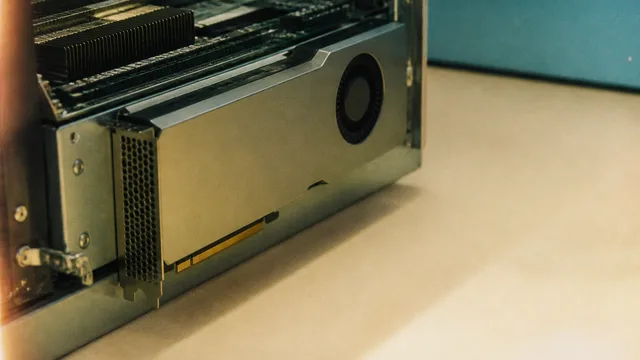
AMD Instinct MI350P: 144GB HBM3E in a PCIe GPU
AMD's Instinct MI350P brings 144GB of HBM3E and 3.6TB/s bandwidth to standard PCIe servers. Here's what it means for the mid-market AI infrastructure gap.

Front-to-Back Motherboards Are Solving Real Problems
The BTF standard relocates power connectors to improve airflow and cable management. Level1Techs demonstrates the practical benefits beyond aesthetics.

Alibaba Bans Claude Code Over Alleged Backdoor Risks
Alibaba is banning Claude Code starting July 10, citing alleged backdoor tracking of Chinese users. Here's what developers need to know about the dispute.

Meta Puts Ray-Ban Smart Glasses Behind a Paywall
Meta is rate-limiting its Ray-Ban smart glasses AI features and charging $20/month for extended use. Here's what that actually means for buyers.