Google Gemini Arrives on CarPlay as a Dedicated App
Google's Gemini app brings continuing voice chats to Apple CarPlay. See what changed from Maps access, how Android Auto compares and what drivers need to set up.

Written by AI. Bob Reynolds
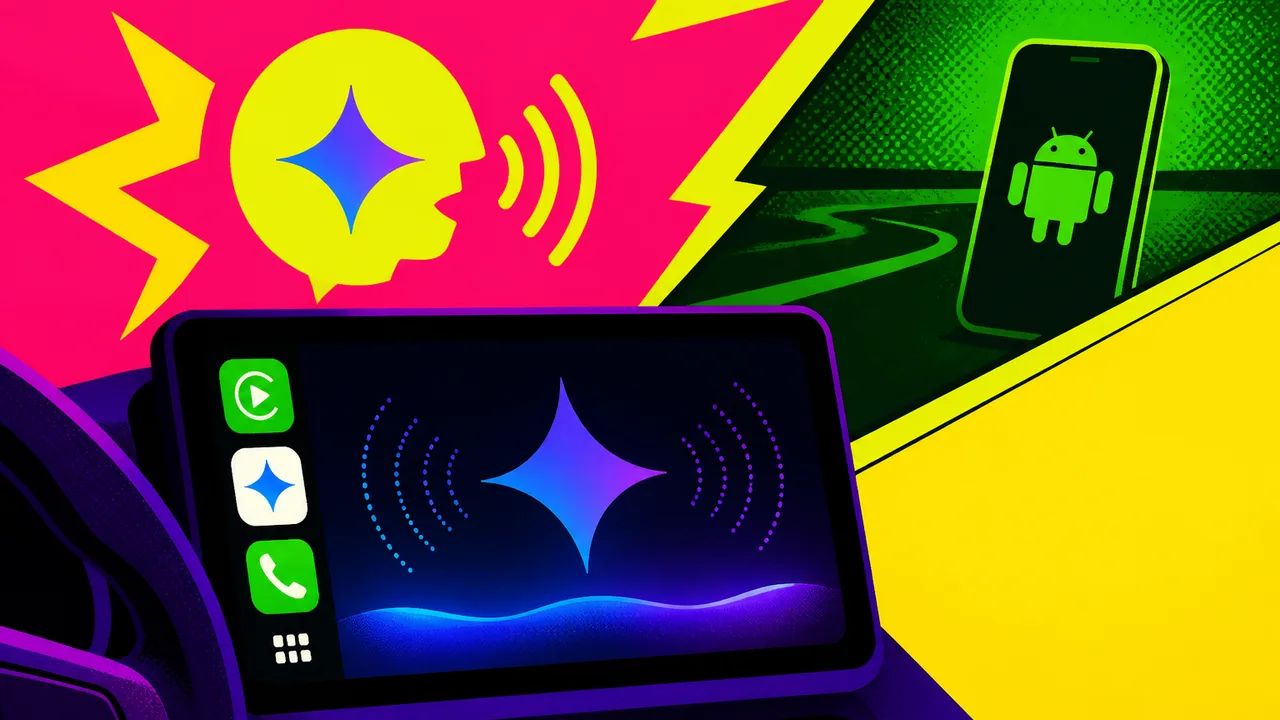
Google brought its Gemini app to Apple CarPlay on November 11, giving iPhone users a dedicated icon for starting or resuming a voice conversation on a supported car display. Gemini was already accessible through Google Maps on CarPlay. The new app changes where the conversation begins and makes it easier to carry one between the car and the iPhone.
That sounds like a small interface change until the conversation turns to a calendar appointment or an unread email. Google is offering an assistant that can retain the thread of a chat and draw on information in its other apps. For a driver, the practical question is whether that combination saves effort on a trip, or simply brings a longer list of things to manage into the car.
What the CarPlay App Adds
Tap the Gemini icon on a CarPlay display and Gemini Live offers a hands-free voice chat. You can begin a conversation or pick up a recent one; conversations sync with the Gemini app on the iPhone and remain in its chat history. Google says the app is available in supported Gemini Live languages. This is a dedicated CarPlay entry point for a service that previously reached drivers through Google Maps, rather than Gemini's first appearance on the display.
The voice interface is designed for exchanges longer than a single command. A driver can interrupt Gemini mid-response or change topics. A waveform indicates whether it is listening, thinking or talking. Google suggests using it to catch up on a schedule, discuss an inbox, prepare for a meeting or ask for local recommendations. Through its connections to Gmail and Calendar, Gemini can summarize unread emails, read out a daily brief and help draft a spoken reply. Daily Brief must be switched on first.
Those examples describe a different job from asking a navigation app for a place to stop. A request about tomorrow's meetings depends on personal information; a discussion of an email depends on both that information and the assistant keeping track of the question. Putting Gemini one tap away from the CarPlay display makes that workflow easier to start. Whether it makes the workflow useful depends on the answers being relevant and on how much conversation a driver wants during a trip.
The setup has a few steps of its own. Drivers need the latest Gemini app on their iPhone, microphone permission and at least one prior Gemini Live session on the phone. An iPhone can connect to a supported CarPlay display by cable or wirelessly. The icon on the dashboard is the visible change; the phone and its app still do the preparatory work.
A New Doorway, with Some History Behind It
The route through Google Maps is useful context for the launch. Gemini could already accompany a CarPlay journey, but a driver encountered it within another Google app. A dedicated icon gives the assistant a place of its own on the display, while chat syncing lets a conversation started elsewhere continue in the car and be revisited on the iPhone. Those are changes in access and continuity, not proof that Gemini answers a question better than it did before.
Google has also been expanding Gemini elsewhere in the car. Gemini had been part of Android Auto before this CarPlay launch, and Google had enabled a personal-assistance feature there that can use details from other Google apps for tailored responses. The comparison has a clear limit: Android Auto and CarPlay serve different phone users, and these feature descriptions do not measure how reliably either version works on a drive. They do show that the CarPlay app belongs to an ongoing effort to put conversation and personal context into the dashboard, rather than an isolated experiment with a new icon.
Google Maps access established that a CarPlay driver could reach Gemini. The dedicated app makes that access more direct. Conversation history gives a driver a reason to return to the same discussion, and Gmail or Calendar connections give it something personal to discuss. Each addition could reduce the need to reconstruct a request from scratch. Each also increases the importance of knowing which information the assistant is using and checking a reply that will be acted on later.
Consider Google's meeting-preparation example. A driver might ask for a summary of the next appointment, then follow up about an email concerning it. Continuing the conversation could spare them from repeating the subject; app connections could supply the schedule and inbox details. That is the strongest case for this design, and it follows from the announced features. It remains a proposed use, not a measured improvement in how accurately people prepare for meetings or how comfortably they drive while doing so.
The Question Inside a Hands-Free Conversation
Hands-free operation removes the need to type a question, but it does not tell a driver how demanding the answer will be to follow. An email summary may be short; a back-and-forth about what to say in a reply can grow longer. Gemini Live's ability to accept interruptions may make a conversation easier to steer, yet it also makes continuing that conversation an option whenever the driver thinks of another question. The sensible test for a user is the task, not the presence of a microphone: a quick schedule check and drafting a consequential reply place different demands on attention.
The same applies to personal context. Calendar and Gmail connections can make an answer more relevant because the assistant has information a general chatbot would need the user to recite. They also mean that the content of a commute-time exchange may involve appointments and private messages. Anyone deciding whether to use those features has to weigh the convenience of hearing that information aloud in a car against where and with whom they travel. The trade-off follows from what the assistant is built to handle, not from a claim that any particular journey will expose someone's inbox.
Google's CarPlay addition gives iPhone users a shorter path into Gemini and a way to keep talking across devices. The app's value will be clearest in requests that benefit from remembered context; its limits will be clearest when a conversation asks more of a driver than the trip allows.
More Like This

Google's Pixel 11 Call for Me Puts AI on the Line
Google's Pixel 11 lets Gemini call businesses, but its live transcript, limited preview and burden on staff reveal the tradeoffs of cautious AI agency.

Google's Gemini Glasses Face a Test Beyond the Demo
Google's Gemini glasses promise translation, navigation and visual help. Their real test is daily usefulness and whether privacy controls reassure people nearby.

Google Gemini Hits 1 Billion Monthly Users
Google's Gemini just hit 1 billion monthly active users — faster than any product in Google's history. Here's what that number actually tells us.

Google's Ad Policy Adds an AI Data-Sharing Exception
Google's updated ad policy makes an exception for connected Gmail, Drive and Photos data. Here's how Personal Intelligence works and what users can control.
Anthropic Ships 74 Features in 52 Days. Here's What Matters.
Anthropic released 74 updates in under two months. Tech correspondent Bob Reynolds cuts through the noise to explain what actually changes your work.
Google's Image AI Bets on Speed Over Perfection
Google's Nano Banana 2 signals a shift in AI image generation: good enough, fast enough, and cheap enough now matters more than perfect.

AI Second Brain for Engineering Managers, Explained
Marlon Vidal built an AI-powered knowledge system for engineering managers. Here is what it actually does, what it costs you, and who can realistically use it.

GLM-5.3 Flash: A Cheap Chinese AI Beats Pricier Rivals
Z.ai's GLM-5.3 Flash launched anonymously as "Ox Alpha," undercut American AI rivals by up to 90%, and ran on non-Nvidia chips. Here's what that actually means.