Google Faces Pressure to Divest Chrome Browser
Public Knowledge and the DOJ want Google to sell Chrome. Here's what's actually at stake — and why the browser question is just the start.

Written by AI. Zara Chen
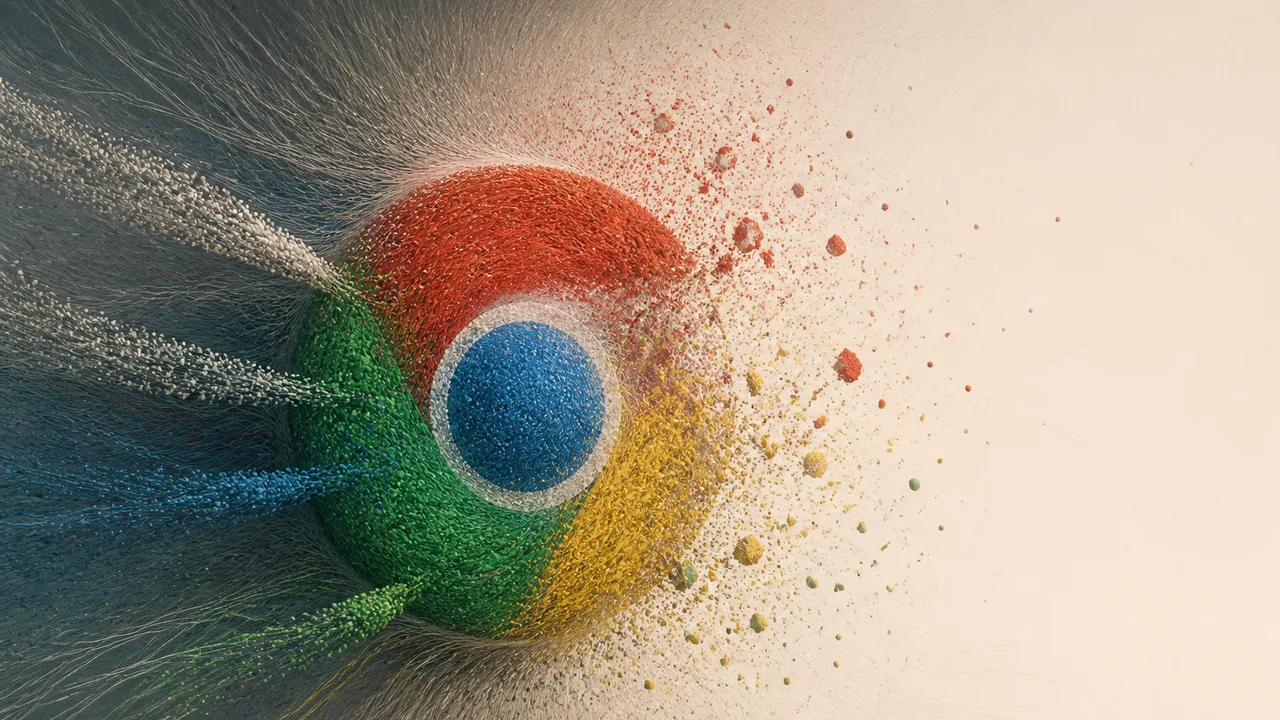
Think about the last time you, like, actually chose your browser. Not just clicked what was already there — actually went out of your way to download something, set it as default, made a deliberate decision. For most people reading this, the answer is probably: I didn't. Chrome was just... there. Pre-installed, pre-defaulted, pre-assumed. The neutral ground of the internet.
That assumption is now at the center of one of the biggest antitrust fights in tech history. And the question isn't just whether Google should give up Chrome — it's whether Chrome was ever actually neutral in the first place.
The filing that's pushing this forward
Nonprofit advocacy group Public Knowledge has filed an amicus brief with the D.C. Circuit Court of Appeals arguing that Google should be required to divest Chrome entirely, according to MediaPost. The filing also calls for prohibiting Google from paying Apple to make Google the default search engine on Safari — a financial arrangement that Wired reports delivers Apple billions of dollars each year. (JPMorgan, cited by Yahoo Finance, estimated Apple's exposure at around $12.5 billion annually if that deal collapses — which gives you a sense of the scale.)
Public Knowledge isn't alone here. The Department of Justice has been pushing the same remedies. As CBS News reported, the DOJ describes Chrome as "one of the largest entry points that exists for searches" — which is the crux of the whole argument. The browser isn't just a browser. It's infrastructure. It's how people start their sessions, how searches get routed, how defaults get baked in and then quietly forgotten.
PC Gamer put it plainly: the remedy being sought is to "require Google to divest Chrome—a critical distribution point—to shield against self-preferencing." And Android, for what it's worth, is also potentially on the table, though that's a more complicated discussion for another day.
Wait, didn't we do this with Microsoft?
Here's the part that kind of makes my brain do a double-take every time I sit down to think about it: Chrome killed Internet Explorer. Like, Chrome is the reason IE is dead. Chrome came in, was faster and better, and people switched — en masse, voluntarily — because it was the superior product. And now Chrome is the one being accused of exactly the kind of distribution-lock-in that Microsoft used to protect IE. The cycle is something.
The Microsoft parallel is the obvious one to reach for here, and it holds up. The DOJ sued Microsoft in the late 1990s over bundling Internet Explorer with Windows and effectively strangling Netscape. A judge initially ordered Microsoft to be broken up. That breakup order, as The New York Times reported, was overturned on appeal, and Microsoft ultimately settled via consent decree rather than structural breakup.
The reason that history matters isn't just precedent-as-legal-argument. It's the pattern it reveals: winning an antitrust case against a tech giant is hard. Getting a court to actually order structural remedies — a forced sale, a divestiture — is even harder. Courts tend to prefer behavioral remedies (rules about what you can and can't do) over structural ones (actually cutting the company apart). The DOJ and Public Knowledge are asking for the more aggressive option. That's a deliberate choice, and it reflects how exhausted regulators have apparently gotten with behavioral fixes that don't fix much.
What "self-preferencing" actually means in practice
The technical term is self-preferencing, but honestly the concept is pretty intuitive once you see it. When Chrome is the browser, Google gets to decide what's prominent in the address bar, how search suggestions populate, which engine handles ambiguous queries, how fast Google's own sites load relative to competitors. None of that requires a conspiracy memo. It's just... what happens when the same company controls the pipe and the destination.
The Apple deal is a version of the same thing, just with a different mechanism. Google pays Apple — $12.5 billion annually at risk, per JPMorgan's estimate via Yahoo Finance — to be the default search on Safari. So even when people aren't using Chrome, Google has paid for the default position. The reach of the distribution advantage extends beyond the browser Google actually owns.
That's what regulators mean when they describe Chrome as "one of the largest entry points that exists for searches." The browser market and the search market aren't really separate markets. They're the same market, vertically integrated.
The case against breaking it up
Not everyone thinks forcing a Chrome sale is the right call, and the skepticism isn't just coming from Google's lawyers. Open Web Advocacy, a group that's been pretty critical of browser monopoly dynamics in other contexts, notes that industry voices have cautioned against the DOJ's forced-sale plan — raising concerns about what happens to Chrome's development, security infrastructure, and the broader web standards work Google funds through its browser team.
This is genuinely not nothing. Chrome's Blink engine underpins a huge chunk of how the modern web works. The resources Google puts into browser security, web standards bodies, and developer tooling are real. A Chrome that gets sold to... who, exactly? Some private equity firm? A less-resourced tech company? — might not maintain that infrastructure at the same level. That's a legitimate public interest concern, separate from whatever Google's lawyers are arguing in court.
The counterargument is that Google's browser investment is also, entirely, in Google's interest — and that the existence of those investments doesn't automatically mean the current ownership structure is the only one that could produce them. But it's still an open question that doesn't have a clean answer.
What no one can really predict
Here's the honest state of play: even if courts ultimately side with the DOJ and Public Knowledge on the merits, the remedies phase is a separate, messy battle. History suggests that structural remedies in tech antitrust cases are more often threatened than executed. The Microsoft breakup never actually happened. The question of who would buy Chrome, at what price, under what conditions for maintaining the open web commitments Google has made — none of that is resolved.
And then there's the Android question hovering in the background. If Chrome is a "critical distribution point" for search, Android is an even bigger one. Wired reports that divestiture of Android has been raised as a possibility too. That's an exponentially more complex untangling.
What's new about this moment, though, is the convergence of pressure. It's not just the DOJ. It's advocacy groups filing amicus briefs, it's state attorneys general, it's a broader political climate where tech breakups have moved from fringe-left policy proposal to something that Republicans and Democrats can both get behind for entirely different reasons. The Overton window on this stuff has shifted.
For those of us who grew up with Chrome as just the way the internet works — who never thought twice about what was happening in the address bar, who have seventeen tabs open right now across three Google products — there's something disorienting about watching regulators treat that seamlessness as the crime rather than the feature. But that's kind of the point. The seamlessness is what makes it hard to see where the product ends and the lock-in begins.
Maybe that's the more interesting question than whether Chrome gets sold: what would it even feel like to use an internet where the browser and the search engine weren't quietly owned by the same company, optimizing for the same bottom line? Most of us have never experienced that. We just assumed that's what neutral looks like.
More Like This
This Creator Got Shadowbanned on YouTube in 25 Days—On Purpose
A vidIQ creator deliberately shadowbanned their channel with AI-generated content to expose how YouTube's algorithm actually works. The results are wild.
Master Remote Access with Comet Pro KVM
Explore the Comet Pro KVM for seamless remote PC access: Wi-Fi 6, out-of-band management, and Tailscale security.

China's AI Models Are Splitting Washington in Two
Kimi and China's open-source AI models aren't just challenging Silicon Valley—they're fracturing the Trump administration's AI strategy along a fault line that won't close easily.
Google's Chrome AI Update and the Zero-Click Future
Google's new Chrome AI mode lets users search across open tabs, screenshots, and PDFs at once. Here's what that means for websites and web traffic.
![Man in Laravel cap looking thoughtful beside phone displaying "Debounce for [301]" hashtag on pink background](https://static.buzzrag.com/articles/laravel-13-6-drops-debounceable-jobs-and-json-health-checks/thumb-5e646253.webp)
Laravel 13.6 Drops Debounceable Jobs and JSON Health Checks
Laravel 13.6 introduces debounceable jobs, JSON health check responses, and Cloudflare email support. Here's what developers need to know.

New Siri Indexes Your Private Data. Now What?
Apple rebuilt Siri's on-device index from scratch. It's genuinely better. It also reads your messages, mail, and photos. Here's what that actually means for you.

GNU Coreutils Now Run Natively on Windows
Microsoft has ported GNU Coreutils to Windows as native binaries. Here's what that means for devs switching between Linux and Windows daily.

iOS 27 Beta 1 Hands-On: Cool Features, No Siri
iOS 27 Beta 1 is here with Photos AI tools, Liquid Glass tweaks, and Wallet upgrades — but the new Siri everyone wants? Still on a waitlist.