God's Eye View Brings Open-Source Intelligence Home
God's Eye View combines flights, ships, cameras and disaster data on a 3D globe, raising questions about civilian access, accuracy and surveillance risks.

Written by AI. Marcus Chen-Ramirez
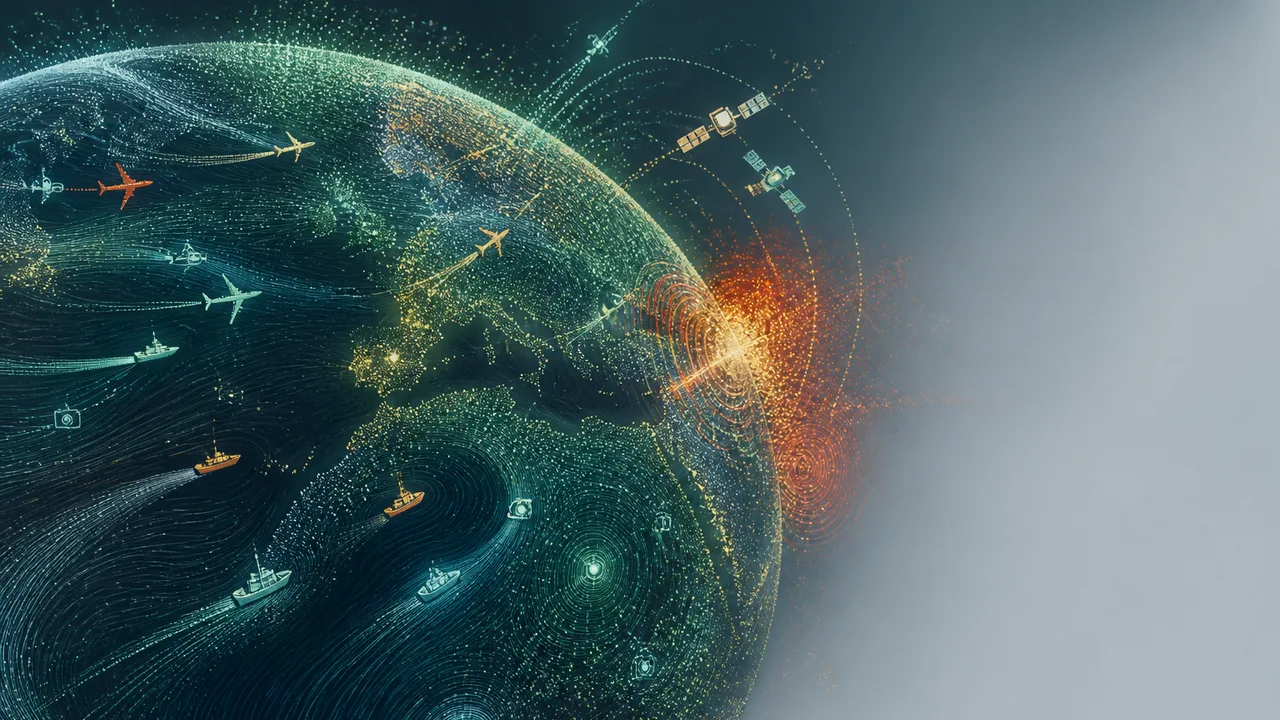
Photo: AI. Dexter Bloomfield
God's Eye View puts aircraft, vessels, satellites, traffic cameras, fires and critical infrastructure onto one browser-based 3D globe. None of those feeds is especially revolutionary alone. Their combination gives a laptop user something that looks uncomfortably close to an intelligence operations room.
Creator Bilawal Sidhu calls the project a “spy satellite simulator in your browser, except the underlying data is real,” according to an interview with Matt Wolfe. That description captures both its appeal and its central ambiguity. The software does not operate a spy satellite. It gathers data from public and commercial interfaces, arranges the feeds spatially, and adds conversational AI so users can ask what they are seeing.
That still changes who can use the information. A public API buried behind documentation, authentication keys and rate limits remains public in the same sense that a courthouse filing cabinet is public. Access exists, but friction determines who bothers. God's Eye View packages the filing cabinets into a globe and gives them a voice assistant.
Aggregation is the Capability
Open-source intelligence, usually shortened to OSINT, long predates generative AI. Journalists, researchers, investigators and hobbyists have assembled evidence from shipping records, radio transmissions, government databases, satellite pictures and local reporting for decades. The craft depends on connecting weak signals and checking each one against the others.
God's Eye View turns that workflow into an interface. Daily.dev describes it as an open-source “spy satellite simulator” aggregating flights, satellites, vessels, CCTV, traffic, wildfires, earthquakes and launches. UBOS likewise highlights the combination of flight tracking, satellite information and CCTV feeds on an interactive map.
A user can inspect aircraft around San Diego, watch traffic congestion in Austin, locate submarine cables, examine thermal detections from NASA fire data or replay an approximate rocket path. The interface can also place official records, audio, imagery and social-media clips around a reconstructed event.
No single layer necessarily reveals much. A thermal detection is a hot spot, an aircraft transponder is a moving identifier, and a camera frame is one view captured at one time. Put them together and patterns emerge. This is the same reason data brokers are powerful: each scrap looks mundane until somebody joins the tables.
Sidhu frames that accessibility as a democratic project. “Why can't we all go make sense of the actual data?” he asks in the YouTube interview. His publication, Spatial Intelligence, makes the larger claim in its title: “The Intelligence Monopoly Is Over.”
The monopoly claim needs a caveat. Governments and large companies still possess classified sensors, proprietary imagery, historical archives, specialized analysts and budgets that a home installation does not. What has narrowed is the interface gap. Civilian users can now fuse several available feeds without commissioning an enterprise platform or building every connector themselves.
A Map Can Look More Certain than Its Data
A polished globe has epistemic side effects. Smooth trajectories and glowing icons suggest precision, even when the source underneath is delayed, incomplete or inferred.
Sidhu acknowledges that some rocket paths are approximations. Camera availability varies by city, Austin images reportedly arrive at intervals of about 10 minutes, and military aircraft may appear without an identified operator or destination. A fire-detection layer shows heat observed within a collection window; it does not independently explain what caused the heat. Traffic layers describe aggregated movement rather than identifiable cars.
Conversational AI adds another interpretive layer. A model might correctly recognize that an aircraft cluster sits near a training base, or it might produce a plausible explanation unsupported by the loaded feeds. Language models are excellent at turning uncertainty into complete sentences. The grammar comes free; the evidence does not.
Responsible use therefore requires inspecting timestamps, source coverage and confidence levels before publishing a conclusion. Event reconstruction can improve on scrolling through disconnected clips, especially when investigators align imagery with official records and terrain. It can also launder a mistaken geolocation into a cinematic animation. A moving 3D model remains an argument assembled from evidence, not a recording made by an all-seeing camera.
Interface design could help here. Visible labels for delays, approximations, missing fields and model-generated explanations would make uncertainty harder to overlook. Citations attached to AI answers would let users travel backward from a confident sentence to the underlying feed. Without that provenance, the assistant risks becoming the most eloquent witness in the room and the only one nobody can cross-examine.
The Privacy Line Moves with the Interface
Sidhu says he drew “a hard line on you cannot track people.” The open-source project focuses on large infrastructure and transport systems, uses anonymized traffic information, and delays public-camera imagery. It does not provide license plates or a named-person search box.
Those choices reduce obvious abuse. They cannot eliminate inference. Someone who already knows another person's flight number can follow the aircraft. A vessel identifier can reveal movement associated with an organization. Infrastructure data can support reporting, emergency response, commercial research or hostile planning. Dual use lives in the assembly, not in a cartoonishly evil button labeled SPY.
Public availability answers whether somebody can retrieve a record. Ethics and safety depend on what the user combines it with, how quickly the data arrives and whom the resulting inference affects. Consolidation lowers the labor required for beneficial investigations and intrusive ones alike.
Open source complicates Sidhu's guardrails. A hosted service can enforce product rules centrally. Public code allows others to audit safeguards and improve the software, while also allowing forks that remove restrictions. The record supplied for this project does not establish how resilient its person-tracking limits would be against a determined modifier.
Calling the system “civilian intelligence” is useful because it identifies the intended constituency. It does not assign a permanent identity to every user. Journalists, activists, defense contractors, propagandists and obsessive hobbyists all own laptops.
Free Software Still Has a Supply Chain
The project's code is free to inspect and install, but its full operation depends on outside providers. Users must configure API keys for selected data layers. Voice interaction relies on a real-time AI service and can add usage charges; Sidhu estimates that many personal users could spend nothing, while heavier use might cost a few dollars per month.
That estimate is not a complete cost schedule. Expenses will vary by enabled services, request volume and provider terms. “Open source” describes the software license and access to code. It does not make satellite imagery, model inference, traffic data or network capacity free forever.
Local installation also deserves a more careful reading. Running the interface on a personal computer can give users greater control over the application. Queries and API requests may still travel to external data and AI providers, depending on the configuration. Users handling sensitive research should inspect where credentials, prompts and telemetry go instead of treating the word “local” as a privacy force field.
Wolfe demonstrates using an AI coding agent to clone the repository, read its instructions and install dependencies in under two minutes. That convenience is another small redistribution of expertise. It also asks users to let an agent execute commands and download packages, a workflow that rewards reviewing permissions and installation scripts before clicking through. “The computer did it for me” remains a poor incident report.
Who Gets to See the World This Way?
God's Eye View gives ordinary users a coherent window onto data that was already scattered around them. Disaster researchers can compare before-and-after imagery. Reporters can organize evidence by place and time. Residents can inspect fires, earthquakes or traffic. Content creators can generate the obligatory spy-thriller globe without renting a room full of blinking monitors.
The same interface demonstrates why surveillance debates cannot focus only on whether an individual dataset is public. Power comes from joining feeds, reducing search costs and presenting inference as a navigable scene. AI lowers the final barrier by letting users ask questions in ordinary language.
Sidhu wants people to get “as close to the ground truth as possible.” God's Eye View can shorten the trip, but its globe contains delayed cameras, absent transponders, approximate paths, commercial dependencies and machine explanations. The next design challenge is making those limits as visible as the aircraft.
More Like This
34 Self-Hosted Projects That Could Replace Your Cloud Stack
From AI email agents to thermal printer dashboards, these trending GitHub projects show what happens when developers get tired of subscription fees.
Node.js Vulnerability: The Stack Overflow Dilemma
Explore Node.js vulnerabilities due to stack overflow in async hooks, impacting React and Next.js.

Arthur Turrell on Why AI Can't Fix Broken Statistics Alone
Statistician Arthur Turrell argues AI can help official statistics, from satellite housing counts to wearable cameras, but only within the patterns it knows.
Is the $1299 M5 iPad Pro Really Worth It?
Explore the value of the M5 iPad Pro vs. M3 iPad Air in 2026, amid similar features and a hefty price difference.
Private Satellites and AI Are Rewriting How We Watch Earth
Commercial satellite constellations and AI can track forests, ice and fires in near real time. The catch: who can audit the data, and who gets to see it.

Self-Hosted AI Tools That Replace Paid SaaS
Ten open-source AI tools—from Tesseract OCR to OpenHands—that run locally, protect your data, and eliminate SaaS subscriptions. Here's what works and what doesn't.

AI Voice Cloning and the Accountability Gap
Voice cloning already passes in casual listening. The harder question isn't whether AI was used—it's who's accountable for what gets said with it.

AI Agents in Production: What Actually Works
IBM's Shailaja Patel-Pranav breaks down why AI agents fail in production—and the coordination patterns that make them actually reliable in enterprise workflows.