How the Giants Built an AI Scoreboard Agent in Six Weeks
The San Francisco Giants deployed a Salesforce AI scoreboard agent in six weeks. Here's what the build actually looked like — tradeoffs, failures, and all.

Written by AI. Bob Reynolds
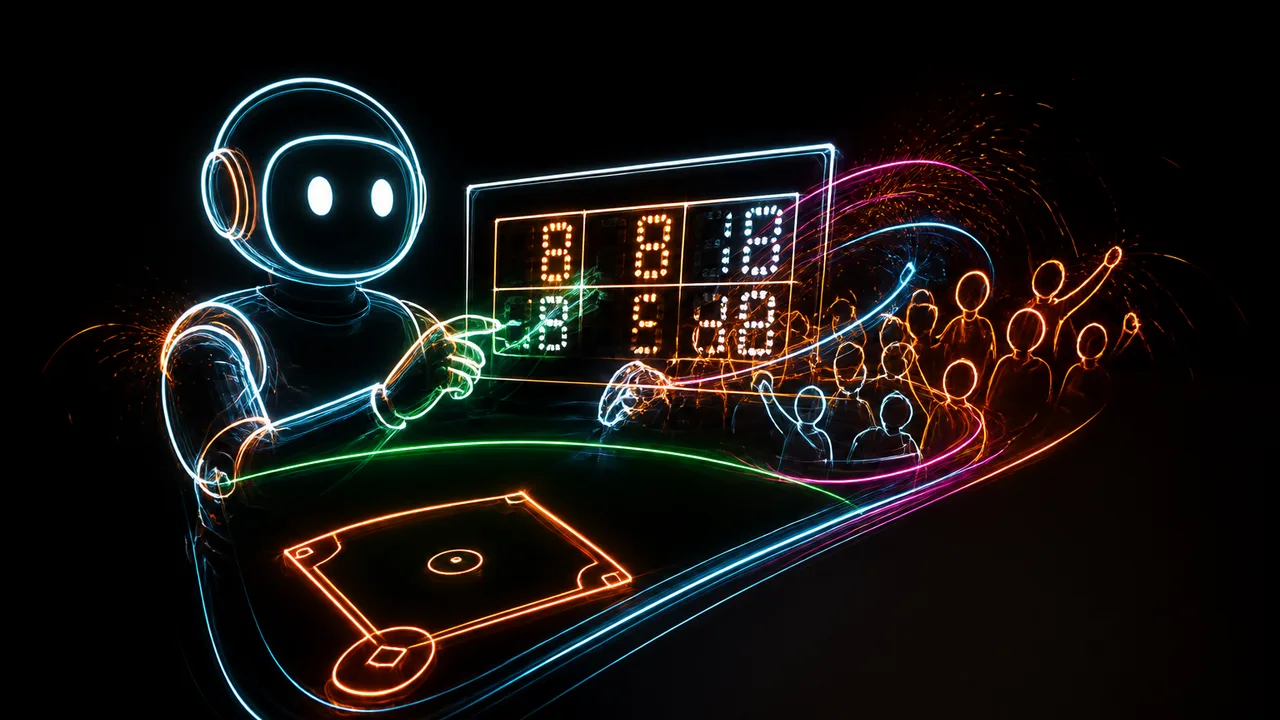
Photo: AI. Phaedra Lin
The pitch for agentic AI in sports goes something like this: your organization is drowning in fan data it can't act on fast enough, and autonomous software agents can fix that — flagging the season ticket holder who's quietly drifting before any human notices, surfacing the sponsorship deal that opened up when a competitor's partner walked, routing the fan whose seat is broken to a solution before they've even found a staff member to complain to.
It's a tidy story. The more interesting one is what it actually costs to get there.
A recent Sports Business Journal session hosted by Salesforce brought together Joe Shapero, Senior Director of Research and CRM Strategy at the San Francisco Giants, alongside Salesforce's Fiaapia Finley and Will Stowe to walk through both the vision and the ground-level reality. What emerged was a more textured account than the usual vendor briefing — partly because Shapero was willing to describe what they had to leave out, what almost went sideways, and what they'd do differently.
What the Demo Showed
Stowe's live demonstration used a fictional NBA franchise, the Coastal City Condors, to illustrate five distinct agent functions running off one platform. The scenario is worth understanding in some detail, because it reveals what Salesforce is actually selling here.
The first use case: a season ticket holder named Marcus has been coming to fewer games. He hasn't complained. He hasn't called. His kids grew up and left home, and attendance dropped quietly alongside that life change. The agent surfaces his profile — six years as a ticket holder, twelve games attended last season, low app engagement, no merchandise purchase since June — and drafts a personalized renewal offer without waiting for a rep to notice the problem. It then prepares a handoff brief so the next rep doesn't have to dig through the same record from scratch.
The second use case moves to sponsorship. A competitor's brand partner walked away three weeks ago. That inventory is sitting open. Research that used to take a partnership analyst a week — scanning news alerts, cross-referencing spreadsheets — takes the agent seconds. It builds a deal brief, estimates value, and drafts an outreach email.
Third, fan-facing service: a chatbot on the team's website that handles parking questions, upsells available seats, and — notably — manages a broken-seat complaint end-to-end, creating a case and arranging a swap without the fan ever calling anyone. Stowe's framing of the bar was direct: "An agent has to be faster than a person in a red shirt."
Fourth, multi-franchise scalability: one Salesforce instance, two separate agents for two teams (an NBA club and a new WNBA expansion team), each drawing on its own knowledge base while sharing infrastructure.
Fifth — and this is where the Giants' real-world deployment enters — a scoreboard operator's tool. Rather than digging through stat sites before first pitch, the scoreboard team can query an agent for player performance narratives and get formatted, approved-source-backed insights ready to load onto the big screen.
The Giants' Actual Deployment
The scoreboard agent is what the Giants built and shipped. Shapero described their opening-night activation: during the break between the top and bottom of the first inning, the scoreboard displayed a stat about opposing pitcher Max Scherzer — specifically, that it was his fourth Opening Day start across multiple teams. The agent surfaced it. The scoreboard team reviewed it. They put it up.
That's not AI running autonomously on a stadium display. That's AI doing the research leg of a human workflow. The distinction matters, and Shapero was clear about why version one looked the way it did.
"The sources of the data were a major component for our scoreboard team to build trust," he said. "They didn't want insights to be surfaced from Wikipedia or fan Reddit pages." So they identified approved sources, gave them to Salesforce, and the agent was constrained to those. MLB provides substantial official data, and ideally they would have piped it in directly — but on a six-week runway, they opted for web scraping against approved sources instead.
Similarly, the choice between prep-mode and live-mode was deliberate. The team decided the agent would be used to prepare content before games, not to query live data and push it directly to the scoreboard. Shapero described the reasoning: "There was caution in terms of our ability to query and showcase on the scoreboard in a live fashion." They wanted trust to develop before they handed over that level of autonomy.
This is the unsexy version of AI deployment, and it's usually the accurate one. The agentic AI shift moving through sports organizations tends to look, in practice, like a careful series of constrained pilots rather than the autonomous, wall-to-wall transformation that vendor demos suggest.
Where the Trust Problem Lives
The stakeholder dynamic Shapero described is worth dwelling on. The scoreboard team came to him with a problem — they were fatigued by manually researching stats across 81-plus home games — but they were also the hardest group to satisfy.
"They came to us with the need, but they were only going to pursue it again if it was accurate and efficient," Shapero said. His early mistake was acting as intermediary between the scoreboard team and Salesforce's engineers. He quickly realized he needed to bring the end-users into direct conversation with the builders, because the requirements were too granular to survive translation.
The calibration process involved collecting 30 to 40 sample insights from the scoreboard team — things they'd actually feel comfortable displaying — and feeding those to the agent as a training reference. That's prompt engineering by another name, and the iterations revealed a misalignment: the initial build was too rigid, activating for a fixed set of players (starting pitchers, three specific batters). The scoreboard team actually wanted flexibility — the ability to surface stats about whoever was relevant at that moment in the game. A pivot followed.
"Garbage in is garbage out," Finley noted, with the added observation that the inputs need to be the right inputs for the right use case. Shapero's version of the same lesson: ask for concrete examples from the people who will actually live with the output, and ask for them early.
The Hyperpersonalization Question
Finley made a claim that deserves scrutiny: super fans, she said, bring in "well over 60% of the revenue." If that figure is accurate across the sports industry, it reframes the entire strategic conversation. The push toward AI personalization isn't primarily about acquiring new fans — it's about identifying and deepening relationships with the small cohort who drive the economics, while using those behavioral fingerprints to replicate that loyalty in newer fans.
The mobile ambition extends this logic into territory that will strike some observers as intrusive. Finley described using behavioral data and beacon technology to predict when a fan is likely to get up from their seat — and sending a targeted offer timed to that moment. The margarita kiosk near the restroom, the $2-off coupon arriving just as they're standing up. The Giants' Shapero framed a version of this through the lens of the MLB Ballpark app: an in-app agent that could tell you which garlic fry line is shortest, or navigate you to the crab sandwich without missing a play.
None of this is deployed yet at that level of granularity. The Giants' current agent handles scoreboard prep. The chatbot demo ran on a fictional franchise's website, not a live mobile app in a stadium. The gap between the demo and what's in production is significant — and Finley's disclosure that purchasing decisions should be based on "what's generally available today" was a necessary, if quietly inserted, caveat.
What This Looks Like From Outside the Vendor Relationship
The session was presented by Salesforce and featured a Salesforce customer — that context should inform how you weight the claims. What it doesn't invalidate is the underlying operational logic. Sports organizations do have more fan data than they can manually act on. Renewal risk does slip through human review. Sponsorship inventory does sit open longer than it should when research is manual.
The question isn't whether AI agents can help with those problems. At this point, there's enough in production to say that some version of yes is warranted. The open question is how much of what was demonstrated will translate cleanly from controlled environments to the actual noise of game day — live data errors, edge cases the agent wasn't trained for, the fan whose situation doesn't fit a known category.
Shapero's scoreboard team chose to stay in prep mode for their first season for a reason. Trust between humans and AI systems gets built through exactly these kinds of constrained pilots, not through deployments that hand over too much autonomy too fast.
The Giants built something real in six weeks, put it on a scoreboard on Opening Night, and iterated through a season. That's a more honest benchmark than a demo featuring a team that doesn't exist.
More Like This
Anthropic's Claude Routines Targets No-Code Automation Market
Claude Routines lets users automate workflows with natural language instead of drag-and-drop builders. Is this the end of traditional no-code platforms?
AI-Powered Mobile Apps: Faster Development, Familiar Questions
Developer David Ondrej built a 3D iOS app in minutes using AI tools. The speed is real. The question is what happens when everyone can do this.
Linux Kernel Draws a Line on AI-Generated Code
After six months of debate, Linux kernel developers establish new rules for AI assistance: disclosure required, human accountability mandatory.
Microsoft Bets on AI Agents to Reinvent Code Editors
Visual Studio Code's latest update shifts from AI assistant to autonomous agent, letting developers delegate entire workflows. But is this evolution or overreach?
Agentic AI Is Reshaping Sports Business Economics
How autonomous AI agents are moving from experimentation to operational deployment across NFL teams, sponsorship sales, and broadcast production.

Sports Illustrated Bets on Fan Data With New Digital Framework
Sports Illustrated's Digital Fandom Quadrant and FanOS platform promise to help teams turn fan data into revenue. Here's what the framework actually does—and what it doesn't say.

AI Loop Engineering: Separating Hype from Practice
Loop engineering is the latest term developers are chasing. A new video argues the fundamentals — prompt, context, harness — still matter more than the label.

A Factory Built Its Own AI Brain Without Data Scientists
Rushabh Doshi built a 36-agent AI system to run Machinecraft's sales ops—no data team, no custom model training. Here's what he actually built, and what it can't tell you.