France's Fridge Attacks Expose a Cold-Chain Weak Point
France blames an Iranian unit for fridge attacks that spoiled food. A separate blood-storage incident shows how alarms and staff intervention can limit losses.

Written by AI. Bob Reynolds
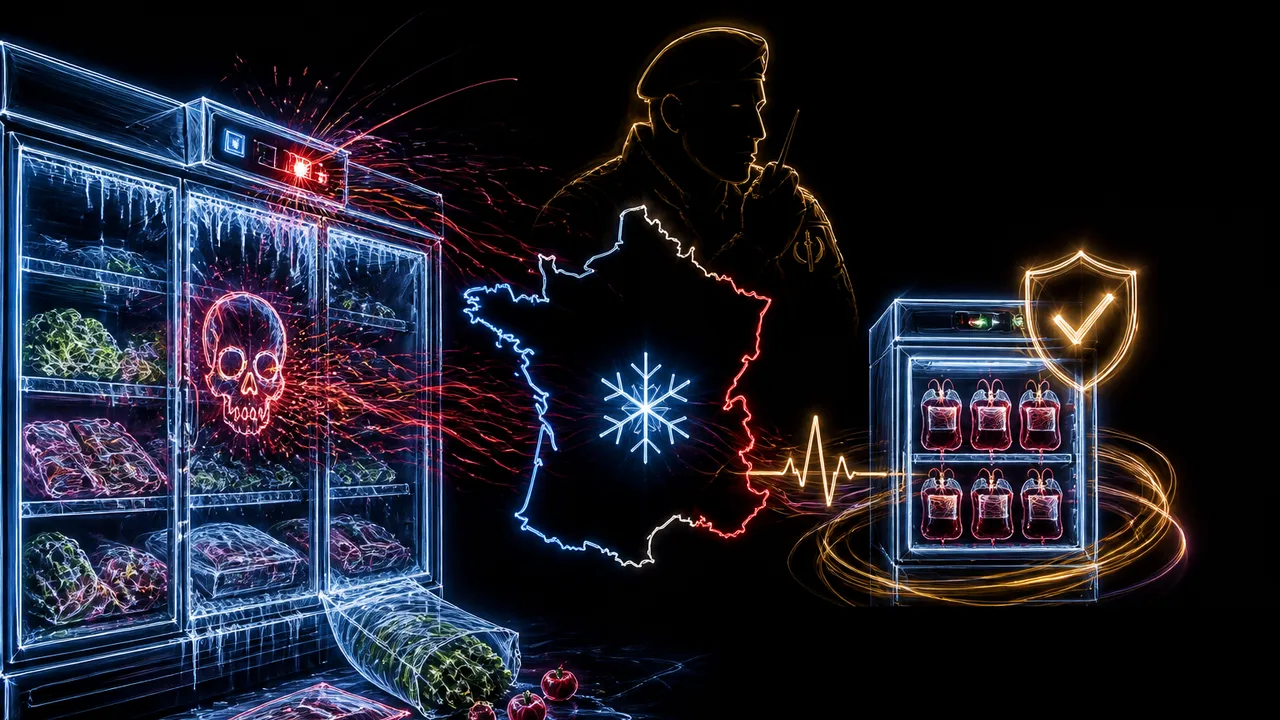
France says hackers changed refrigeration settings at roughly 700 food distribution and retail sites during attacks that began on October 11. Food spoiled, and French authorities say the attacks caused at least 15 fires. On November 9, the government blamed Shahid Kaveh, a cyber unit it links to Iran’s Islamic Revolutionary Guard Corps. The Paris prosecutor’s office opened a criminal investigation and sought international arrest warrants for the unit’s leadership.
The name of the alleged attacker will shape France’s diplomatic response. For a shop handling perishable food, the immediate problem was plainer: a controller that should have kept goods cold was taking altered instructions. An intrusion into a setting became a problem with stock, equipment and, in some locations, fire. That is the route from a computer compromise to a physical loss.
When a Setting Becomes a Loss
The attacks overnight on October 11 and 12 changed defrost settings on industrial refrigeration controllers. A defrost setting governs part of how refrigeration equipment operates. Raising it can interfere with the conditions needed to preserve food. French authorities estimate food losses in the tens of millions of euros and report damage to equipment as well as the fires. They have not publicly specified how each fire started, so the reported fire count should not be read as an explanation of the electrical or mechanical failure at every site.
The affected businesses extended beyond supermarkets. France’s cybersecurity agency, CERT-FR, identified major grocery chains alongside butcher shops, a slaughterhouse and food-processing facilities. That breadth helps explain why a change to one class of equipment could reach beyond a single retailer’s shelves. The controls serve businesses at several points in the movement and storage of food. An attacker who can alter them need not interrupt a payment system or shut down a warehouse network to force a business to discard products.
A changed controller setting is an instruction to equipment; the losses depend on what the equipment does, how long conditions remain unsafe and whether people can intervene. The French account identifies spoilage and fires as outcomes of the October attacks, but it does not supply a site-by-site account from which to judge whether each location had the same opportunity to respond. A headline number of roughly 700 targeted locations describes reach. It cannot, by itself, describe the damage at any one of them.
Why France Named Shahid Kaveh
The attribution has a history. CERT-FR says Shahid Kaveh claimed a sabotage campaign against Israeli and US interests in March and April 2026 that included Israeli refrigeration equipment and other industrial-control systems. It also says the unit conducted large-scale reconnaissance of Schneider Electric industrial systems in April, including systems in France. Searching for equipment that can be reached over a network is a plausible precursor to attacking it; a prior claim of responsibility, however, remains a claim by the group.
For the October attacks, French investigators cited infrastructure also used to examine Schneider Electric systems, use of an internet-connected-device search platform they associate with Shahid Kaveh, publicity from an outlet they link to the unit, and traces of Farsi on attacker infrastructure. These are the indicators France has described. The government has not publicly laid out its full attribution case. The strongest fair reading is that France has made a formal accusation and identified reasons for it, while the public cannot assess all the steps behind its conclusion.
That history gives the accusation more context than a language trace or an online boast alone would provide. It also explains why French investigators looked at industrial systems beyond refrigerators: they linked attacks on equipment at small hydroelectric installations during the same period to the October campaign. Those incidents reportedly had limited or moderate effects. The connection France draws concerns activity and investigative indicators, rather than a claim that every affected machine suffered the same damage.
A Nearby Case with a Different Outcome
On November 2, temperature and defrost settings were altered at three facilities operated by the French Blood Establishment, or EFS. The service said the intrusion came through an outside refrigeration supplier and that it was not directly targeted. The affected rooms held frozen plasma and biobank samples. Monitoring systems raised alarms; employees regained control of some equipment, took other units out of service and moved contents to other storage. EFS reported no loss of blood products or samples.
The mechanism resembles the supermarket disruption: someone changed settings on equipment whose job was to keep valuable contents cold. The response provides a contrast. At EFS, an alarm led to human intervention and, where needed, a move to refrigeration without a network connection. In the October food attacks, French authorities reported extensive spoilage. An alarm was useful at EFS because staff could act on it before the stored products were lost.
The comparison has firm limits. Authorities have not linked the blood-storage incident to the Iranian operation. The facilities stored different products, and the accounts do not give comparable figures for how long temperatures were affected or how much stock each site held. EFS’s outcome therefore cannot prove that its monitoring was better than a supermarket’s, or that installing an alarm would have prevented the October losses. It does show the operational sequence a defender needs: notice an unsafe change, regain control or isolate the equipment, and have somewhere suitable to move what must stay cold.
The EFS incident also puts an outside supplier in the picture. EFS says the attack reached its sites through that supplier; the route into the October supermarket controllers has not been set out in equivalent detail here. For an operator, that makes a practical question more precise than a general warning about connected devices: who can change a temperature setting, and what can staff do if the setting changes without their consent? The French food losses and the EFS response illustrate different answers at the point where a compromised control meets a product with a deadline.
France has attributed the October supermarket attacks to Shahid Kaveh. The cases still illuminate the same exposed task. Refrigeration controls keep perishable goods usable only while their instructions and the response to faults hold up. In October, altered instructions were followed by discarded food and fires. At EFS, an alarm gave staff time to move what the equipment was supposed to protect.
More Like This

F-35 Parts in Hong Kong Put Supply Chains on Alert
Reports of F-35 parts diverted to Hong Kong sparked a Pentagon inquiry and questions about sensitivity, controls and proof across supply chains today.
Why Onions Make You Cry: The Physics We Missed
Cornell researchers built an onion guillotine to solve the physics of why cutting onions makes you cry—and debunked a few popular kitchen hacks along the way.
French Supermarket Fridge Hack Exposes a Maintenance Gap
A cyberattack warmed fridges in hundreds of French stores. The disruption shows why remote refrigeration needs secure access and a plan for aging controllers.
PHP Security Fix Follows Millions of Attack Attempts
PHP shipped fixes amid millions of attack attempts. Governments reported no confirmed break-ins, but operators still need to check their versions and patch promptly.

AI Second Brain for Engineering Managers, Explained
Marlon Vidal built an AI-powered knowledge system for engineering managers. Here is what it actually does, what it costs you, and who can realistically use it.

GLM-5.3 Flash: A Cheap Chinese AI Beats Pricier Rivals
Z.ai's GLM-5.3 Flash launched anonymously as "Ox Alpha," undercut American AI rivals by up to 90%, and ran on non-Nvidia chips. Here's what that actually means.