FCC Kills TV Ownership Cap in Win for Big Broadcasters
The FCC's vote to repeal the 39% TV ownership cap replaces a hard limit with "case-by-case review." We've seen this movie before — in radio.

Written by AI. Mike Sullivan
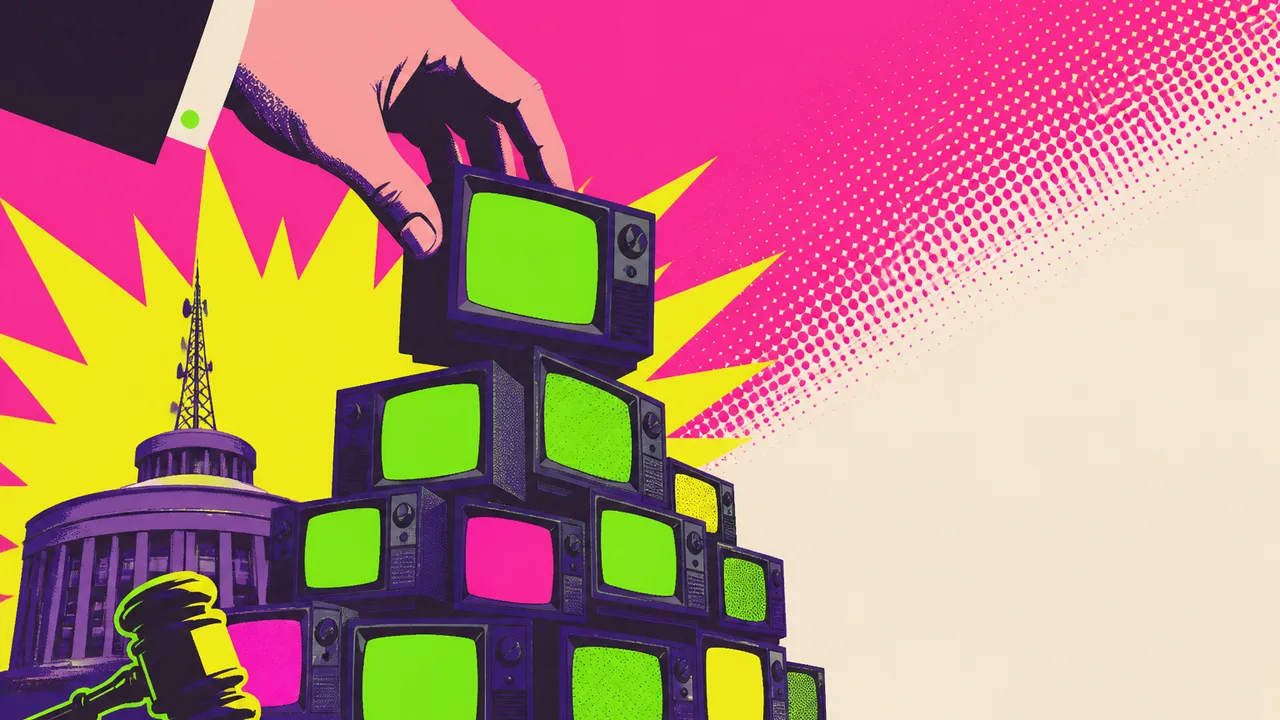
The op-ed announcing the end of a decades-old media ownership rule ran on Breitbart. That's not an incidental detail. That's the whole story in miniature.
FCC Chairman Brendan Carr announced Wednesday that the Commission will vote on August 6 to repeal the 39% national television ownership cap — the rule that currently prevents any single company from owning broadcast stations that collectively reach more than 39% of U.S. TV households. According to Ars Technica, Carr plans to replace the hard numerical limit with a "case-by-case review" of each proposed merger. Variety reports the vote is scheduled for August 6. CNN notes the decision delivers a "long-sought win" for Trump-aligned broadcasters including Sinclair and Nexstar.
So: a regulatory decision that will determine who controls what Americans watch on local news was announced on a website with a known political orientation, and it primarily benefits broadcasters with a known political alignment. Carr can argue the policy is sound on the merits — and there is a legitimate version of that argument — but the optics are doing a lot of work here. Or rather, the optics are doing exactly the work they were designed to do.
A Number With a History
The 39% figure has always had the feeling of a number negotiated rather than discovered. According to legal scholar Daniel Suhr writing for Law & Liberty, it was the product of a congressional compromise after the FCC attempted to raise the cap from 35% and Congress pushed back — a political settlement dressed up as regulatory precision. You don't arrive at 39% through engineering. You arrive at it through horse-trading.
The cap has been contested practically since it existed, with broadcast groups arguing it's an anachronism in a media landscape now dominated by streaming, social platforms, and algorithmic recommendation engines. That argument isn't wrong. The question isn't whether the 39% figure was sacred — it wasn't — but what happens when you remove it and hand the replacement authority to the agency doing the removing.
That replacement is "case-by-case review." Three words that sound reasonable until you spend thirty seconds thinking about what they actually mean. They mean: no rule. They mean: come ask us nicely and we'll see how we feel. They mean the FCC is trading a transparent constraint for discretionary gatekeeping, which is a great deal for whoever controls the FCC and a much less great deal for everyone who doesn't. Trust us, the regulator is saying. And if your instinct is to ask what the track record on that particular promise looks like — well, that's the correct instinct.
The Radio Movie, Already in Progress
We have seen this film. In 1996, the Telecommunications Act largely lifted caps on radio station ownership. What followed was a consolidation wave that, according to the Texas State Historical Association's account of Clear Channel's rise, turned Clear Channel into a media giant reaching an audience that dwarfed anything previously possible under the old rules.
If you listened to radio in the late 1990s and early 2000s, you remember what came after. Not as an abstraction. You remember that your city's rock station started to sound like your cousin's city's rock station, because they were effectively the same station running the same playlist from the same corporate programming desk. Howard Stern's show sounded identical in every market it ran — same bits, same guests, same commercial breaks — because that was the point. Local was expensive. Syndication was profitable. The things that made your city's radio feel like your city's radio — the weird morning guy who knew the local sports history, the music director who'd actually go see bands at local venues — those things got optimized away. "Diversity of voices" is how policy papers describe it. What actually disappeared was texture. The specific, un-scalable stuff that can't be strip-mined for margin.
Local broadcast television still carries more of that texture than radio did, which is partly why this moment matters more than it might seem. Gallup research on Americans' news consumption has found that television remains Americans' primary news source — particularly for older and rural viewers who aren't fully plugged into the streaming and social media ecosystem that coastal media observers tend to treat as universal. When we talk about who controls local TV news, we're talking about who controls the information diet of a substantial chunk of the electorate that is underserved by most digital alternatives. That's not a small thing to hand over to a "case-by-case review."
What Isn't Being Said
Two things are simultaneously true, and neither camp in this debate wants to acknowledge both.
First: the current cap is genuinely arbitrary. A rule set at 39% through political compromise doesn't automatically reflect some optimal level of media pluralism. The broadcast industry has been disrupted beyond recognition since the cap's origins, and the argument that legacy ownership rules map cleanly onto the modern attention economy has real problems. The proponents of repeal aren't making up the modernization argument — there's something to it.
Second: "case-by-case review" replacing a numerical cap is not a modernization. It's a transfer. The constraint moves from a rule everyone can read to a discretionary judgment that depends entirely on who's in the chair at the FCC and what relationships they're managing. Fans of deregulation generally dislike regulatory discretion — it creates uncertainty, invites capture, rewards the politically connected. A clean rule, even an imperfect one, at least applies to everyone equally. Case-by-case review applies to everyone differently, which is a feature if you're well-connected and a bug if you're not.
The fact that the chairman of the FCC announced this on Breitbart suggests the administration is not particularly worried about the appearance of whose interests "differently" currently favors.
What nobody in this debate is fully engaging with: the internet did not actually solve local news. Streaming did not save the Dayton city council beat. The argument that broadcast consolidation doesn't matter because audiences can get their news elsewhere was tested for two decades, and local news coverage cratered during that period — not because of broadcast consolidation specifically, but because the economics of local journalism collapsed in ways that no one has yet figured out how to fix. If broadcast television becomes another vehicle for national homogenization under a different brand of corporate centralization, the thing that fills the gap isn't going to be some scrappy local digital startup. It's going to be nothing, or something that looks a lot like nothing.
The August 6 vote, per TV News Check, will set the framework. Briefs.co notes that broadcasters could pursue substantially larger mergers once the cap falls. The question of whether the FCC's case-by-case reviews will constrain those mergers in practice is a question worth asking early, because the radio story suggests you don't get a good answer until after it's too late to act on it.
The rule is going. The reviews will begin. And the companies that will benefit most announced their win on the website where the announcement was published.
More Like This
Do You Really Need an $80 HDMI Cable? Maybe Not
Tech reviewer Adam tests a premium HDMI 2.1 cable. We examine what you're actually paying for and whether most users need it.
When Agents Generate Their Own UI: The Three Flavors Explained
CopilotKit's Tyler Slaton maps the spectrum of generative UI—from pixel-perfect control to agents writing raw HTML. Each approach makes different tradeoffs.
Can Unreal Engine 5 Run on a $500 MacBook? Sort Of.
Testing Unreal Engine 5.7 on the MacBook Neo reveals what happens when professional software meets budget hardware—and why friction matters.
Ted Turner, PWHL Detroit, and a Turbulent Sports Media Day
Ted Turner's death, PWHL's Detroit expansion, FanDuel's CEO ouster, and ESPN's NFL rights silence made May 7 a defining day in sports business.
AV2 vs H.266: The Codec War With Real Energy Stakes
AV2 and H.266 promise 30% bandwidth gains — but the patent war behind them shapes who pays, in money and in watts.
Google's Chrome AI Update and the Zero-Click Future
Google's new Chrome AI mode lets users search across open tabs, screenshots, and PDFs at once. Here's what that means for websites and web traffic.

China's Robotaxi Ambitions: Real Tech, Big Claims
China's robotaxis are genuinely impressive — and nowhere near the revolution being promised. A skeptic's look at what's real and what's familiar noise.

Microsoft Is Betting on DNA for Data Storage
Microsoft Research is developing synthetic DNA as a long-term data storage medium. Here's what the science actually says, and what remains unresolved.